Manufacturing Custom Parts for the Automotive Industry: Processes, Materials, and Standards
By Adil, Managing Director at AMN Engineering · · 8 min read
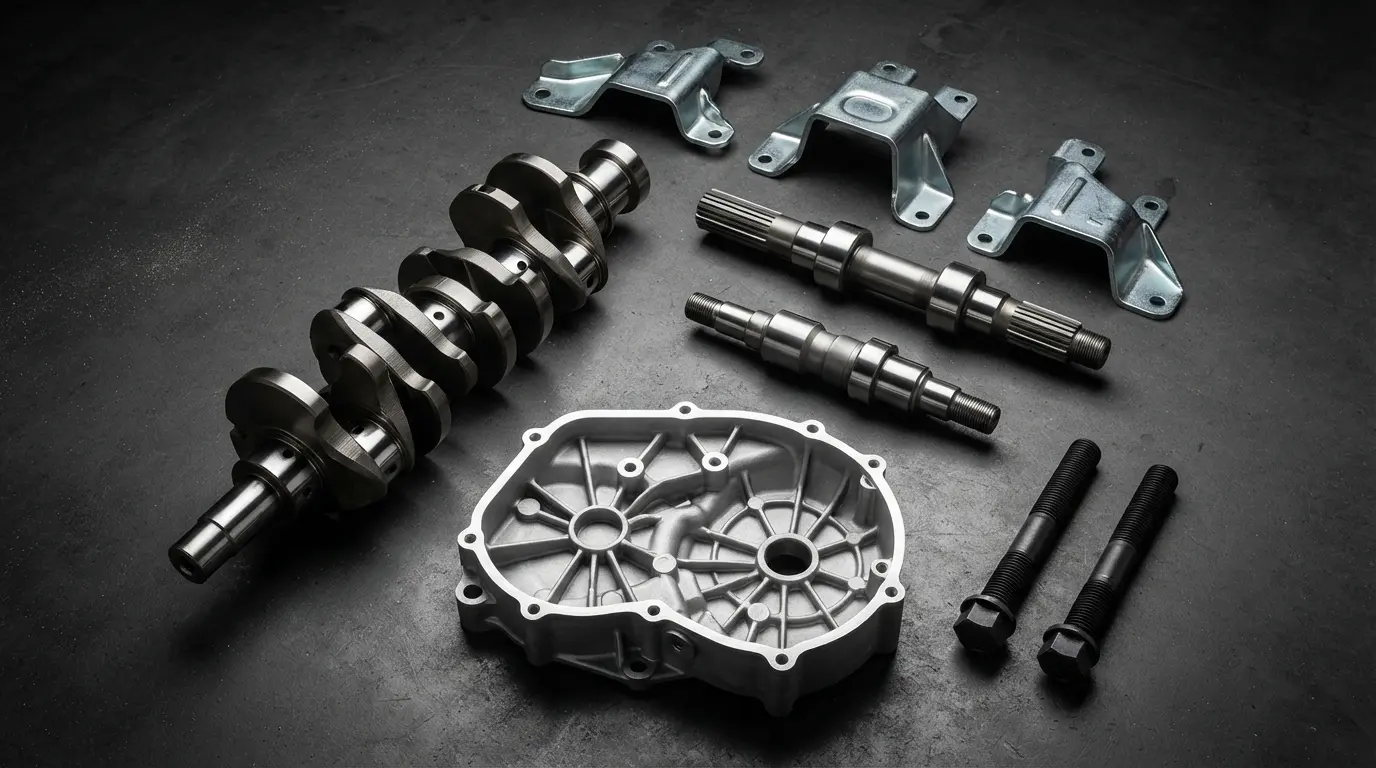
Automotive manufacturing is one of the most demanding sectors in contract manufacturing. Parts must meet tight tolerances, withstand millions of fatigue cycles, pass rigorous quality standards, and cost as little as possible per unit. Getting any of these wrong means rejected batches, line stoppages, and costly recalls.
This guide covers the processes, materials, and quality standards involved in manufacturing custom automotive components. We produce automotive parts at AMN Engineering including shafts, bushings, brackets, stamped components, and forged elements for clients in the automotive supply chain.
Why Automotive Manufacturing Is Different
Automotive parts face unique requirements that general engineering parts do not:
Fatigue resistance. Engine components, suspension parts, and drivetrain elements experience millions of stress cycles over a vehicle's lifetime. Materials and processes must be selected for fatigue performance, not just static strength.
Tight tolerances at high volume. Automotive tolerances are typically plus or minus 0.02 to 0.05mm on critical features, and these must be held consistently across thousands of identical parts.
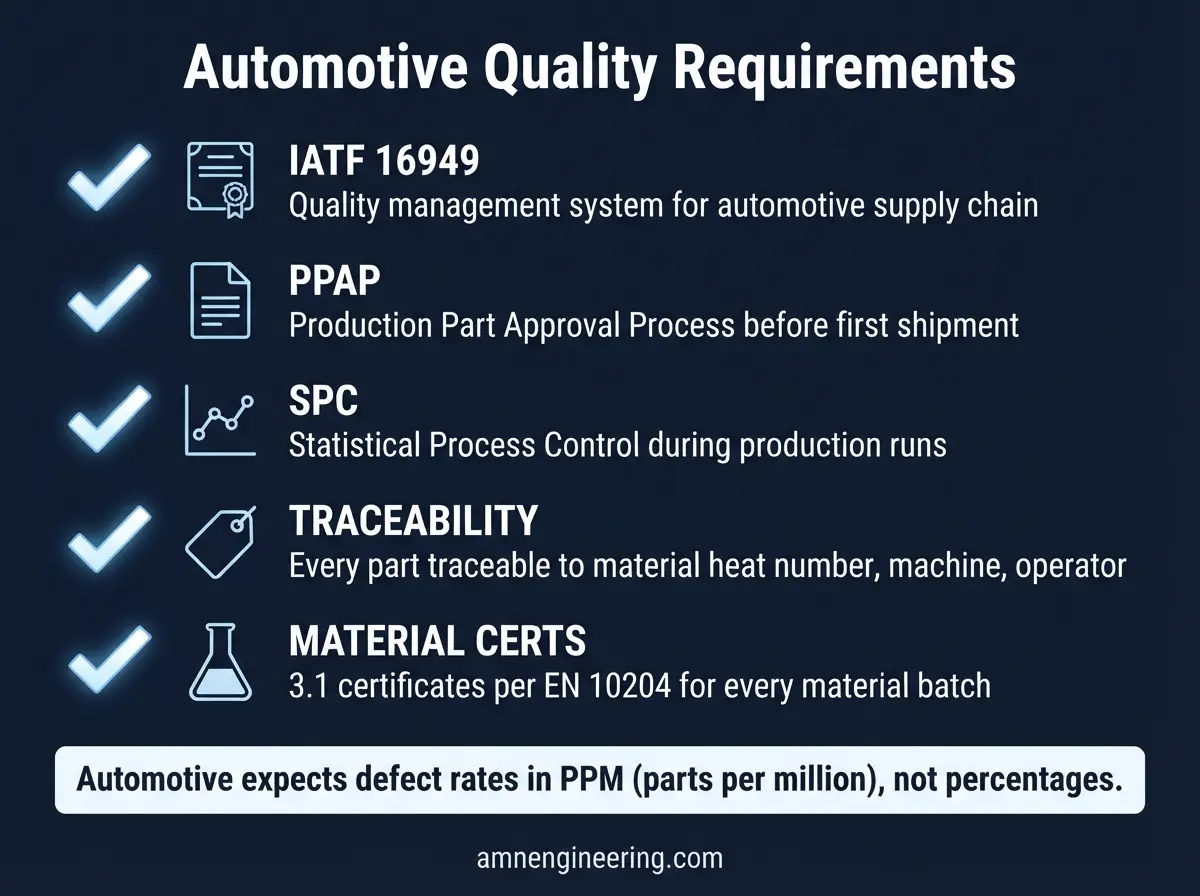
Traceability. Every part must be traceable to its raw material batch, manufacturing date, machine, and operator. This is not optional. It is a requirement of automotive quality standards.
Zero defect culture. Automotive OEMs and Tier 1 suppliers expect defect rates in parts per million (PPM), not parts per hundred. Quality systems must be designed to catch defects before they leave the factory.
Common Automotive Parts and Their Processes
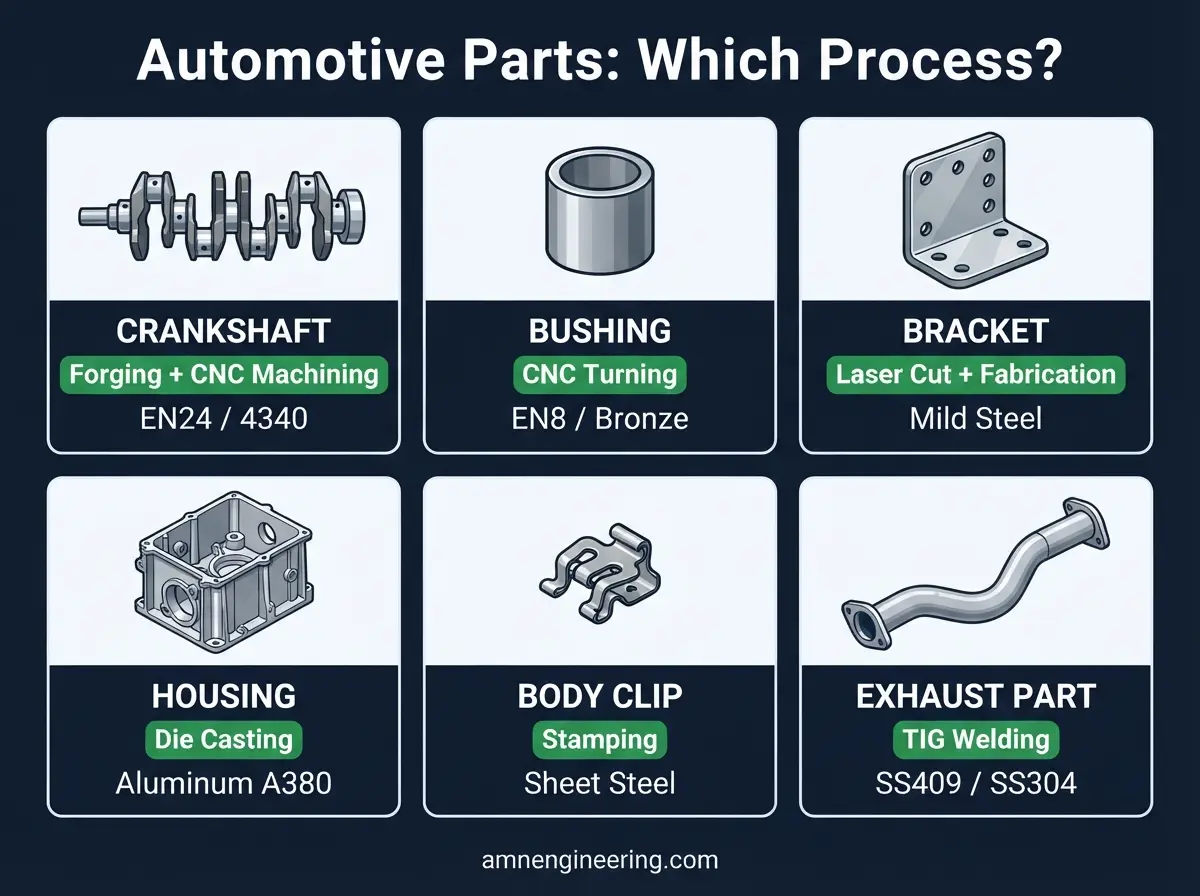
| Part Type | Typical Process | Material | Critical Requirements |
|---|---|---|---|
| Crankshafts | Forging + CNC machining | EN24, 4340 | Grain flow, fatigue strength |
| Connecting rods | Forging + machining | EN24, 4340 | Weight balance, fatigue |
| Shafts and axles | CNC turning + grinding | EN8, EN24 | Surface finish, bearing fits |
| Bushings and sleeves | CNC turning | EN8, bronze, SS304 | Bore tolerance, concentricity |
| Brackets and mounts | Laser cutting + fabrication | Mild steel, EN8 | Hole positions, flatness |
| Body brackets | Stamping | Sheet steel | Dimensional consistency |
| Housings and covers | Die casting | Aluminum | Wall thickness, porosity free |
| Exhaust components | Fabrication + welding | SS304, SS409 | Corrosion, heat resistance |
| Gear blanks | Forging + CNC machining | EN24, EN36 | Hardness, tooth profile |
| Wheel studs and bolts | Forging + threading | Grade 10.9 steel | Tensile strength, thread quality |
Materials Used in Automotive Manufacturing
Carbon and Alloy Steels
- EN8: Shafts, pins, bushings, general components
- EN24: High stress shafts, connecting rods, gears
- EN36: Carburizing grade for gears and bearings
- Grade 8.8/10.9/12.9 bolts: High strength fasteners
Stainless Steels
- SS304: Exhaust trim, decorative parts
- SS409/SS430: Exhaust system components (ferritic grades for heat resistance)
Aluminum Alloys
- Al 6061 T6: Structural brackets, housings
- Al A380: Die casting alloy for covers, housings, brackets
Cast Iron
- Gray iron (GG25/FC250): Brake drums, cylinder heads, engine blocks (sand casting)
- Ductile iron (GGG40): Suspension components, steering knuckles
Quality Standards
IATF 16949
The primary quality management standard for the automotive supply chain. It builds on ISO 9001 and adds automotive specific requirements: advanced product quality planning (APQP), production part approval process (PPAP), failure mode and effects analysis (FMEA), and measurement system analysis (MSA).
PPAP (Production Part Approval Process)
Before a new part enters production, the supplier must submit a PPAP package that includes: dimensional results, material certifications, process flow diagrams, control plans, and initial sample parts. This proves the manufacturing process is capable of consistently producing parts that meet specification.
Material Certifications
All materials must have traceable material test certificates (3.1 per EN 10204). Each part must be traceable to its material heat number.
Manufacturing Processes for Automotive
Forging
Used for any component that experiences high cyclic stress: crankshafts, connecting rods, steering knuckles, axle shafts. Forging creates aligned grain flow that dramatically improves fatigue life. Read more: Forging vs Casting vs Machining.
CNC Machining
Used for precision features: bearing seats, seal surfaces, thread cutting, bolt hole patterns. Most automotive parts require CNC machining after forging, casting, or stamping to achieve final tolerances. Read more: CNC Turning vs Milling.
Stamping
Used for high volume sheet metal parts: body brackets, clips, washers, electrical contacts, structural reinforcements. Progressive die stamping produces hundreds of parts per hour. Read more: Stamping vs Laser Cutting.
Die Casting
Used for aluminum housings, covers, and brackets where complex shapes are needed at high volume. Read more: Die Casting vs Sand Casting.
Heat Treatment
Hardening, tempering, carburizing, and nitriding processes are used to achieve the required hardness, wear resistance, and strength for gears, shafts, and bearings.
How to Work with a Contract Manufacturer for Automotive Parts
Start with a Trial Batch
Even with automotive parts, start with a trial order of 50 to 100 pieces. Verify dimensions, material, surface finish, and documentation before committing to production volumes. Read more: Prototype to Production.
Provide Complete Documentation
Automotive RFQs should include: 3D CAD model (STEP), 2D drawing with GD&T, material specification, heat treatment requirements, surface finish, coating, testing requirements, and annual volume estimate. Read more: 5 Things in Your RFQ.
Require Full Traceability
Every part must be traceable to: raw material heat number, manufacturing date, machine, operator, and inspection results. This is not optional in automotive. Ensure your manufacturer's systems support this level of traceability.
Frequently Asked Questions
IATF 16949 is the primary quality standard for the automotive supply chain. It covers quality planning, process control, traceability, and continuous improvement beyond ISO 9001 requirements.
Forging followed by CNC machining for shafts that experience cyclic stress. CNC turning from billet for lower stress applications or small quantities.
Yes. Pakistani contract manufacturers produce automotive components including shafts, bushings, brackets, stampings, and forged parts. The key is verifying that the manufacturer has the equipment, quality systems, and traceability capability required for automotive work.
EN8 and EN24 for shafts and structural parts. Aluminum alloys for die cast housings. Sheet steel for stamped brackets. Stainless steel for exhaust components.