5 Things to Include in Your RFQ to Get the Most Accurate Manufacturing Quote
By Adil, Managing Director at AMN Engineering · · 10 min read
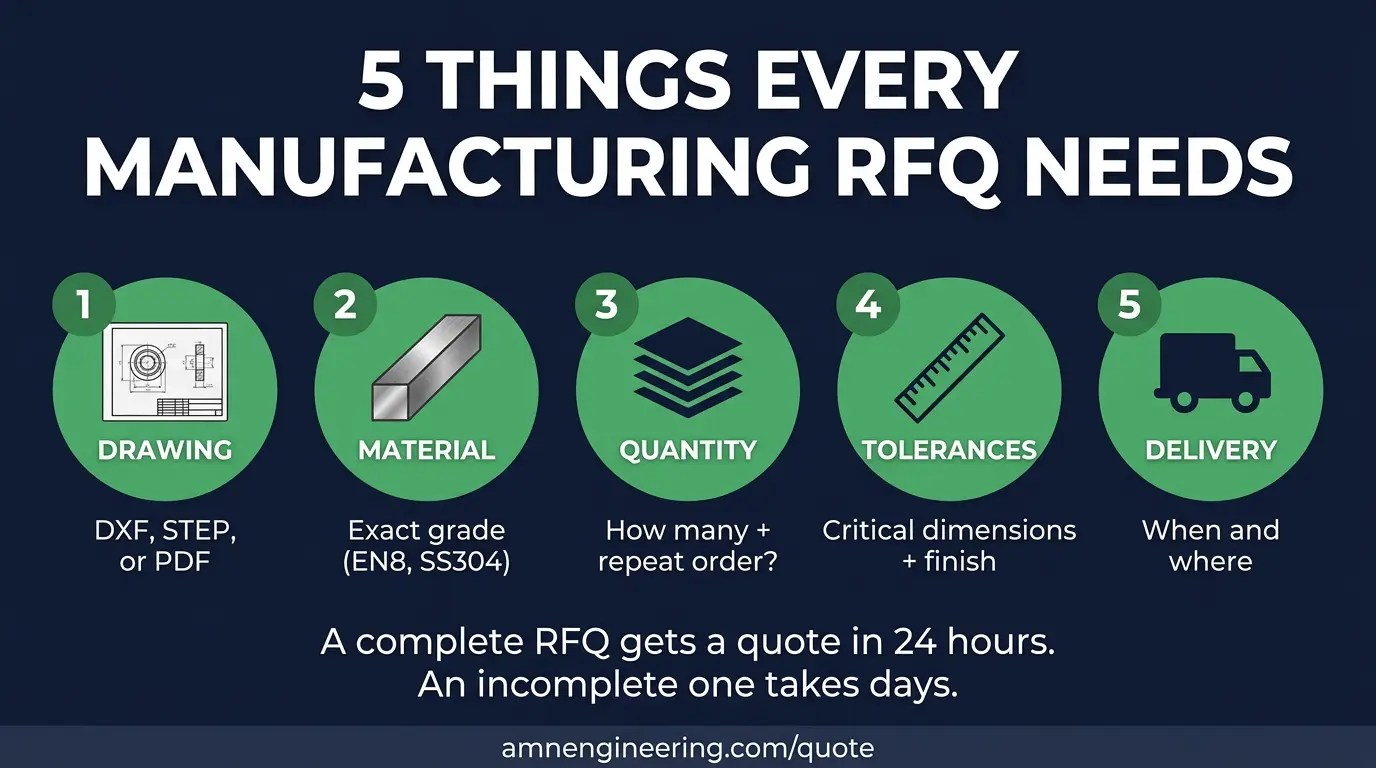
Every week we receive RFQs from procurement managers worldwide. Some are excellent, we can quote in 2 hours. Others missing critical info, 2 days going back and forth. The difference is how well the RFQ is written. This guide covers five things every manufacturing RFQ should include to get the most accurate quote from your CNC machining, laser cutting, metal fabrication, and forging suppliers.
Why Your RFQ Matters
A vague RFQ gets a vague quote. A detailed RFQ gets a precise quote. It is that simple.
When a manufacturer receives an incomplete RFQ, two things happen:
- The manufacturer guesses. Missing details get filled in with assumptions. Those assumptions lead to inaccurate pricing, sometimes too high (you overpay), sometimes too low (problems during production).
- The manufacturer asks questions. Every back and forth email adds 1 to 2 days to the quoting process. A complete RFQ avoids this entirely.
A complete RFQ also helps you compare suppliers fairly. When every manufacturer is quoting the same clearly defined scope, you can compare apples to apples instead of guessing why one quote is 40 percent higher than another.
Thing 1: A Proper Drawing
The drawing is the single most important element of any RFQ. Without a clear drawing, everything else is guesswork.
What to Send
- Best: 3D CAD file (STEP, IGES) plus a 2D dimensioned PDF
- Good: 2D DXF file (especially for laser cutting)
- Acceptable: Hand sketch with all dimensions clearly marked
- Not acceptable: Verbal description, blurry photo
What to Include on the Drawing
- All critical dimensions with tolerances
- Material specification
- Surface finish requirements
- Thread specifications
- Coating requirements (for example galvanizing)
- Special notes or instructions
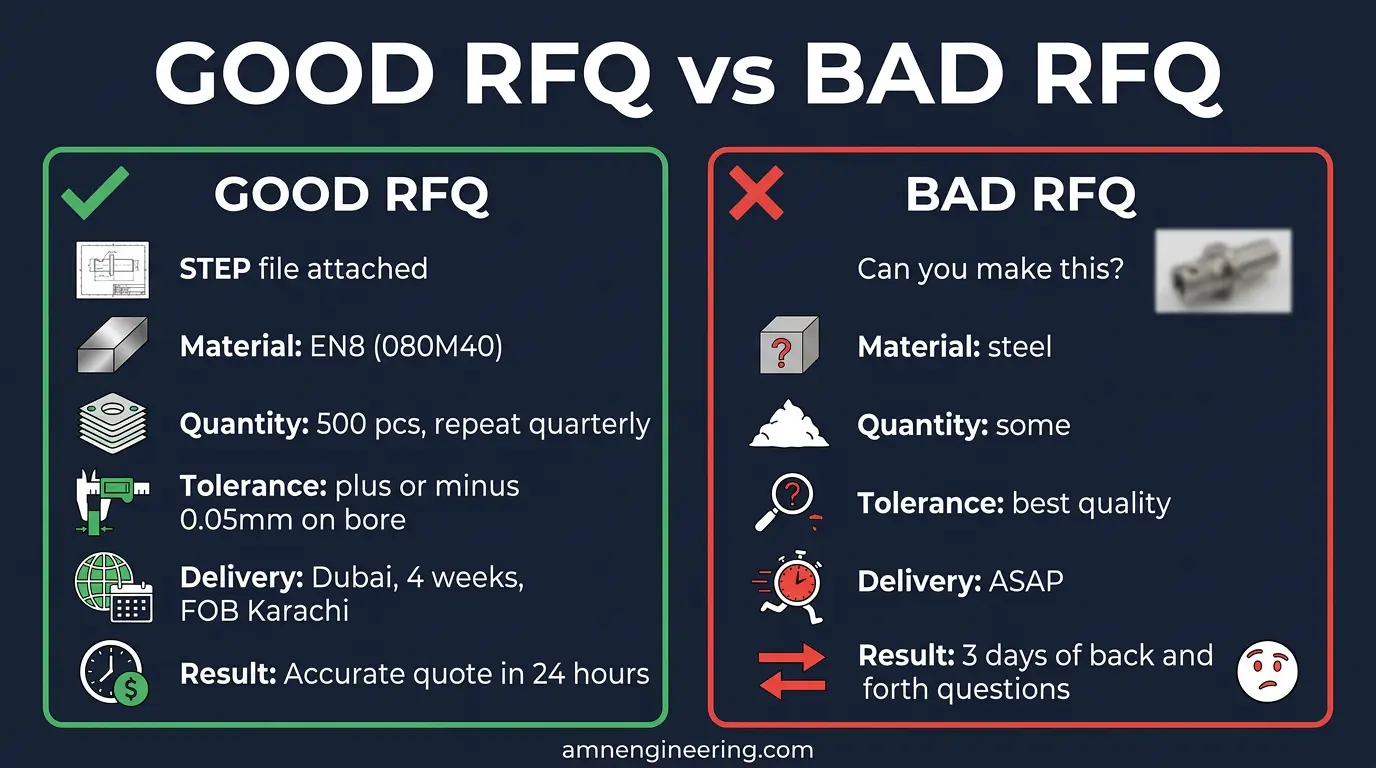
Thing 2: Material Specification
"Steel" is not a material specification. There are hundreds of steel grades, each with different properties and prices.
Be specific. State the exact grade:
- EN8, EN24, SS304 (see our EN8 vs EN24 vs SS304 comparison)
- Aluminum 6061
- Stainless 304 or 316
If you are not sure which material to specify, tell the manufacturer what the part does and what environment it operates in. For example: "This shaft drives a pump in a water treatment plant. It needs corrosion resistance." A good manufacturer will recommend the right material based on the application.
Thing 3: Quantity and Order Pattern
Quantity dramatically affects pricing. A single prototype costs very differently from a production run of 5,000 pieces. Include these details:
- Immediate quantity: How many do you need now? 1, 50, 500, 5,000?
- Expected annual volume: Is this a repeat order? For example, 200 pieces every quarter.
- Prototype vs production: These require different quoting approaches. Prototypes have higher per piece cost but lower total commitment. Production runs benefit from setup amortization and bulk material pricing.
Thing 4: Tolerances and Finish Requirements
Specify tolerances for critical dimensions. If you do not specify, the manufacturer will use defaults:
- Default machining tolerance: plus or minus 0.1mm
- Default fabrication tolerance: plus or minus 0.5mm
Tighter tolerances cost more. Only specify tight tolerances where they are functionally needed. A bearing seat needs plus or minus 0.02mm. A non critical shoulder does not.
Surface Finish
Specify Ra value if you have a requirement. Otherwise, standard machined finish is assumed. Common specifications:
- Ra 3.2: Standard machined finish
- Ra 1.6: Fine machined finish
- Ra 0.8: Precision finish (higher cost)
Coating and Treatment
If the part requires post processing, include it in your RFQ:
- Galvanizing
- Powder coating (specify color if needed)
- Electroplating (zinc, nickel, chrome)
- Heat treatment (hardening, tempering, case hardening)
Thing 5: Delivery Timeline and Location
When Do You Need It?
State a required date or lead time. "As soon as possible" is not helpful. "Needed by March 15" or "within 4 weeks" is clear and allows the manufacturer to plan accordingly.
Where Does It Ship?
Delivery location affects the quote. Shipping from Pakistan to Dubai takes 5 to 7 days. Shipping to the USA takes 20 to 25 days. The freight cost and transit time vary significantly by destination. See our Pakistan vs China vs India comparison for more on logistics.
Include your delivery address or at minimum your city and country.
Shipping Terms
Specify your preferred shipping terms:
- FOB: Free on Board (you arrange shipping from the port)
- CIF: Cost, Insurance, and Freight (manufacturer delivers to your port)
- DDP: Delivered Duty Paid (manufacturer delivers to your door, all inclusive)
Bonus: What NOT to Do in an RFQ
After years of receiving RFQs, here are the most common mistakes we see:
Do not send a blurry photo. A photo of a part taken from across the room tells us almost nothing. If you must photograph an existing part, take clear close up photos from multiple angles with a ruler for scale.
Do not specify "best quality" without defining it. "Best quality" means different things to different people. Specify the actual tolerance, surface finish, and testing requirements you need.
Do not ask 10 suppliers and negotiate only on price. Pick 2 to 3 capable manufacturers and build relationships. A manufacturer who knows your business will catch design issues, suggest cost saving alternatives, and prioritize your orders.
Do not forget to mention the application. Telling the manufacturer what the part does helps catch potential problems. "This is a food contact surface" immediately tells us we need food grade stainless and a specific surface finish. Without that context, we might quote the wrong material.
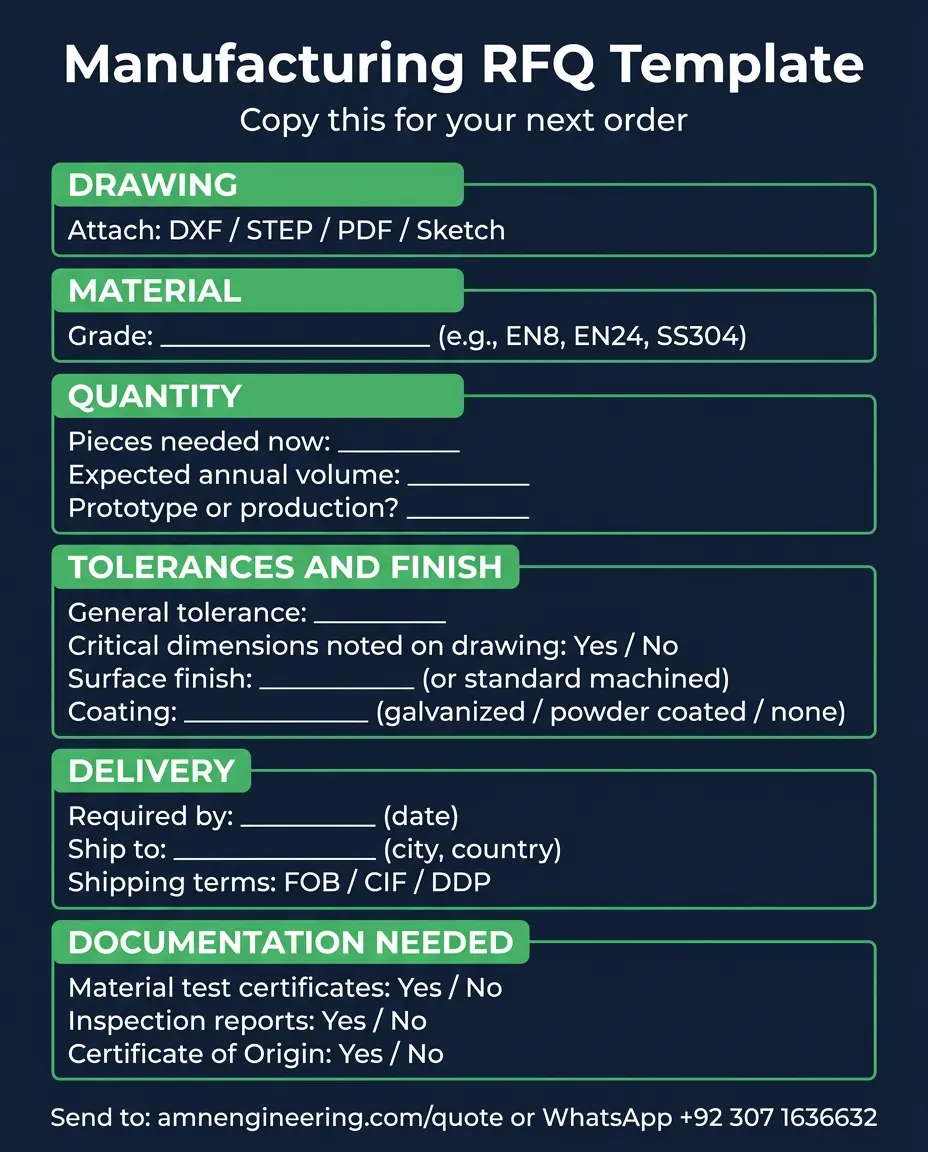
RFQ Template You Can Copy
Use this template to structure your next RFQ. Fill in the items that apply to your part:
- Drawing attached (DXF / STEP / PDF)
- Material (exact grade, for example EN8, SS304, Aluminum 6061)
- Quantity (immediate quantity + expected annual volume)
- Tolerances (general tolerance + critical tolerances marked on drawing)
- Surface finish (Ra value or standard machined)
- Coating or treatment (galvanizing, powder coating, heat treatment, etc.)
- Delivery (required date + delivery location)
- Shipping terms (FOB, CIF, or DDP)
- Documentation needed (material test certificates, dimensional reports, certificate of origin)
- Any other notes (application details, packaging requirements, etc.)
Frequently Asked Questions
Five essential things: a detailed drawing (DXF, STEP, or dimensioned PDF), material specification (exact grade), quantity and order pattern, tolerance and finish requirements, and delivery timeline with location. The more complete your RFQ, the faster and more accurate the quote.
Yes, for simple parts. A dimensioned sketch with material and quantity is enough for an initial quote. For complex parts or tight tolerances, a proper CAD file (STEP or DXF) gives a much more accurate quote.
For laser cutting: DXF. For CNC machined parts: STEP or IGES plus a dimensioned PDF. A PDF drawing is always useful as a reference regardless of what other files you send.
A complete RFQ should receive a quote within 24 to 48 hours from a responsive manufacturer. Incomplete RFQs take longer because the manufacturer needs to ask clarifying questions first.
Optional. A target price can help manufacturers suggest cost saving alternatives. But it may also anchor the quote. If you are comparing multiple suppliers, it is often better to let each one quote independently.