Sourcing Manufactured Parts from Pakistan vs. China vs. India: A Buyer's Comparison
By Adil, Managing Director at AMN Engineering · · 12 min read

Manufacturing in Pakistan vs. China vs. India: which country should you source your custom parts from? If you're a procurement manager or engineer comparing suppliers across Asia, this guide breaks down the real differences in cost, quality, lead times, MOQs, and logistics based on 25+ years of competing against Chinese and Indian suppliers.
China dominates the manufacturing conversation. India is the rising alternative. But Pakistan, with lower labor costs, no minimum order requirements, and 5 to 7 day shipping to the GCC, is the option most buyers overlook. That's a mistake, and the numbers below explain why.
This is not a neutral comparison. We are a Pakistani manufacturer, and we believe Pakistan offers the best value for custom-machined and fabricated parts in small-to-medium volumes. But we've kept the data honest so you can decide for yourself.
China is the established high-volume option but no longer the cheapest, India is a competitive middle ground with inconsistent quality, and Pakistan offers the lowest cost with no minimum order for small-to-medium custom parts. For Western and GCC buyers weighing all three, Pakistan wins on total landed cost, flexibility, and fast GCC shipping, while China still leads only at very high volumes.
AMN Engineering is a Lahore, Pakistan based contract manufacturer serving buyers in the US, UK, Gulf, and worldwide.
Pakistan vs. China vs. India at a Glance
Before diving into details, here's the full comparison across every factor that matters to buyers:
| Factor | Pakistan | China | India |
|---|---|---|---|
| Labor Cost | Lowest of the three | Rising rapidly since 2018 | Moderate, varies by region |
| Raw Material Cost | Competitive (local steel mills) | Lowest (massive supply chain) | Moderate |
| CNC Machining Cost | 30–50% lower than China | Baseline | 10–25% lower than China |
| Minimum Order Quantity | No minimum (even 1 piece) | Often 500–1,000+ pieces | 100–500 pieces typical |
| Lead Time | 2–4 weeks typical | 2–6 weeks (+ shipping) | 3–6 weeks |
| Quality Systems | Growing, ISO-certified shops available | Mature, well-documented | Varies widely by supplier |
| Communication | English-fluent, WhatsApp, same culture as GCC | Language barriers common | English-fluent |
| Shipping to GCC | 5–7 days by sea | 15–25 days by sea | 7–12 days by sea |
| Shipping to Europe | 14–18 days by sea | 20–30 days by sea | 15–22 days by sea |
| Will They Copy My Parts? | Very low risk (contract mfg model) | Higher risk (well-documented) | Moderate risk |
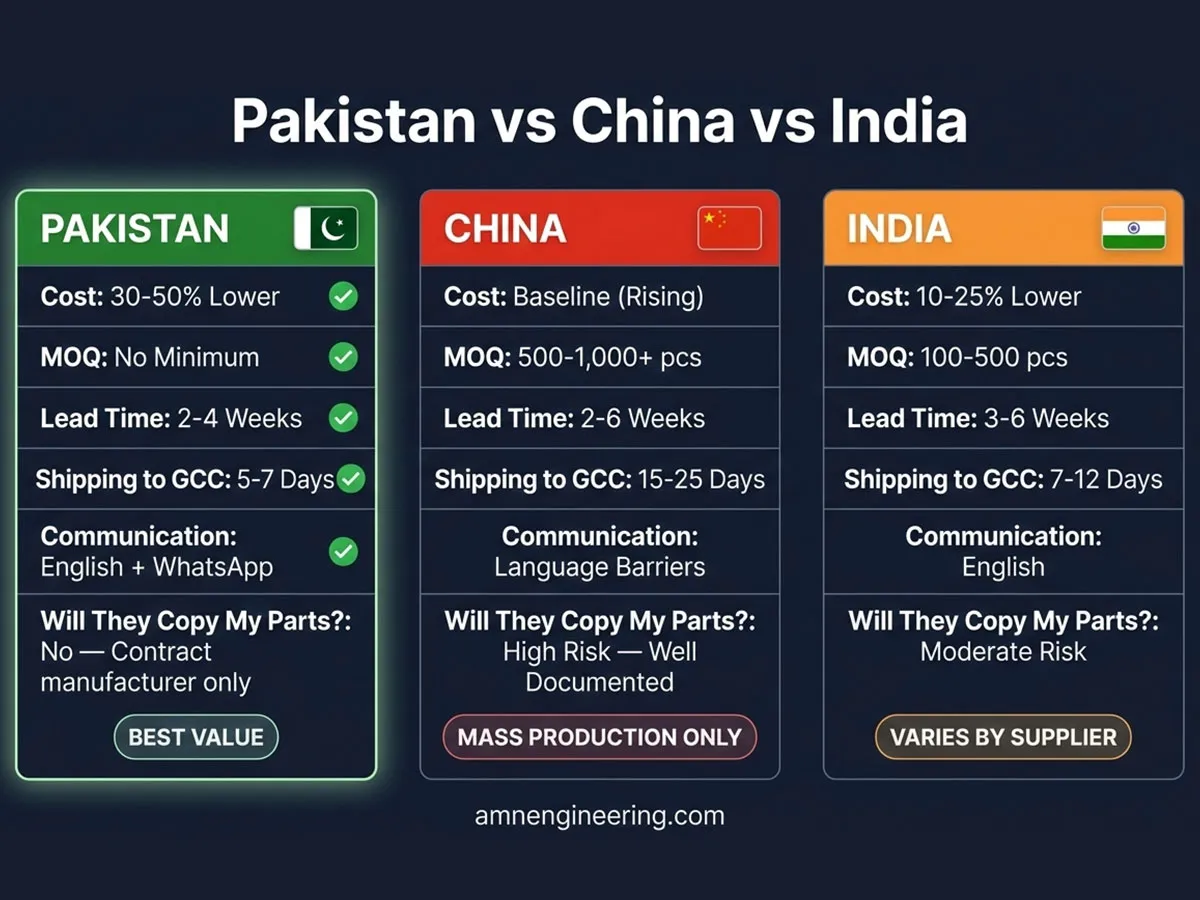
Cost: Why Pakistan Is 30–50% Cheaper
Manufacturing cost is the first thing every buyer compares. Here's how the three countries stack up for a typical order: 500 precision shafts in EN8 steel, 200mm length, ±0.05mm tolerance:
China: No Longer the Cheapest Option
The days of ultra-cheap Chinese manufacturing are over. Labor costs in manufacturing hubs like Shenzhen and Dongguan have risen steadily over the past decade. According to the International Labour Organization, Chinese manufacturing wages have increased by over 100% since 2010. Add ocean freight, customs duties, and 15–25 day shipping times, and the total landed cost is often higher than buyers expect.
India: Competitive but Inconsistent
Indian manufacturers offer pricing typically 10 to 25% lower than Chinese equivalents. However, costs vary dramatically between regions. A shop in Pune quotes differently than one in Ludhiana. Quality inconsistency adds hidden costs through rework and rejection. Multiple supplier audits may be needed before finding a reliable partner.
Pakistan: The Best Value for Custom Parts
This is where the math changes. Pakistani manufacturers typically quote 30–50% lower than Chinese suppliers for equivalent work. The reasons are structural, not temporary:
- Labor costs are among the lowest in Asia
- Raw materials are sourced from local steel mills (Amreli Steels, International Steels Limited)
- Overhead costs (rent, utilities, administration) are significantly lower than China or India
- No trading company markup because you deal directly with the factory
The Hidden Cost Most Buyers Miss
When you calculate total landed cost (unit price + shipping + customs duty + lead time cost + quality rejection rate), Pakistan typically comes out 25 to 40% cheaper than China for batches under 5,000 pieces. For GCC buyers, the shipping cost advantage adds another layer: Karachi to Dubai is 5 to 7 days by sea compared to 15 to 25 days from Shanghai.
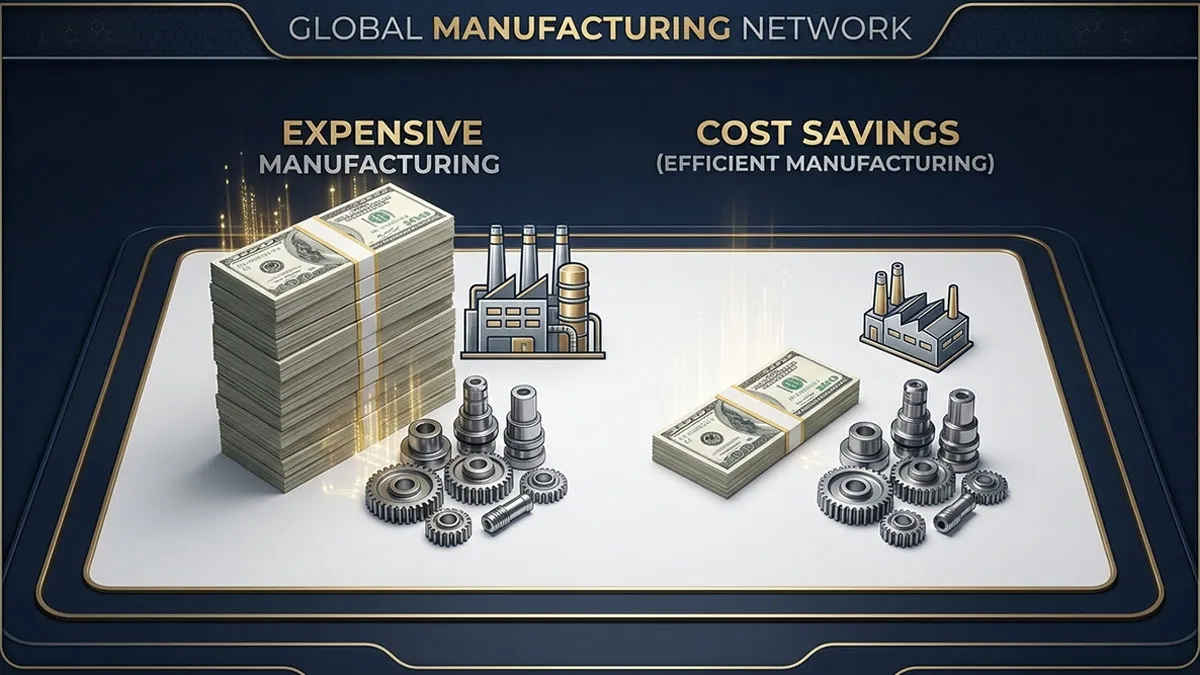
Quality: Can Pakistani Manufacturers Meet International Standards?
Let's be honest: when buyers hear "manufacturing in Pakistan," quality is their first concern. That skepticism is understandable, but it's increasingly outdated.
What's True
Pakistan's manufacturing sector doesn't have the same depth of quality infrastructure as China's. You won't find the same density of ISO 9001 and IATF 16949 certified facilities. The country doesn't yet have the same scale of precision manufacturing.
What's Also True
Top-tier Pakistani manufacturers operate at quality levels that match or exceed mid-range Chinese or Indian suppliers. Export-oriented Pakistani factories survive on quality because there is no domestic market large enough to absorb substandard work. Companies that have invested in CNC machines, coordinate measuring machines (CMMs), and trained engineers produce parts that meet international standards because they have to.
How to Verify Quality Before Placing a Large Order
There are practical steps any buyer can take to validate a Pakistani supplier's quality before committing:
- Request material test certificates (MTCs) with every order. Reputable suppliers include these as standard
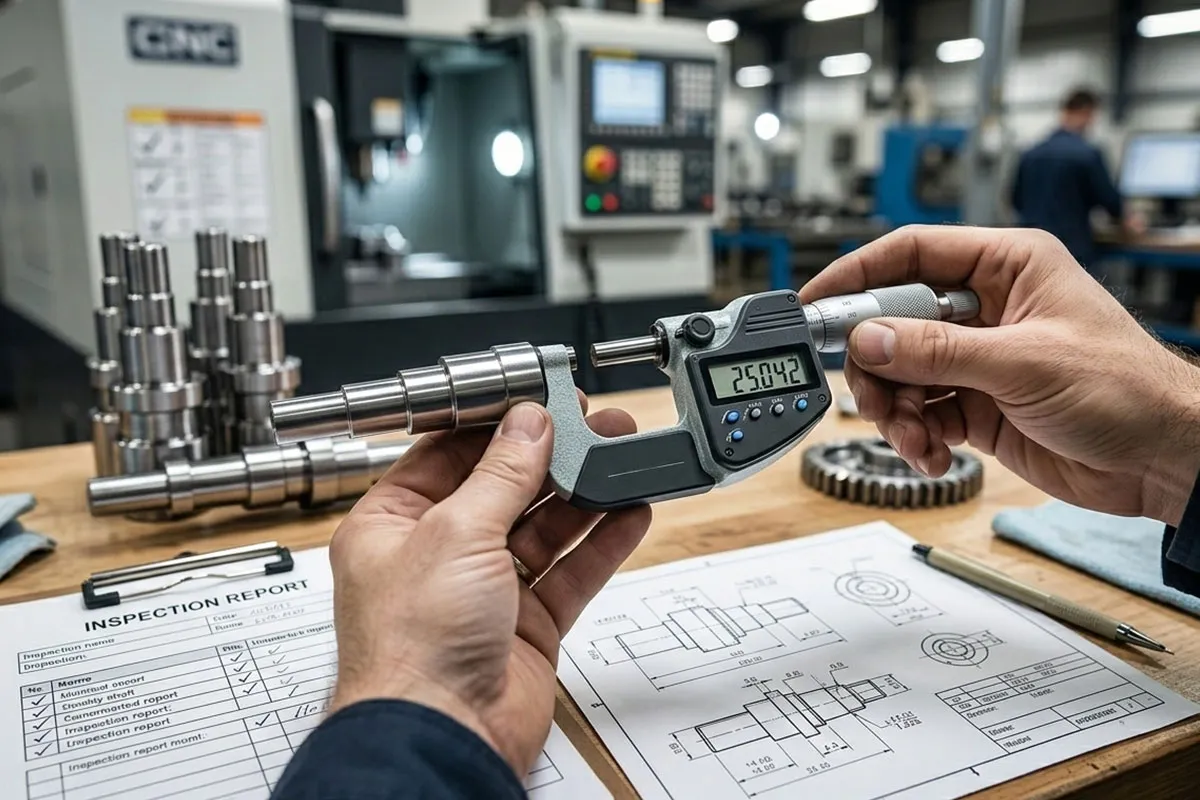
- Ask for dimensional inspection reports with actual measured values against your drawing tolerances
- Arrange third-party inspection through SGS, Bureau Veritas, or TÜV. All three operate in Pakistan
- Start with a prototype or trial order of 10–50 pieces before committing to production volumes
- Request a virtual or in-person factory tour. Serious manufacturers welcome this
At AMN Engineering in Lahore, every part goes through incoming material inspection, in-process checks, and final dimensional verification before shipping. We provide material certificates and inspection reports as standard, and third-party inspection is available on request.
Minimum Order Quantities: No MOQ vs. 1,000-Piece Minimums
This is one of Pakistan's strongest advantages and China's biggest weakness for small and medium buyers.
China: Built for Scale, Not Flexibility
China built its manufacturing dominance on volume. Most Chinese factories are optimized for large production runs. Their machines, their workforce, their pricing models all assume high quantities. Request 50 custom CNC parts and you'll either get rejected, quoted an absurdly high price, or put at the bottom of the priority list. Typical MOQ from Chinese contract manufacturers: 500–1,000+ pieces.
India: Middle Ground, but Lead Times Suffer
Indian suppliers are more willing to take smaller orders than Chinese factories. However, lead times stretch significantly at low volumes, and pricing becomes less competitive. You can expect MOQs of 100–500 pieces from most Indian contract manufacturers.
Pakistan: Built for Custom and Low-Volume Work
Pakistan's manufacturing cost structure allows factories to profitably accept orders that Chinese suppliers would refuse. This includes:
- Prototype development: 1–10 pieces for R&D and testing
- Spare parts: Single replacement components manufactured to drawing
- Custom one-off manufacturing: Unique parts with no repeat order expected
- Small batch production: 50–5,000 pieces at competitive per-unit pricing
- Pre-production trials: Test batches before scaling to mass production
If you need 50,000+ identical parts, China's scale advantage in tooling amortization is hard to beat. But for anything under 5,000 pieces (which covers the majority of custom manufacturing orders), Pakistan offers better value, faster turnaround, and more flexibility.
Lead Times and Shipping to GCC, Europe, and USA
Manufacturing Lead Times
Domestic lead time is the time from order confirmation to parts ready for dispatch:
- Pakistan: 2–4 weeks for most CNC machining, laser cutting, and fabrication work. Prototypes can be ready in 7–10 days.
- China: 2–4 weeks for standard work, but communication delays and factory scheduling frequently push this to 6+ weeks.
- India: 3–6 weeks. Infrastructure bottlenecks and domestic logistics challenges within India add unpredictable delays.
Shipping Times to Key Markets
| Destination | From Pakistan (Karachi) | From China (Shanghai) | From India (Mumbai) |
|---|---|---|---|
| Dubai, UAE | 5–7 days | 15–20 days | 7–10 days |
| Saudi Arabia | 7–10 days | 18–25 days | 10–14 days |
| Qatar | 5–8 days | 15–22 days | 8–12 days |
| United Kingdom | 14–18 days | 25–30 days | 18–22 days |
| Germany | 16–20 days | 25–35 days | 20–25 days |
| USA (East Coast) | 20–25 days | 18–22 days | 18–22 days |
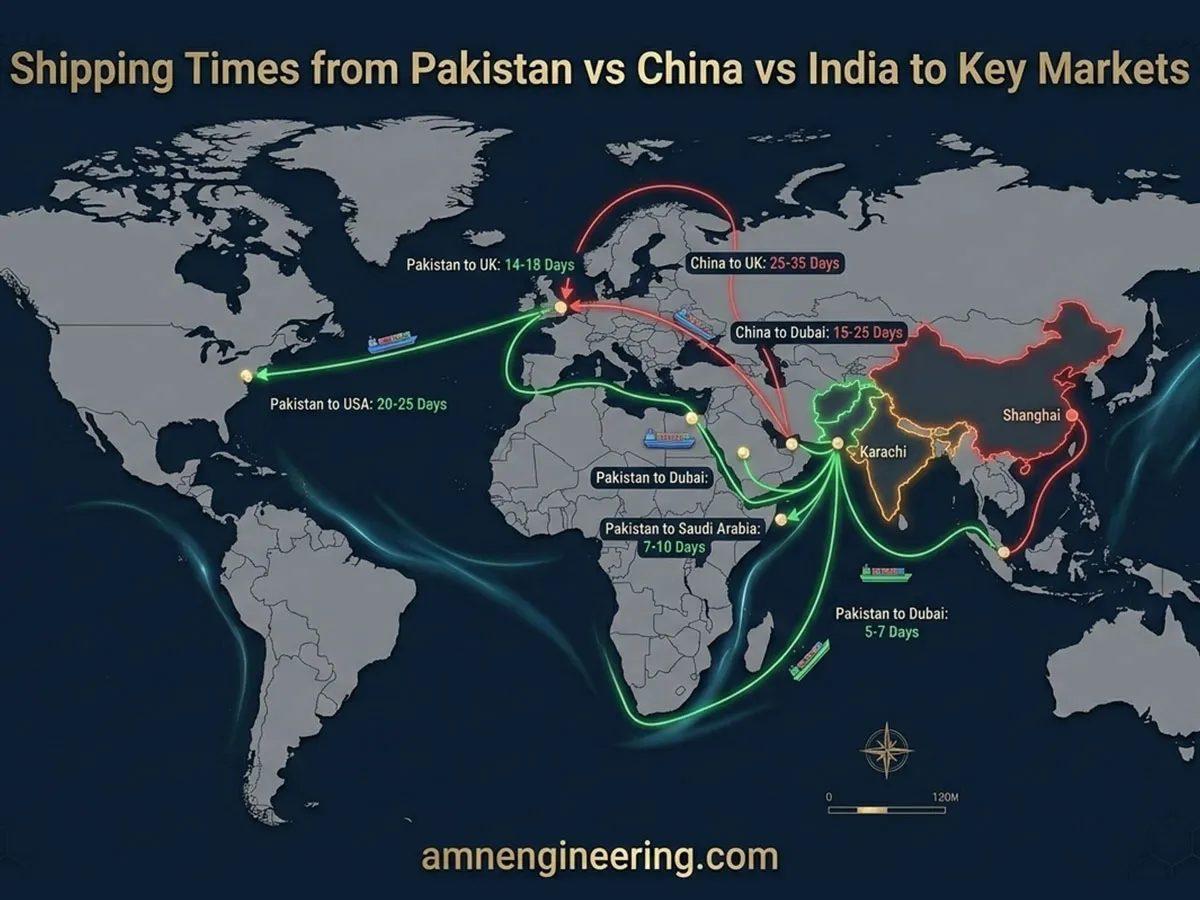
What This Means for GCC Buyers
For buyers in the UAE, Saudi Arabia, and Qatar, the logistics advantage is enormous. A part ordered from Lahore can be manufactured, galvanized, inspected, and delivered to Dubai in under 3 weeks total. The same part from China would take 5 to 7 weeks. That's not a minor difference. It's the difference between making a project deadline and missing it.
Communication and Business Culture
This is the factor that never appears on a spreadsheet but determines whether a supplier relationship actually works.
China: Language Barriers and Time Zone Gaps
Language barriers remain a real issue with Chinese suppliers. While trading companies provide English-speaking intermediaries, direct communication with the factory floor is often lost in translation. Time zone differences (5–8 hours ahead of GCC, 8–13 hours ahead of Europe) make real-time communication difficult. Business culture favors extended relationship-building before transactions, which can slow down first orders.
India: English-Fluent but Over-Promising Is Common
English proficiency across Indian manufacturers is strong, and cultural alignment with Western business practices is generally good. However, buyers frequently report over-promising on timelines and inconsistency between what's agreed and what's delivered. The time zone works well for European buyers but creates gaps for GCC-based procurement teams.
Pakistan: English, WhatsApp, and Shared Culture with GCC
English is widely spoken in Pakistan's business community, especially in export-oriented manufacturing. For GCC buyers, there's a significant cultural advantage: shared business customs, similar working hours (Pakistan is only 1 hour ahead of UAE), overlapping holidays, and a large Pakistani diaspora across the Gulf that provides existing trust networks.
Most Pakistani manufacturers communicate via WhatsApp. The same tool GCC procurement teams already use daily. This means real-time updates, voice notes for quick clarifications, and progress photos sent directly to your phone.
At AMN Engineering, we respond to inquiries within hours (usually via WhatsApp), provide quotes within 24 hours, and share progress photos during production. Our clients in Dubai, Saudi Arabia, and the United States consistently tell us this responsiveness is what sets us apart from Chinese and Indian alternatives.
Will They Copy My Parts? Design Safety Compared
If you're sending proprietary drawings to a factory overseas, you need to know: will they use my designs to sell the same parts to someone else?
China: A Well-Documented Problem
China has a well-documented history of design copying in manufacturing. Legal frameworks exist on paper, but enforcement is inconsistent. There are countless documented cases of suppliers manufacturing competitor copies using your tooling, or selling identical parts under their own brand. Once your drawings are inside a Chinese factory, you have limited control over how they're used.
India: Better Laws, Uneven Enforcement
India has stronger intellectual property laws than China, but enforcement is still catching up in practice. Risk is moderate: better than China, but not guaranteed protection.
Pakistan: Natural Protection Through Business Model
Pakistan offers a natural advantage here, and it comes down to business model rather than law. Most Pakistani manufacturers, including AMN Engineering, are pure contract manufacturers. This means:
- We don't sell finished products
- We don't have a product catalog
- We don't compete with our own clients
- We make parts to your drawings, and your drawings stay your drawings
There is simply no business incentive to copy your designs. Contract manufacturers have no retail channel, no brand to sell under, and no reason to risk a client relationship. This is a structural advantage, not a legal one.
When to Source from Each Country
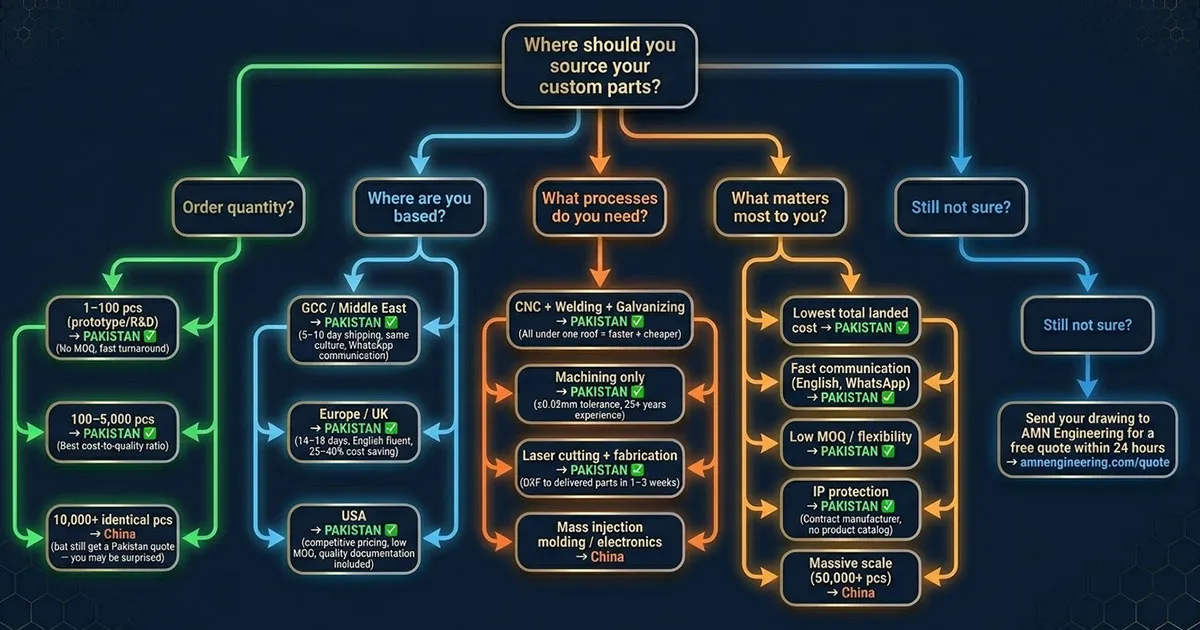
Choose Pakistan When:
- You need custom metal parts in any quantity, from a single prototype to 5,000+ pieces
- You want the lowest total landed cost (unit price + shipping + lead time savings)
- You're based in the GCC and need parts delivered in under 3 weeks total
- You need low or no minimum order quantities, ideal for R&D, spare parts, and first orders
- You want direct, English-language communication with the factory (not a trading company)
- Your parts require multiple processes (CNC machining + laser cutting + welding + galvanizing + threading) under one roof. This eliminates coordination between 3 to 4 separate vendors
- You value design safety. Contract manufacturers in Pakistan make parts to your drawings, not their own products
- You want quality documentation included as standard (material test certificates, inspection reports)
Consider China When:
- You need 50,000+ identical parts where tooling amortization makes unit costs extremely low
- You require highly specialized processes like advanced injection molding or complex electronics assembly
- Your product needs a deeply integrated supply chain (components + PCB + assembly + packaging from one industrial zone)
Even for larger volumes, it's worth getting a Pakistan quote. Many buyers are surprised that total landed cost from Pakistan is competitive at higher quantities when you factor in shipping, communication, and flexibility.
Consider India When:
- Your project requires software-hardware integration (India's IT sector advantage)
- You're primarily serving the Indian domestic market
- You need very large-scale casting or forging (India has massive foundry capacity)
Note: India's quality consistency varies significantly between suppliers, and lead times can be unpredictable due to domestic logistics challenges.
The Bottom Line
For procurement managers sourcing custom metal parts in small-to-medium volumes, Pakistan offers the strongest combination of low cost, flexible MOQs, fast GCC shipping, and design safety. China still wins at very high volumes (50,000+ pieces) where tooling costs spread thin. India works best when you need software-hardware integration or access to its domestic market.
But for CNC machined parts, fabricated components, or anything that needs multiple processes under one roof, Pakistan deserves a spot in your quoting round. The numbers consistently show 25 to 40% lower total landed cost compared to China, with shorter lead times and direct factory communication.
The best way to verify this is simple: send us your drawing and compare the quote against what you're currently paying.
Frequently Asked Questions
Yes. For small-to-medium batch sizes (1 to 5,000 pieces), Pakistani manufacturers typically quote 30 to 50% lower than Chinese suppliers for equivalent CNC machining, laser cutting, and fabrication work. When you calculate total landed cost, including shipping, customs, lead time, and quality rejection rates, Pakistan is often 25 to 40% cheaper overall. China's cost advantage only kicks in at very high volumes (50,000+ pieces) where tooling amortization offsets per-unit pricing.
Most Pakistani contract manufacturers have no standard MOQ. At AMN Engineering, we accept orders as small as 1 piece for prototypes and 50+ pieces for production runs. This compares to typical Chinese MOQs of 500 to 1,000+ pieces and Indian MOQs of 100 to 500 pieces. Pakistan's low overhead structure makes small-batch manufacturing economically viable.
Sea freight from Karachi, Pakistan to Dubai takes approximately 5 to 7 days. Shipping to Saudi Arabia (Jeddah/Dammam) takes 7 to 10 days. By comparison, shipping from Shanghai, China to Dubai takes 15 to 20 days, and from Mumbai, India to Dubai takes 7 to 10 days. Pakistan's port in Karachi sits on the Arabian Sea, giving it the shortest sea route to all GCC countries.
Yes. Pakistan has a growing base of ISO-certified CNC machining facilities, particularly in Lahore, Karachi, and Sialkot. Export-oriented manufacturers invest in multi-axis CNC lathes, CNC milling machines, laser cutting equipment, and CMM inspection tools. Pakistani manufacturers regularly produce parts to tolerances of ±0.01mm for international clients including pump manufacturers, food processing companies, and building materials suppliers.
Design copying risk in Pakistan is very low, and the reason is structural, not legal. Most Pakistani manufacturers are pure contract manufacturers who make parts to your drawings. They don't sell finished products, don't have product catalogs, and don't compete with their clients. With no retail channel and no product brand, there is no business incentive to copy your designs.
Pakistani contract manufacturers offer a wide range of metalworking processes including: CNC machining (turning and milling), laser cutting, metal fabrication and welding, forging, grinding and precision finishing, die casting, stamping, threading (BSP, metric, UNC), hot-dip galvanizing to ISO 1461 standards, and steel conduit and conduit fittings manufacturing. Many facilities, including AMN Engineering, offer multiple processes under one roof.