What Is Contract Manufacturing? A Complete Guide for Buyers
By Adil, Managing Director at AMN Engineering · · 10 min read
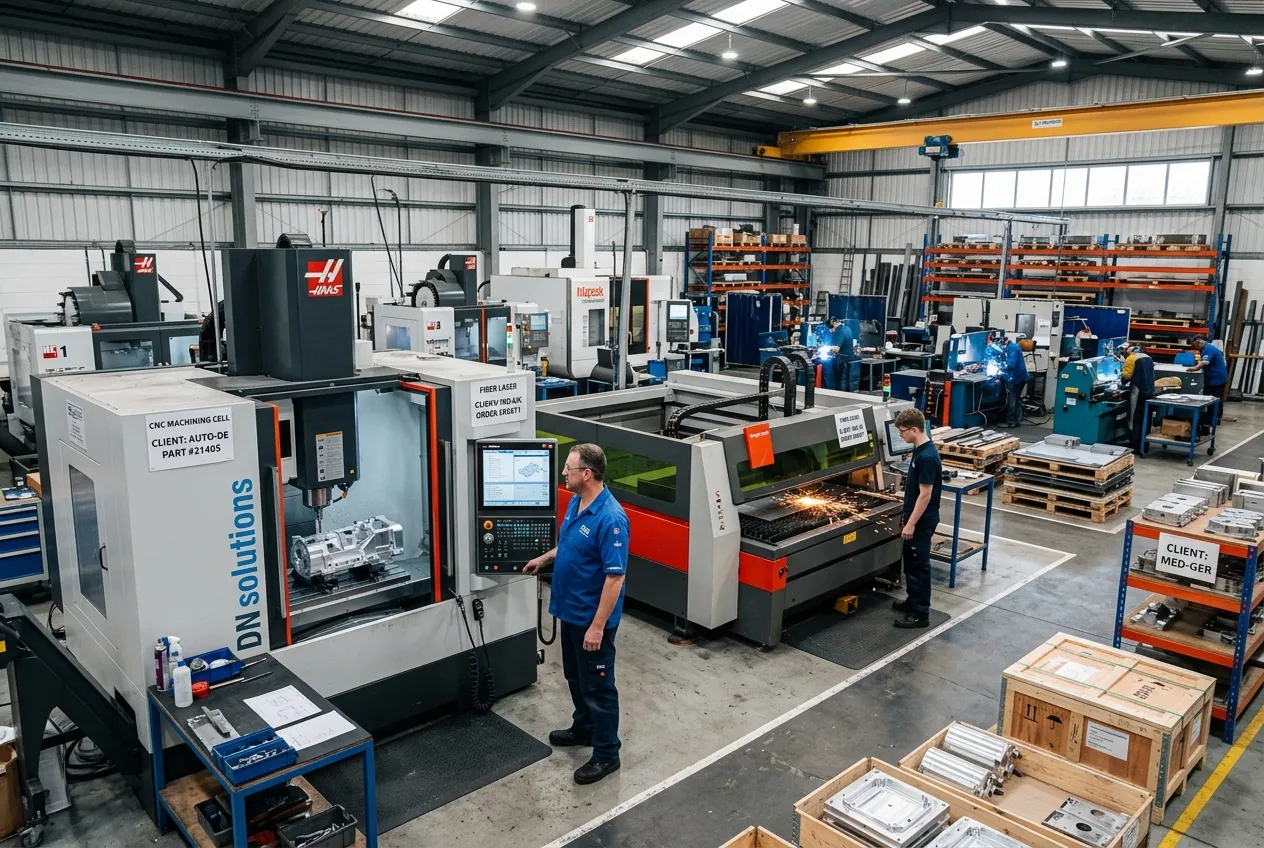
What is contract manufacturing? In simple terms, it means hiring an external factory to make parts or products for you. You provide the design. They provide the machines, labor, and expertise. You get finished parts delivered to your door.
Contract manufacturing is how thousands of companies around the world produce custom parts without owning a single machine. From automotive components to food processing equipment to electrical fittings, contract manufacturers produce the parts that keep industries running.
This guide explains everything a buyer needs to know: how the process works, the benefits and risks, how it compares to OEM and in house manufacturing, and how to find the right manufacturing partner. We have been a contract manufacturer in Lahore since 1999, serving clients across the GCC, Europe, and the USA, so this comes from the production side of the relationship.
Contract Manufacturing Defined
Contract manufacturing is an outsourcing arrangement where a company (the buyer) hires an external manufacturer (the contract manufacturer) to produce parts, components, or complete products according to the buyer's specifications.
The key characteristics of contract manufacturing:
You own the design. The contract manufacturer works from your drawings, CAD files, and specifications. They do not design the product. They produce exactly what you specify.
They own the equipment. The contract manufacturer invests in machines, tools, and facilities. You do not need to buy CNC machines, laser cutters, or welding equipment. You pay for the finished parts.
They provide the labor. Skilled operators, engineers, and quality inspectors are the manufacturer's responsibility. You do not need to hire, train, or manage production staff.
You retain all rights. Your designs, specifications, and intellectual property remain yours. A reputable contract manufacturer does not sell your parts to anyone else or use your designs for their own products.
How It Works: Step by Step
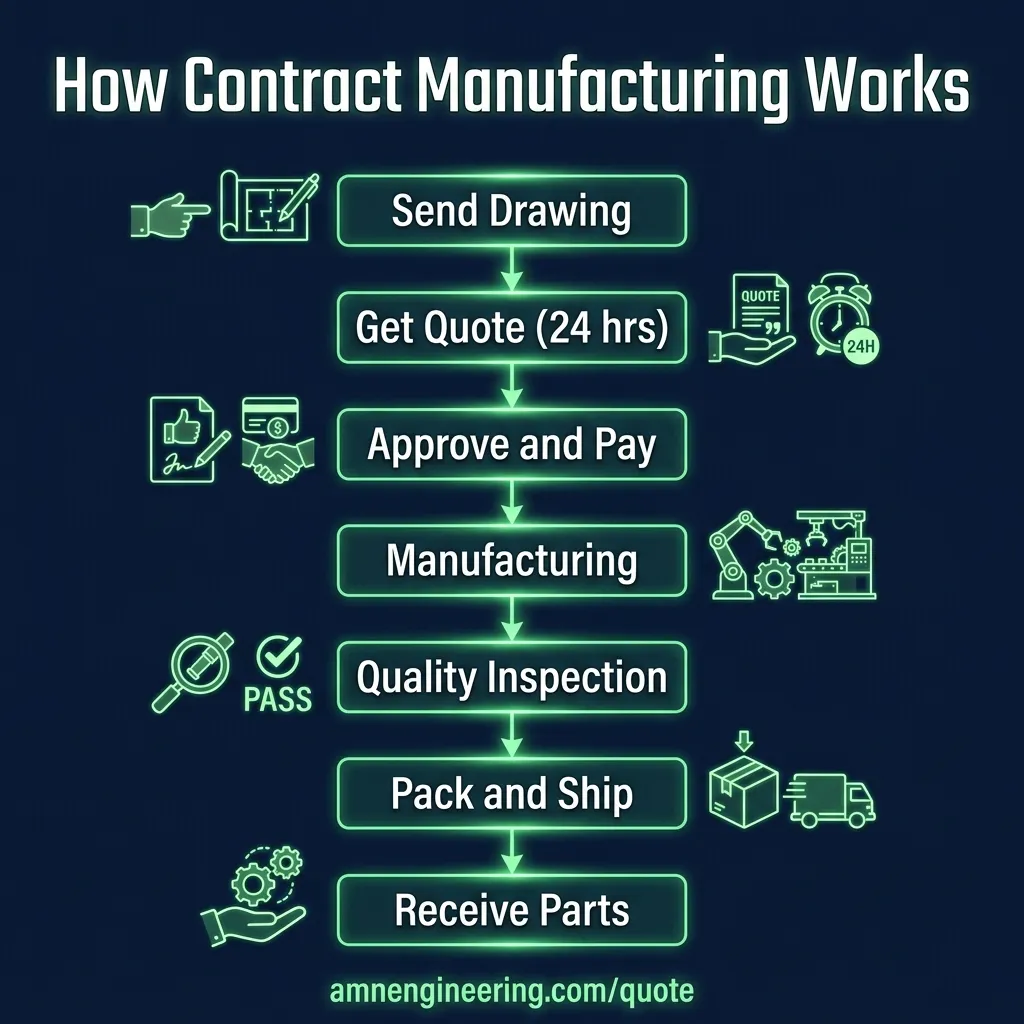
The contract manufacturing process follows a straightforward sequence:
1. You Send a Drawing and Specifications
Share your part design in any format: DXF, STEP, IGES, PDF, or a dimensioned sketch. Include the material grade, quantity, tolerances, finish requirements, and any special notes. For guidance on preparing an effective request, see our guide: 5 Things to Include in Your RFQ.
2. The Manufacturer Quotes
The contract manufacturer reviews your requirements and provides a detailed quote: unit price, total cost, material, process, lead time, and any tooling charges. A good manufacturer quotes within 24 hours for standard work.
3. You Approve and Place the Order
Once you accept the quote, you place a purchase order. Standard payment for first orders is typically 50% advance with the balance before shipping.
4. Manufacturing
The manufacturer produces your parts using their equipment and processes: CNC machining, laser cutting, metal fabrication, forging, die casting, galvanizing, or whatever the part requires.
5. Quality Inspection
Parts are inspected against your drawing with dimensional checks, material verification, and coating tests. Documentation (material test certificates, inspection reports) is prepared. For details on what this looks like in practice, read: Quality Control in Contract Manufacturing.
6. Shipping
Finished parts are packed for export and shipped to your location. Typical shipping from Pakistan: 5 to 7 days to Dubai, 14 to 18 days to Europe, 20 to 25 days to USA by sea.
7. You Receive Parts
Inspect on arrival. If satisfied, reorder. Over time, the relationship develops into a reliable supply chain with better pricing, faster turnaround, and deeper technical collaboration.
Benefits of Contract Manufacturing
Lower Cost
Building your own manufacturing capability requires massive capital investment: machines, tooling, factory space, utilities, maintenance, and skilled labor. Contract manufacturing converts this fixed cost into a variable cost. You pay per part, only when you need parts.
For small and medium companies, this is transformative. Instead of spending $500,000 on CNC machines, you spend $5,000 on a batch of parts. The contract manufacturer has already made the capital investment and spreads it across multiple clients.
Access to Multiple Processes
A good contract manufacturer offers multiple processes under one roof. At AMN Engineering, for example, we offer CNC machining, laser cutting, metal fabrication, forging, grinding, die casting, stamping, threading, and hot dip galvanizing. A single part that needs cutting, machining, welding, and galvanizing is completed in one factory without coordinating between 4 separate vendors.
Scalable Capacity
Need 50 parts this month and 5,000 next month? A contract manufacturer scales production up or down based on your demand. You do not carry the fixed cost of idle machines during slow periods.
Faster Time to Market
Setting up your own production takes months or years. A contract manufacturer can start producing within days of receiving your order. For new product launches, prototypes, and market testing, this speed advantage is critical.
Focus on Your Core Business
Manufacturing is complex. If your core business is design, sales, or service, outsourcing production lets you focus on what you do best while a specialist handles manufacturing.
Risks and How to Manage Them
Quality Risk
The risk: Parts may not meet your specifications.
How to manage it: Start with a trial order of 10 to 50 pieces. Require material test certificates and inspection reports with every shipment. Arrange third party inspection (SGS, Bureau Veritas) for first orders.
Communication Risk
The risk: Misunderstandings about specifications, especially across languages and time zones.
How to manage it: Choose a manufacturer that communicates in your language. Provide clear, dimensioned drawings rather than verbal descriptions. Confirm all specifications in writing before production starts.
Design Safety Risk
The risk: The manufacturer copies your design and sells to competitors.
How to manage it: Choose a pure contract manufacturer (no product catalog, no brand) who has no incentive to copy designs. Sign an NDA before sharing drawings. For more on this topic, see: Manufacturing in Pakistan vs China vs India.
Supply Chain Risk
The risk: Over reliance on a single manufacturer.
How to manage it: For critical components, qualify a backup supplier. Maintain your own drawings and specifications so you can move production if needed. Build relationships with 2 to 3 manufacturers.
Contract Manufacturing vs OEM vs In House
| Factor | Contract Manufacturing | OEM | In House |
|---|---|---|---|
| Who designs? | You design | Manufacturer designs (or co designs) | You design |
| Who produces? | External manufacturer | External manufacturer | Your own factory |
| Who owns the design? | You | Often shared or manufacturer owned | You |
| Capital investment | Zero (pay per part) | Low to moderate | Very high |
| Control over process | Moderate (via specs and inspection) | Lower | Full control |
| Flexibility | High (change suppliers easily) | Moderate | Low (locked into your equipment) |
| Best For | Custom parts, small to medium volumes | Products sold under your brand | High volume, proprietary processes |
Industries That Use Contract Manufacturing
Contract manufacturing serves virtually every industry. Here are the most common:
Oil and gas: Flanges, valve components, pipe fittings, pump parts. These often require forging followed by CNC machining to precise tolerances.
Automotive: Brackets, shafts, bushings, housings, stamped components. High volume production with strict quality requirements.
Food and beverage: SS304 and SS316 components for processing equipment, conveyors, mixers, and filling machines. Hygiene standards require stainless steel and smooth finishes.
Construction and electrical: Steel conduits, conduit fittings, brackets, structural steel components, galvanized frameworks.
Water and pumps: Pump shafts, impellers, casings, bearing housings. Often require specific material grades and tight tolerances.
General industrial: Machine components, jigs, fixtures, tooling, replacement parts, and custom one off manufacturing.
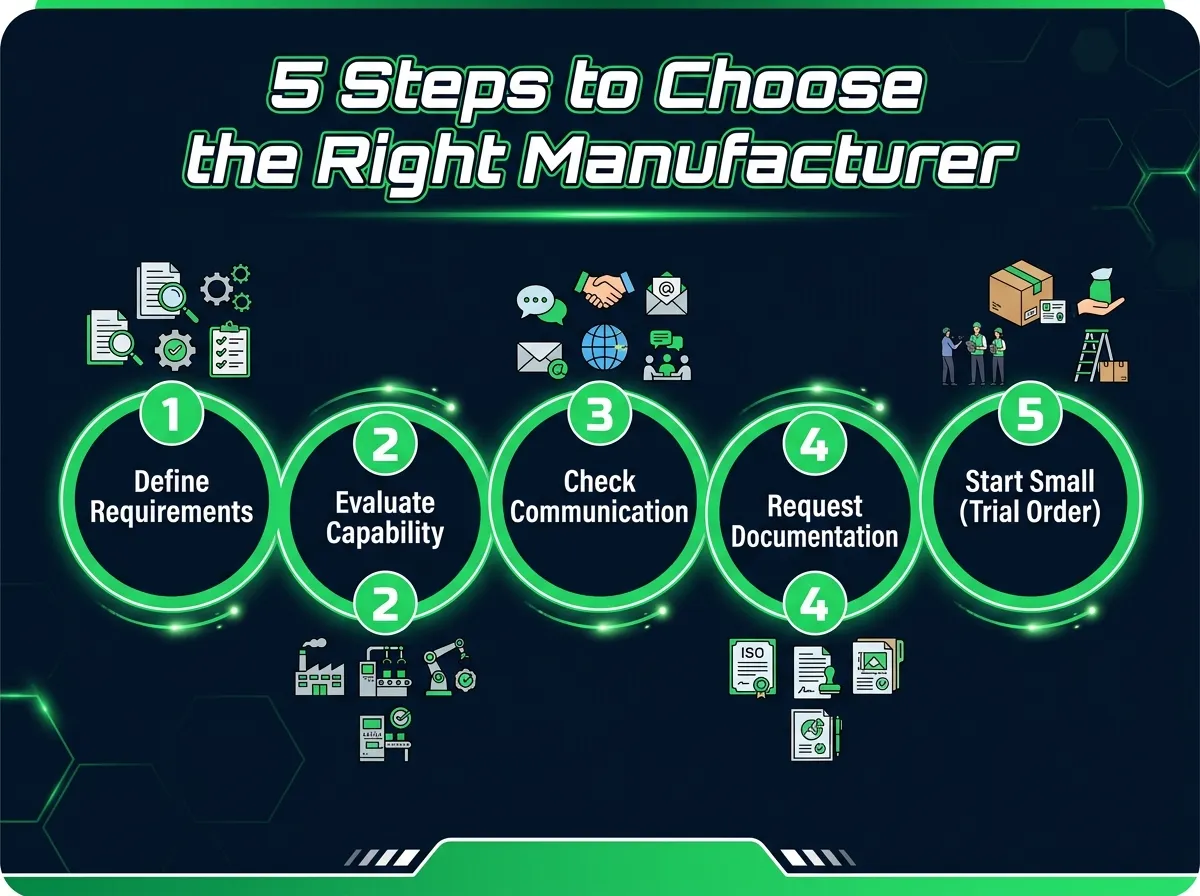
How to Choose the Right Partner
Step 1: Define Your Requirements
Before contacting any manufacturer, be clear on what you need: processes required, materials, quantities, quality standards, and delivery location. The clearer your requirements, the better quotes you will receive.
Step 2: Evaluate Capability
Does the manufacturer have the equipment to produce your parts? Do they handle your material grade? Can they meet your tolerances? A manufacturer with multiple processes under one roof can simplify your supply chain significantly.
Step 3: Check Communication
Send an inquiry and see how they respond. How fast? How detailed? How clearly? The way a manufacturer handles your inquiry is a preview of how they will handle your production order.
Step 4: Request Documentation
Ask for material test certificates from recent orders, sample inspection reports, and references from existing clients. A manufacturer who cannot provide these is not ready for serious export work.
Step 5: Start Small
Always start with a trial order. 10 to 50 pieces is enough to verify quality, communication, packaging, and delivery time without significant financial risk. For guidance on what to include in your first RFQ, see: 5 Things to Include in Your RFQ.
Frequently Asked Questions
Contract manufacturing is when a company outsources the production of parts or products to an external factory. The hiring company provides the design, specifications, and requirements. The contract manufacturer produces the parts using their equipment and labor. The hiring company retains ownership of the design and the finished products.
In contract manufacturing, the buyer owns the design and the manufacturer simply produces it. In OEM (Original Equipment Manufacturer) arrangements, the manufacturer may design and produce the product, which is then sold under the buyer's brand. Contract manufacturing gives the buyer more control over the design and specifications.
The main benefits include lower production costs (no need to invest in equipment), access to specialized processes and expertise, scalable production capacity, faster time to market, and the ability to focus on core business activities like design and sales while the manufacturing partner handles production.
Contract manufacturing is used across virtually every industry including automotive, aerospace, oil and gas, food processing, construction, electrical, pharmaceutical, consumer products, and industrial equipment. Any company that needs custom parts but does not want to invest in manufacturing equipment can benefit from contract manufacturing.
Start by defining your requirements (processes needed, material, volume, quality standards). Search for manufacturers with experience in your industry. Request quotes from 2 to 3 suppliers. Evaluate based on capability, communication, quality documentation, and references. Always start with a small trial order of 10 to 50 pieces before committing to large volumes.