Why "All Under One Roof" Manufacturing Saves You Time, Money, and Headaches
By Adil, Managing Director at AMN Engineering · · 7 min read
Most manufactured parts need more than one process. A bracket starts as a sheet, gets laser cut, bent, welded, and galvanized. A shaft gets CNC turned, threaded, heat treated, and ground.
When each process happens at a different vendor, you are managing multiple purchase orders, multiple deliveries, multiple quality standards, and multiple schedules. Every handoff between vendors adds time, cost, and risk.
The alternative is single source manufacturing where all processes happen under one roof. This guide explains why it matters, how much it saves, and when it makes sense for your parts.
The Problem with Multiple Vendors
When your part needs four processes at four different vendors, here is what actually happens:
Vendor A (laser cutting) cuts the blanks and ships them to Vendor B. Transit time: 2 days. Plus waiting for Vendor B to schedule your job.
Vendor B (bending and welding) forms and welds the parts. Ships to Vendor C. Transit time: 2 days. Plus scheduling wait.
Vendor C (CNC machining) machines the critical features. Ships to Vendor D. Transit time: 2 days. Plus scheduling wait.
Vendor D (galvanizing) galvanizes the finished assembly. Ships to you.
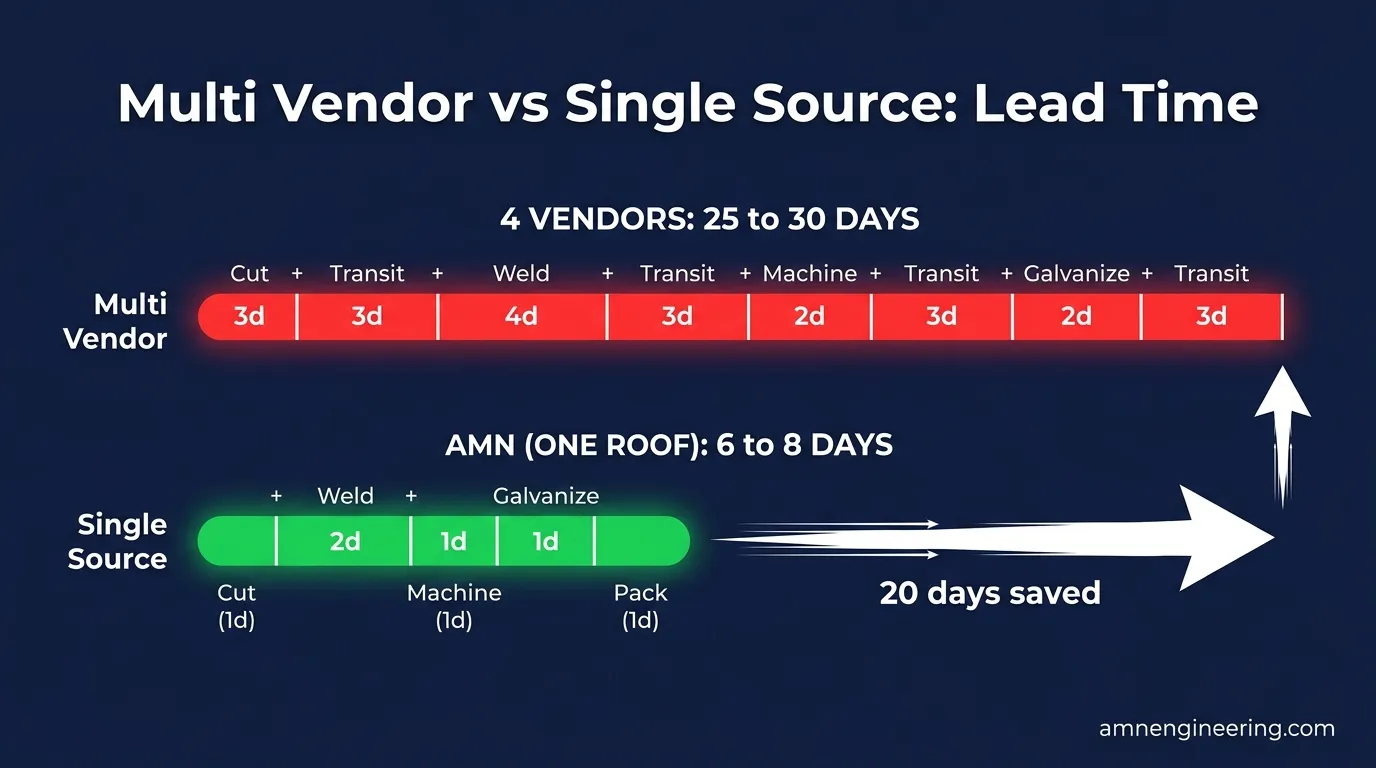
Each handoff adds 3 to 5 working days (transit plus scheduling). Four handoffs add 12 to 20 working days to your lead time that have nothing to do with manufacturing. That is 2 to 4 weeks of pure coordination waste.
And that is the best case. If Vendor B finds a problem with Vendor A's work, everything stops while they sort it out. You are in the middle, making phone calls, coordinating, and waiting.
What "All Under One Roof" Actually Means
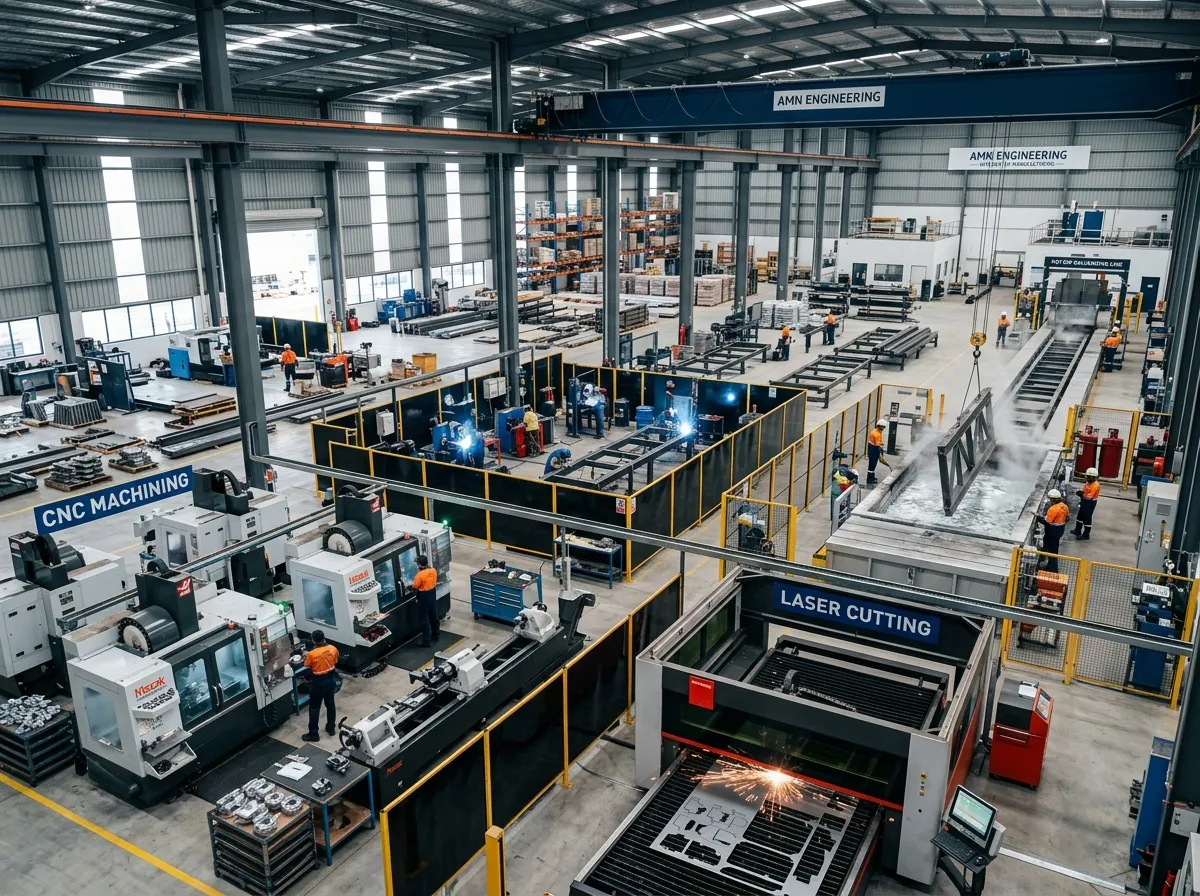
At AMN Engineering in Lahore, we offer these processes in a single facility:
- CNC machining (turning and milling)
- Laser cutting
- Metal fabrication (bending, welding, assembly)
- Forging
- Grinding
- Die casting
- Stamping
- Threading (BSP, metric, UNC)
- Hot dip galvanizing
- Steel conduit manufacturing
- Conduit fittings manufacturing
- Cable trays and cable management
- Ducting, insulation and lagging
When your part needs laser cutting, welding, machining, and galvanizing, it moves from one station to the next within the same building. No shipping between vendors. No scheduling delays. No finger pointing when something goes wrong.
Five Ways Single Source Manufacturing Saves Money
1. Eliminated Transit Time
No shipping between vendors means 2 to 4 weeks saved on a typical multi process part. Your total lead time is the actual manufacturing time plus shipping to you. Nothing in between.
2. Single Point of Accountability
If a dimension is wrong after welding, we fix it before it goes to machining. There is no argument about whose fault it is. One factory, one purchase order, one point of contact. If anything goes wrong, we own it completely.
3. Better Quality Through Process Control
When the same team handles every process, they understand how each step affects the next. Our welders know that the machinist needs a specific datum face left untouched. Our laser operators know that the bender needs certain relief cuts. This cross process knowledge eliminates the mistakes that happen when each vendor works in isolation.
4. Lower Total Cost
You eliminate markup at each stage. When you use four vendors, each one adds their own margin. With a single source, you pay one margin on the entire job. Plus you save on all the shipping costs between vendors.
5. Simplified Communication
One WhatsApp conversation. One quote. One invoice. One set of inspection documents. Instead of coordinating between four different contacts at four different companies, you deal with one person who knows your part from start to finish.
Real Example: A Part That Needs Four Processes
Consider a galvanized steel bracket for an industrial installation:
Multi Vendor Approach (4 vendors):
| Step | Vendor | Time | Cost Element |
|---|---|---|---|
| Laser cut blanks | Vendor A | 3 days mfg + 3 days transit | Cutting + margin + shipping |
| Bend and weld | Vendor B | 3 days wait + 4 days mfg + 3 days transit | Fabrication + margin + shipping |
| Machine mounting holes | Vendor C | 3 days wait + 2 days mfg + 3 days transit | Machining + margin + shipping |
| Hot dip galvanize | Vendor D | 3 days wait + 2 days mfg + ship to you | Galvanizing + margin + shipping |
| Total | 25 to 30 working days | 4 margins + 4 shipping costs |
Single Source Approach (AMN Engineering):
| Step | Station | Time |
|---|---|---|
| Laser cut blanks | Laser shop | Day 1 |
| Bend and weld | Fabrication shop | Day 2 to 3 |
| Machine mounting holes | CNC shop | Day 4 |
| Hot dip galvanize | Galvanizing line | Day 5 |
| Pack and ship | Dispatch | Day 6 |
| Total | 6 to 8 working days |
Same part. Same quality. 20 fewer days. One invoice. One margin. One WhatsApp contact.
When Multi Vendor Still Makes Sense
Single source is not always the answer. Multi vendor makes sense when:
- You need a highly specialized process that only one shop in the country does well (e.g., aerospace grade heat treatment)
- Volumes are so high that dedicated specialist vendors offer significant scale advantages
- Your manufacturer honestly does not have the capability for one of the processes and would be subcontracting it anyway
The key question to ask your manufacturer: "Do you perform all these processes in house, or do you subcontract some of them?" If they subcontract, you lose most of the single source benefits.
Frequently Asked Questions
It means a single factory that performs multiple manufacturing processes (cutting, machining, welding, finishing) in the same facility. Your part moves between stations within the building instead of being shipped between separate vendors.
For a part needing 3 to 4 processes, single source typically saves 2 to 4 weeks compared to using separate vendors. The savings come from eliminating transit time and scheduling delays between vendors.
Yes. You eliminate multiple shipping costs, multiple vendor margins, and coordination overhead. A part that costs $X across four vendors typically costs 15 to 25 percent less from a single source manufacturer.
Ask directly and request a factory tour (in person or video). Ask which specific machines they use for each process. A manufacturer who is vague about their equipment is likely subcontracting.
A good manufacturer will be transparent about what they subcontract. Some subcontracting is acceptable (e.g., specialized heat treatment). But if they subcontract the core processes, you lose the single source advantages.