EN8 vs EN24 vs SS304: How to Choose the Right Steel Grade for Your Parts
By Adil, Managing Director at AMN Engineering · · 11 min read
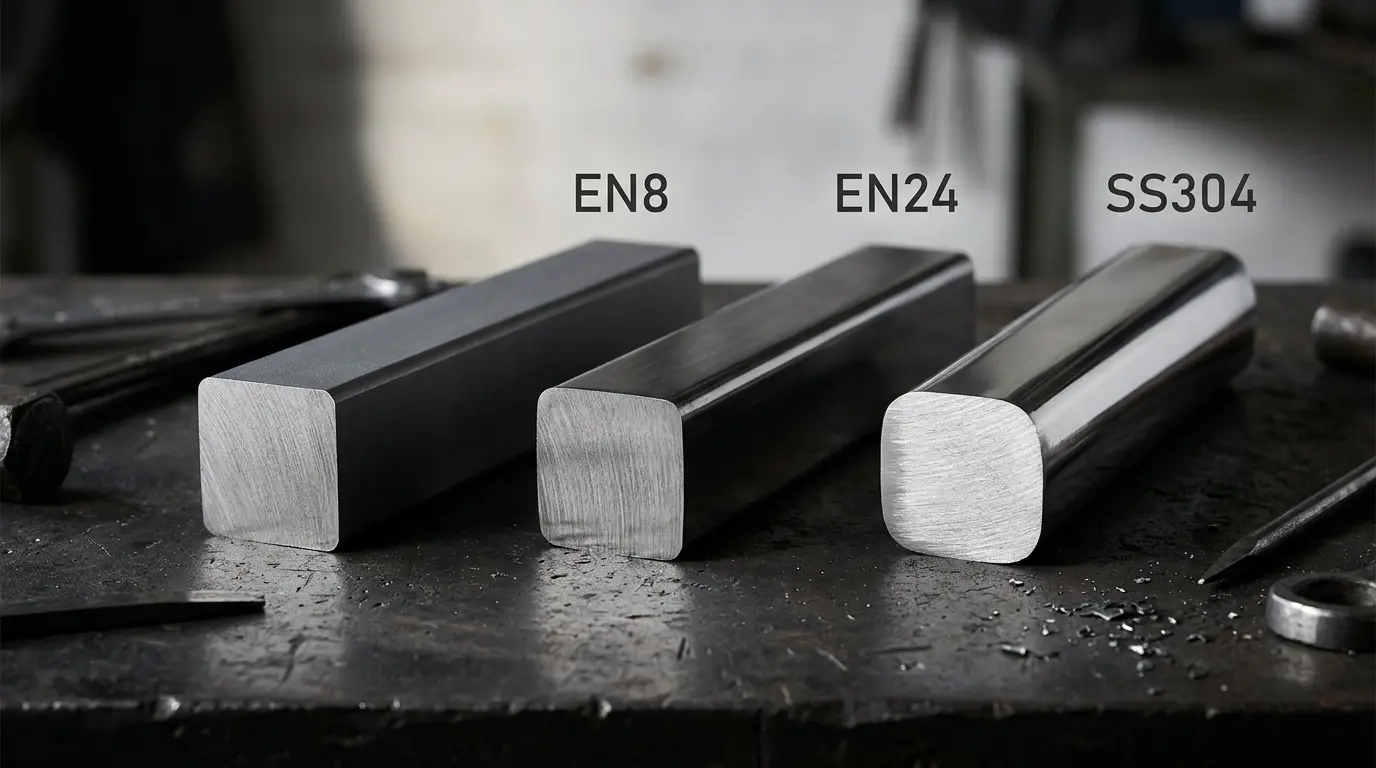
EN8, EN24, and SS304. Three of the most commonly specified steel grades in engineering, and choosing the wrong one can mean premature failure, unnecessary cost, or both. Getting this decision right at the design stage saves you money, avoids delays, and ensures your parts perform as expected.
This guide compares EN8, EN24, and SS304 in plain language. No metallurgy textbook definitions. Just a practical comparison based on 25 years of machining all three grades at our factory in Lahore, so you can choose the right steel for your next project.
EN8 is a medium-carbon steel (AISI 1040) offering good general strength and easy machining. EN24 is a high-strength alloy steel (AISI 4340) with greater strength, toughness, and heat-treatability for heavy-duty, high-stress parts. SS304 is an austenitic stainless steel (AISI 304, also called A2) chosen for corrosion resistance rather than strength. Pick EN8 for general engineering, EN24 for high stress, and SS304 for corrosive environments.
AMN Engineering machines and supplies custom and OEM parts in EN8, EN24, and SS304 for buyers across North America and worldwide.
The Quick Guide
Here is the simplest way to choose:
EN8 = your default choice for general engineering. Good strength, easy to machine, and the cheapest of the three. Use it for shafts, pins, bushings, and bolts where the part is not exposed to extreme stress or corrosive environments.
EN24 = heavy duty. Much stronger and tougher than EN8. Use it when your part faces high stress, shock loads, or fatigue. If EN8 is not strong enough, EN24 is the next step up.
SS304 = corrosion resistance. Does not rust. Use it when your part is exposed to moisture, food contact, chemicals, or outdoor conditions without a protective coating.
That decision covers about 90 percent of cases. Need parts machined from any of these grades? Our CNC machining service handles all three daily.
EN8 Steel: The Workhorse
EN8 (also known as 080M40 or AISI 1040) is a medium carbon steel with approximately 0.4% carbon content. It is the most commonly used steel grade in general engineering for good reason: it offers a solid balance of strength, machinability, and cost.
Key Properties
- Machinability rating: 65% (easy to machine, good surface finish)
- Tensile strength: 550 to 700 MPa (normalized condition)
- Can be surface hardened: flame or induction hardening to 50 to 55 HRC
- Widely available and affordable across all markets
Typical Applications
EN8 is the go to steel for general purpose machined parts. Common applications include:
- Shafts and axles
- Studs and bolts
- Connecting rods
- Bushings and pins
- Rollers and gears (non high stress)
- Hydraulic rams and spindles
Bottom line: If your part does not need extreme strength or corrosion resistance, EN8 is almost always the right starting point. It machines well, costs less, and is available everywhere.
EN24 Steel: The Heavy Duty Option
EN24 (also known as 817M40 or AISI 4340) is a nickel chromium molybdenum alloy steel. The addition of nickel, chromium, and molybdenum gives EN24 significantly higher strength, toughness, and fatigue resistance compared to EN8.
Key Properties
- Tensile strength: 850 to 1,000 MPa (heat treated, T condition)
- Excellent toughness for shock and impact loads
- Can be through hardened: 28 to 32 HRC in T condition, and higher with further heat treatment
- Superior fatigue resistance compared to EN8
Typical Applications
EN24 is used where EN8 would not be strong enough. Common applications include:
- High performance shafts
- Gearbox components
- Connecting rods and crankshafts
- Rock drilling tools
- Heavy duty fasteners
- Parts subject to repeated shock or impact
Drawbacks
Cost: EN24 is 30 to 50 percent more expensive than EN8 in raw material cost.
Machinability: Slightly harder to machine than EN8, requiring slower cutting speeds and more tool wear. Expect 10 to 20 percent higher machining costs.
Bottom line: EN24 is justified when your part faces high stress, shock loads, or fatigue that EN8 cannot handle. Do not specify EN24 for general purpose parts where EN8 would work fine.
SS304: When Corrosion Resistance Matters
SS304 (AISI 304), also known as 18/8 stainless steel (18% chromium, 8% nickel), is an austenitic stainless steel. Its defining feature is excellent corrosion resistance. It does not rust, does not need surface treatment, and maintains a clean appearance over time.
Why Choose SS304
- Corrosion resistance: Excellent resistance to moisture, most chemicals, and atmospheric corrosion
- Food and pharmaceutical grade: Non reactive, easy to clean, meets hygiene standards
- Aesthetic appearance: Clean, modern look without painting or coating
- Weldability: Excellent, easy to weld with standard stainless steel procedures
Drawbacks
Cost: SS304 costs 3 to 4 times more than EN8 in raw material.
Strength: Lower tensile strength than EN24 (515 to 620 MPa), though adequate for many applications.
Machinability: Poor. SS304 is gummy, work hardens during cutting, and causes rapid tool wear. Expect 30 to 50 percent higher machining costs compared to EN8.
Cannot be hardened by heat treatment. SS304 can only be hardened by cold working, not by conventional heat treatment like EN8 or EN24.
Bottom line: Choose SS304 when corrosion resistance is a requirement, not a preference. If your part will be in a dry, non corrosive environment, EN8 or EN24 will perform just as well at a fraction of the cost.
The Full Comparison
| Property | EN8 (080M40) | EN24 (817M40) | SS304 (AISI 304) |
|---|---|---|---|
| Type | Medium carbon steel | Alloy steel (Ni Cr Mo) | Austenitic stainless steel |
| Carbon Content | 0.36 to 0.44% | 0.36 to 0.44% | 0.08% max |
| Tensile Strength | 550 to 700 MPa | 850 to 1,000 MPa (T condition) | 515 to 620 MPa |
| Yield Strength | 280 to 350 MPa | 680 to 850 MPa | 205 MPa |
| Hardness | 170 to 210 HB | 248 to 302 HB (T condition) | 123 to 201 HB |
| Machinability | Good (easy to cut) | Moderate (harder to cut) | Poor (gummy, work hardens) |
| Corrosion Resistance | None (needs coating) | None (needs coating) | Excellent (no coating needed) |
| Can Be Hardened | Surface hardening only | Through hardening possible | No (cold work only) |
| Weldability | Good | Fair (preheat needed) | Excellent |
| Cost (relative) | 1x (baseline) | 1.3 to 1.5x | 3 to 4x |
| Machining Cost | Baseline | 10 to 20% higher | 30 to 50% higher |
| Best For | General engineering | Heavy duty, high stress | Corrosive environments, food grade |
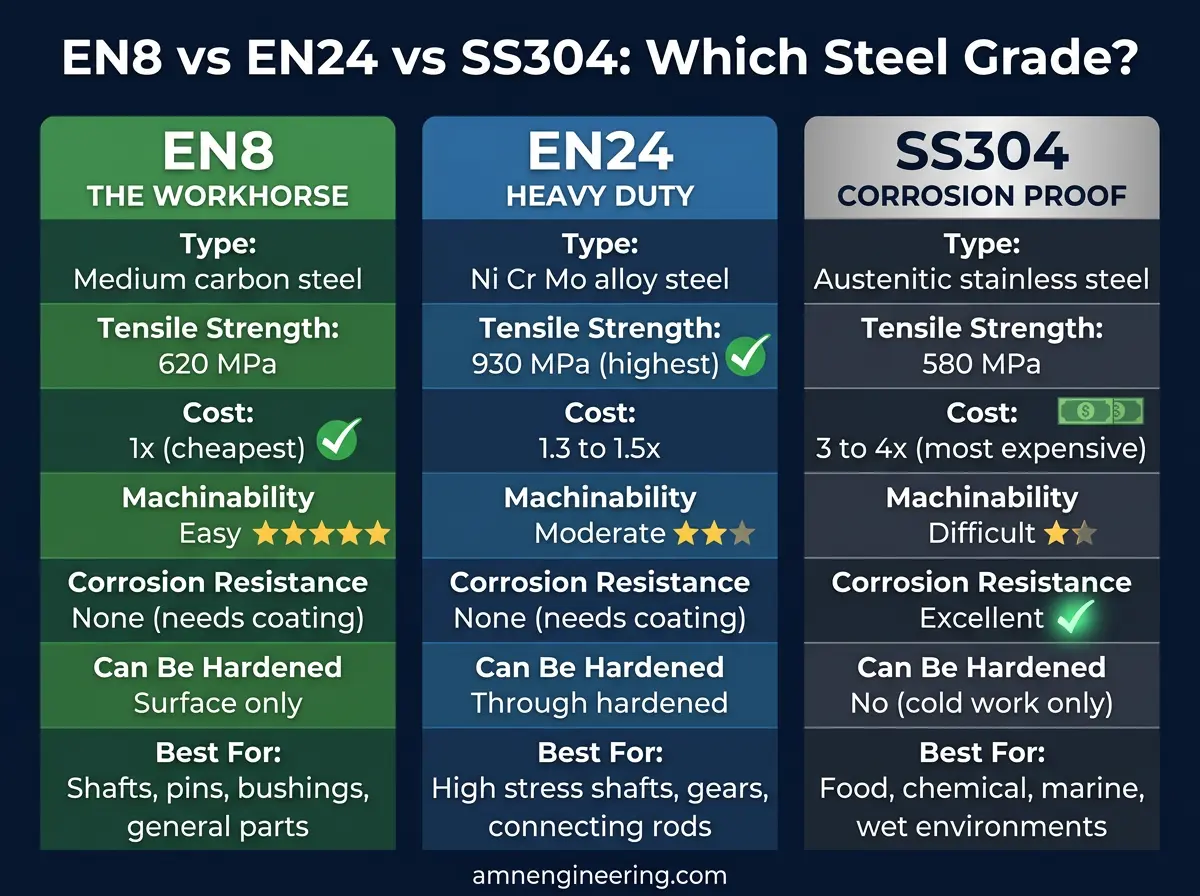
Mechanical Properties Side by Side
| Property | EN8 | EN24 | SS304 |
|---|---|---|---|
| Tensile Strength | 620 MPa | 930 MPa | 580 MPa |
| Yield Strength | 340 MPa | 740 MPa | 205 MPa |
| Elongation | 16% | 12% | 40% |
| Hardness | 179 to 201 HB | 269 to 302 HB | 123 to 201 HB |
| Impact Strength | Moderate | High | Very high |
| Fatigue Limit | Moderate | High | Moderate |
Key takeaway: EN24 is roughly 50% stronger than EN8 in both tensile and yield strength. SS304 is the most ductile of the three (40% elongation) but has the lowest yield strength at 205 MPa.
Cost Comparison
Cost is often the deciding factor. Here is how the three grades compare across raw material, machining, and total part cost:
| Cost Factor | EN8 | EN24 | SS304 |
|---|---|---|---|
| Raw Material Cost | 1.0x | 1.3 to 1.5x | 3 to 4x |
| Machining Cost | 1.0x | 1.1 to 1.2x | 1.3 to 1.5x |
| Total Part Cost | 1.0x | 1.2 to 1.4x | 2 to 3x |
Real example: A part that costs $10 in EN8 would cost approximately $12 to $14 in EN24, and $20 to $30 in SS304.
When Is the Extra Cost Justified?
EN24 is justified when EN8 would fail under the operating conditions. If your part is subject to high stress, shock, or fatigue and EN8 does not have enough strength, spending 20 to 40 percent more on EN24 is far cheaper than replacing a failed part.
SS304 is justified when the alternative is EN8 plus galvanizing or other coating, and that coating would be damaged or insufficient in the operating environment. If the coating will be scratched, worn, or chemically attacked, you will spend more on repeated recoating than you would on stainless steel upfront.
How to Choose: A Simple Decision Process
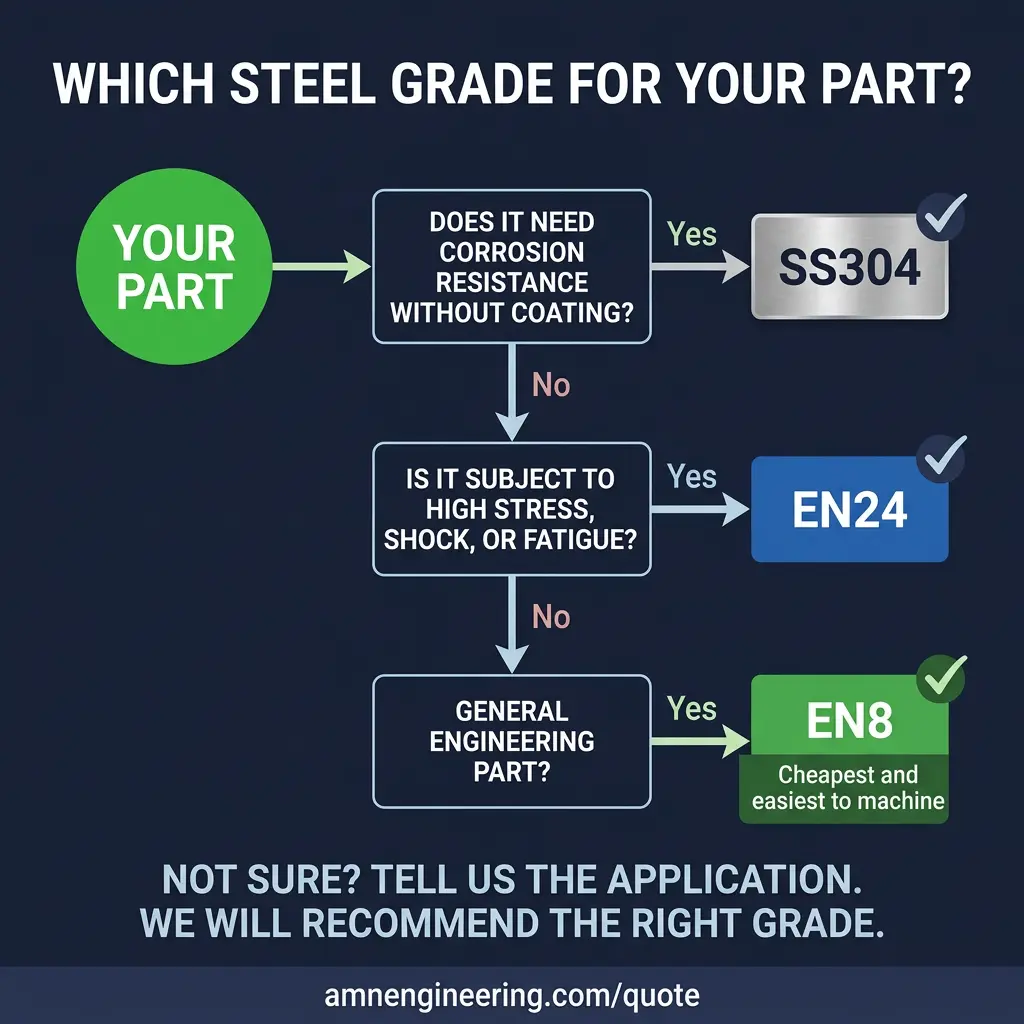
Ask yourself these three questions in order:
Question 1: Does your part need to resist corrosion without a coating?
Yes: Use SS304. No: Go to Question 2.
Question 2: Is your part subject to high stress, shock loads, or fatigue?
Yes: Use EN24. No: Go to Question 3.
Question 3: Is this a general engineering component?
Yes: Use EN8.
That three step process will give you the right answer for the vast majority of machined parts.
Still not sure? Send us your drawing on WhatsApp with your operating conditions. We machine all three grades every day and can recommend the best option for your specific application.
Frequently Asked Questions
EN8 is a medium carbon steel (0.4% carbon) used for general engineering applications. EN24 is a nickel chromium molybdenum alloy steel with much higher strength and toughness, used for heavy duty and high stress applications. EN24 is roughly 30 to 50 percent stronger than EN8 and can be hardened to higher levels, but it costs more and is slightly harder to machine.
Use SS304 (stainless steel 304) when your part will be exposed to moisture, chemicals, or corrosive environments. SS304 does not rust and requires no surface treatment like galvanizing or painting. It is commonly used in food processing, pharmaceutical, marine, and chemical applications where corrosion resistance is essential.
EN8 is the cheapest of the three. It typically costs 40 to 60 percent less than EN24 and 60 to 70 percent less than SS304. For general engineering parts where extreme strength or corrosion resistance is not required, EN8 offers the best value.
Yes. EN8 can be surface hardened (flame or induction hardening) to achieve a hard wear resistant surface while keeping a tough core. However, EN8 cannot be through hardened to the same levels as EN24. For parts needing high overall hardness (above 40 HRC), EN24 is the better choice.
EN8 is the most commonly used medium carbon steel in general engineering. Common applications include shafts, axles, bolts, studs, connecting rods, bushings, gears (non high stress), hydraulic cylinder rods, and machine components. It offers a good balance of strength, machinability, and cost for parts that are not subject to extreme stress or corrosion.
EN8 is roughly equivalent to AISI 1040 (BS designation 080M40) and EN24 is roughly equivalent to AISI 4340 (BS designation 817M40). SS304 is the same material as AISI 304, also known as A2 stainless.