Metal Stamping vs Laser Cutting: When Each Process Wins
By Adil, Managing Director at AMN Engineering · · 6 min read
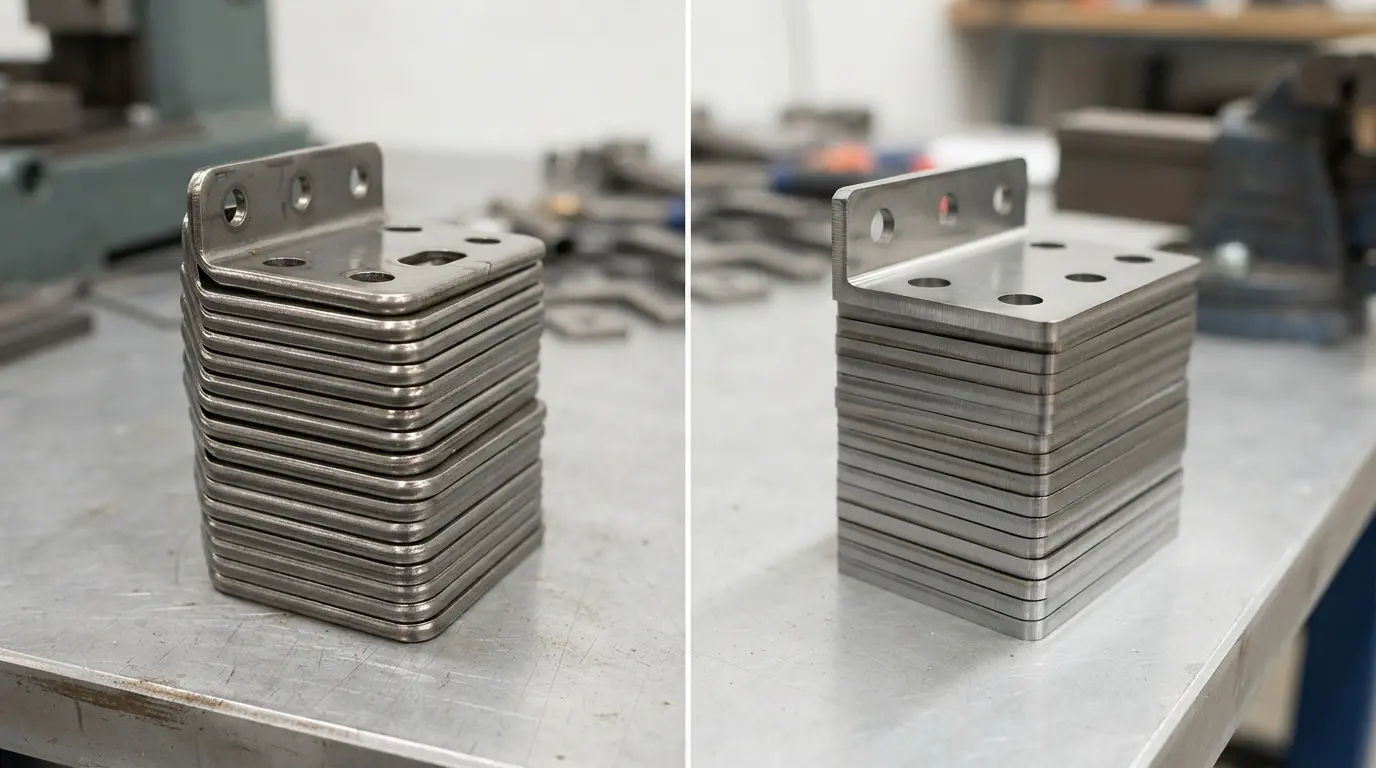
Metal stamping vs laser cutting. Two ways to make flat parts from sheet metal, and the right choice depends almost entirely on one thing: how many parts do you need?
At low volumes, laser wins. At high volumes, stamping wins. The crossover point is where the decision gets interesting. This guide explains exactly where that point is and what other factors affect the decision.
The Quick Rule
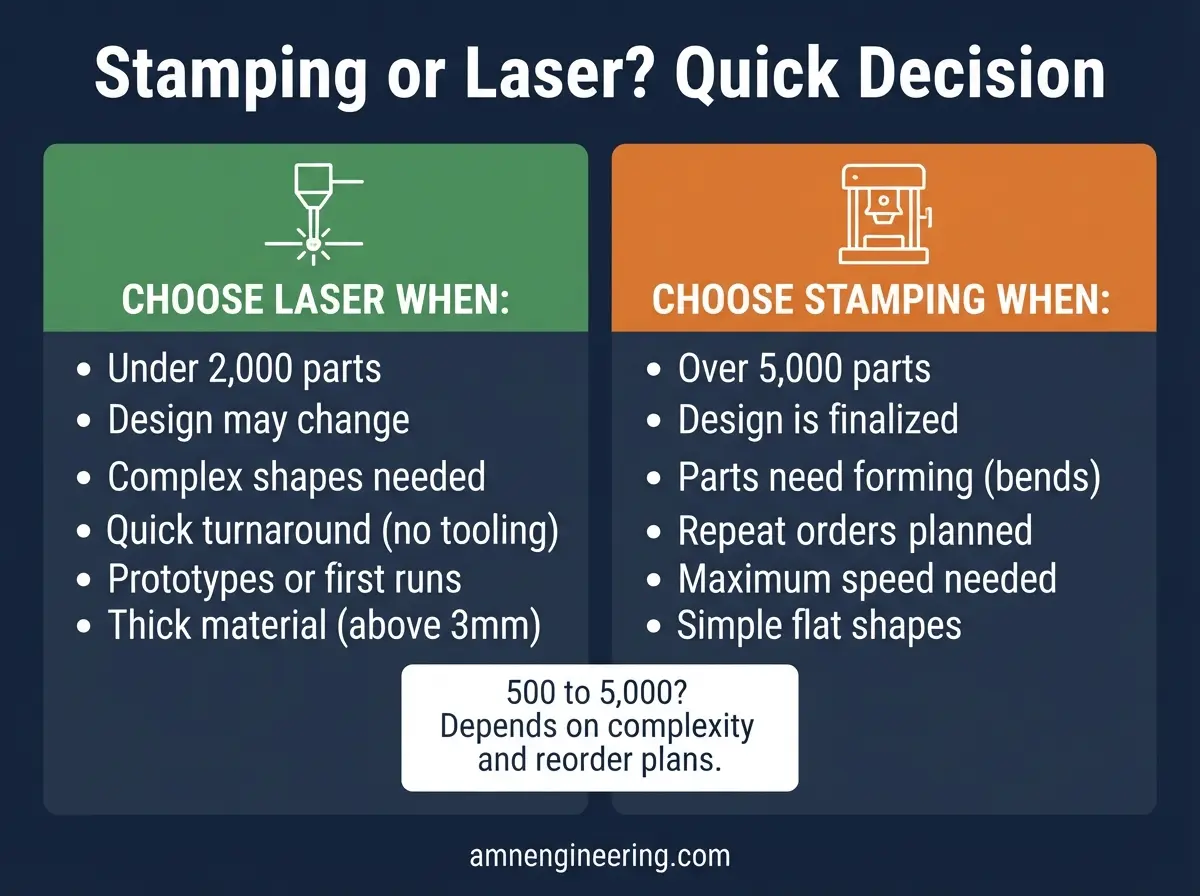
Under 500 parts: Laser cutting. No tooling cost. Fast setup. Change the design for free.
Over 5,000 parts: Stamping. Lower cost per part. Faster production. Tooling cost justified.
500 to 5,000 parts: It depends on part complexity, material, and how often you reorder. Read on.
How Metal Stamping Works
Metal stamping uses a press and a hardened steel die to punch, bend, or form sheet metal into the desired shape. The die is custom made for your specific part. Once the die is installed, every stroke of the press produces a finished part in seconds.
Stamping Strengths
- Extremely fast (100 to 1,000+ parts per hour)
- Very low cost per part at high volumes
- Consistent, repeatable parts
- Can combine cutting, bending, and forming in one stroke (progressive die)
- No heat affected zone
Stamping Limitations
- High tooling cost ($1,000 to $20,000+ per die)
- Design changes require new or modified tooling
- Only works with sheet metal (typically under 6mm)
- Not economical for small batches
How Laser Cutting Works
Laser cutting uses a focused laser beam to cut through sheet metal along a programmed path. No physical tool touches the material. The design is a digital file (DXF) that the machine follows.
Laser Cutting Strengths
- Zero tooling cost (design is a digital file)
- Design changes are free and instant (just modify the file)
- Excellent edge quality (no grinding needed)
- Handles complex shapes, small holes, and intricate details
- Economical from 1 piece to several hundred
Laser Cutting Limitations
- Slower than stamping at high volumes
- Higher cost per part at 5,000+ quantities
- Cannot form or bend (cutting only)
- Heat affected zone (very small but present)
The Full Comparison
| Factor | Metal Stamping | Laser Cutting |
|---|---|---|
| Tooling Cost | High ($1K to $20K+) | Zero |
| Cost per Part (low volume) | Very high (tooling amortized over few parts) | Low |
| Cost per Part (high volume) | Very low | Higher |
| Speed | 100 to 1,000+ parts/hour | 50 to 200 parts/hour (depends on size) |
| Edge Quality | Good (may have burr) | Excellent (clean, burr free) |
| Design Flexibility | None (die is fixed) | Total (change the file anytime) |
| Complexity | Limited by die design | Nearly unlimited |
| Forming Capability | Yes (bend, draw, emboss) | No (cutting only) |
| Material Thickness | Up to 6mm typical | Up to 20mm+ (depends on laser power) |
| Minimum Quantity | 1,000+ to justify tooling | 1 piece |
| Lead Time (first order) | 2 to 6 weeks (die making) | 1 to 2 weeks (no tooling) |
| Design Changes | Expensive (new die) | Free (new file) |
Cost: The Crossover Point
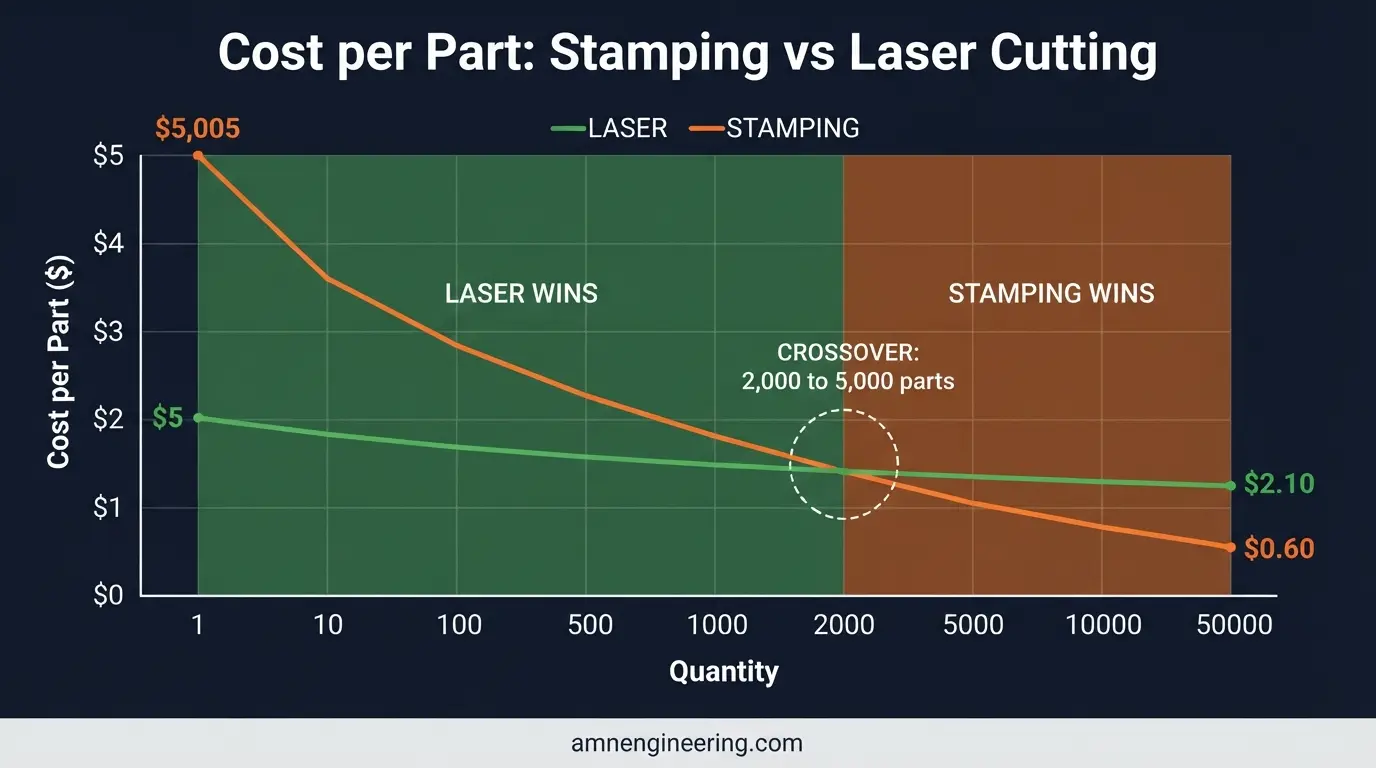
Here is a simplified cost comparison for a typical bracket (100mm x 50mm, 2mm mild steel):
| Quantity | Laser Cost per Part | Stamping Cost per Part | Winner |
|---|---|---|---|
| 1 | $5 | $5,005 (tooling) | Laser |
| 10 | $4 | $504 | Laser |
| 100 | $3.50 | $53 | Laser |
| 500 | $3 | $13 | Laser |
| 1,000 | $2.80 | $8 | Laser (barely) |
| 2,000 | $2.50 | $5 | Close |
| 5,000 | $2.30 | $2 | Stamping |
| 10,000 | $2.20 | $1.20 | Stamping |
| 50,000 | $2.10 | $0.60 | Stamping (clear win) |
The crossover point is typically around 2,000 to 5,000 parts, depending on part complexity and die cost. Below that, laser is cheaper. Above that, stamping's per unit advantage overcomes the tooling investment.
Key insight: If you reorder the same part multiple times, the stamping die is a one time cost. Your second and third orders are pure production cost. This makes stamping increasingly attractive for repeat orders.
When to Choose Each Process
Choose Stamping When:
- You need 5,000+ identical parts (or 2,000+ with planned reorders)
- The part needs forming (bends, draws, embosses) in addition to cutting
- Production speed matters (hundreds of parts per hour)
- The design is finalized and unlikely to change
- You are making washers, clips, brackets, electrical contacts, or similar high volume parts
- You plan to reorder the same part regularly
Choose Laser Cutting When:
- You need 1 to 2,000 parts (or any quantity where design may change)
- The part has complex geometry (intricate cutouts, small holes, tight radii)
- You need quick turnaround (no tooling lead time)
- Edge quality matters and you want to skip grinding
- You are making prototypes, first production runs, or custom one off parts
- You need parts from thicker material (above 3mm)
Can You Use Both?
Yes. Some parts benefit from a combined approach: laser cut the blank (profile) and then stamp the forming features (bends, embosses). This works well when you need the shape flexibility of laser cutting but also need formed features that only stamping can produce.
At AMN Engineering, we offer both stamping and laser cutting in house, plus metal fabrication for bending and welding. We recommend the most cost effective approach based on your quantity and design.
Frequently Asked Questions
Laser cutting is cheaper under 2,000 parts because there is no tooling cost. Stamping is cheaper above 5,000 parts because the per unit cost drops dramatically at volume.
For cutting, yes. For forming (bending, drawing, embossing in the die), no. If your part only needs cutting, laser can replace stamping at any volume where the cost comparison works.
2 to 6 weeks depending on complexity. This is why laser cutting is preferred for urgent orders.
You will need a modified or new die, which costs 20 to 50% of the original die price. With laser cutting, design changes are free.