How to Read a Material Test Certificate (MTC): A Buyer’s Guide
By Adil, Managing Director at AMN Engineering · · 7 min read
A material test certificate (MTC) is one of the most important documents in manufacturing, and one of the least understood by buyers. It proves that the steel or alloy used in your parts is actually what you specified. Without it, you are trusting that the manufacturer used the right material based on their word alone.
This guide teaches you how to read an MTC step by step: what each section means, what numbers to check, and what red flags to look for. Once you understand MTCs, you can verify material quality in under 2 minutes.
We include material test certificates with every shipment at AMN Engineering as standard, not only when requested. This guide explains why that matters and how to use the information.
What Is a Material Test Certificate?
A material test certificate (also called a mill test certificate, mill cert, or MTC) is a document issued by the steel mill or material supplier that records the chemical composition and mechanical properties of a specific batch (heat) of material.
It proves two things:
- What the material is (chemical composition matches the specified grade)
- How strong the material is (mechanical properties meet the grade requirements)
Every heat of steel produced at a mill is tested and certified. The MTC is traceable to that specific heat, meaning you can connect the certificate to the exact batch of metal your parts were made from.
Types of Certificates: EN 10204
The international standard EN 10204 defines different types of inspection documents:
| Type | Name | What It Means | Reliability |
|---|---|---|---|
| 2.1 | Declaration of compliance | Manufacturer states material meets spec. No test data. | Lowest |
| 2.2 | Test report | Manufacturer provides test data from non specific testing. | Low |
| 3.1 | Inspection certificate | Independent testing of the ACTUAL material. Traceable to heat number. | High |
| 3.2 | Inspection certificate with independent validation | 3.1 plus verified by an independent third party. | Highest |
For most engineering applications, you should request a 3.1 certificate. This gives you actual test data (chemical composition and mechanical properties) from the specific heat of material used in your parts. It is traceable, verifiable, and legally meaningful.
A 2.1 certificate is essentially just a statement saying "yes, it meets spec" without any test data to back it up. It provides very little assurance.
How to Read an MTC: Section by Section
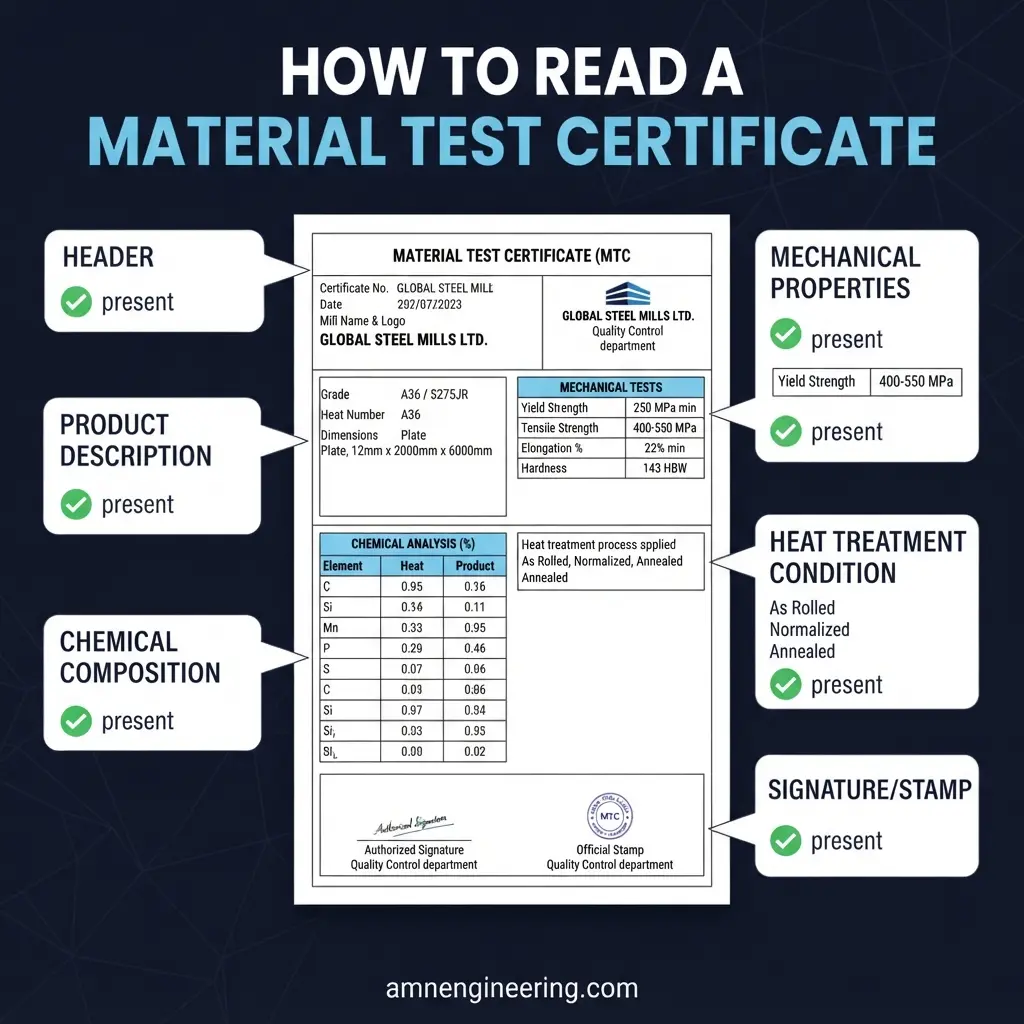
A typical MTC contains these sections:
1. Header Information
- Certificate number: Unique identifier for this certificate
- Date of issue: When the certificate was created
- Steel mill/producer name: Who made the material
- Customer/order reference: The purchase order this material was supplied against
2. Product Description
- Material grade: The standard and grade (e.g., EN8 / 080M40, EN24 / 817M40, SS304)
- Product form: Bar, plate, sheet, tube, billet
- Dimensions: Diameter, thickness, width, length of the supplied material
- Quantity/weight: How much material was supplied
- Heat number: The unique identifier for the specific melt/batch. This is the traceability link.
3. Chemical Composition
A table showing the percentage of each element in the steel:
| Element | Symbol | Typical for EN8 |
|---|---|---|
| Carbon | C | 0.36 to 0.44% |
| Silicon | Si | 0.10 to 0.40% |
| Manganese | Mn | 0.60 to 1.00% |
| Phosphorus | P | 0.050% max |
| Sulfur | S | 0.050% max |
| Chromium | Cr | Residual |
| Nickel | Ni | Residual |
The actual values from testing are listed alongside the specification limits. All actual values must fall within the specified range for the grade.
4. Mechanical Properties
Test results from physical testing of the material:
| Property | What It Measures | Typical for EN8 |
|---|---|---|
| Tensile Strength (Rm) | Maximum force before breaking | 550 to 700 MPa |
| Yield Strength (ReH or Rp0.2) | Force at which permanent deformation starts | 280 to 350 MPa |
| Elongation (A) | How much the material stretches before breaking | 16% minimum |
| Hardness (HB) | Resistance to indentation | 170 to 210 HB |
| Impact (KV) | Energy absorbed before fracturing | Where specified |
5. Heat Treatment Condition
States whether the material was supplied in: normalized, annealed, quenched and tempered, or as rolled condition. This affects the mechanical properties.
6. Stamp/Signature
The authorized signatory from the mill or testing laboratory. On a 3.1 certificate, this must be signed by someone independent of the production department.
What to Check First
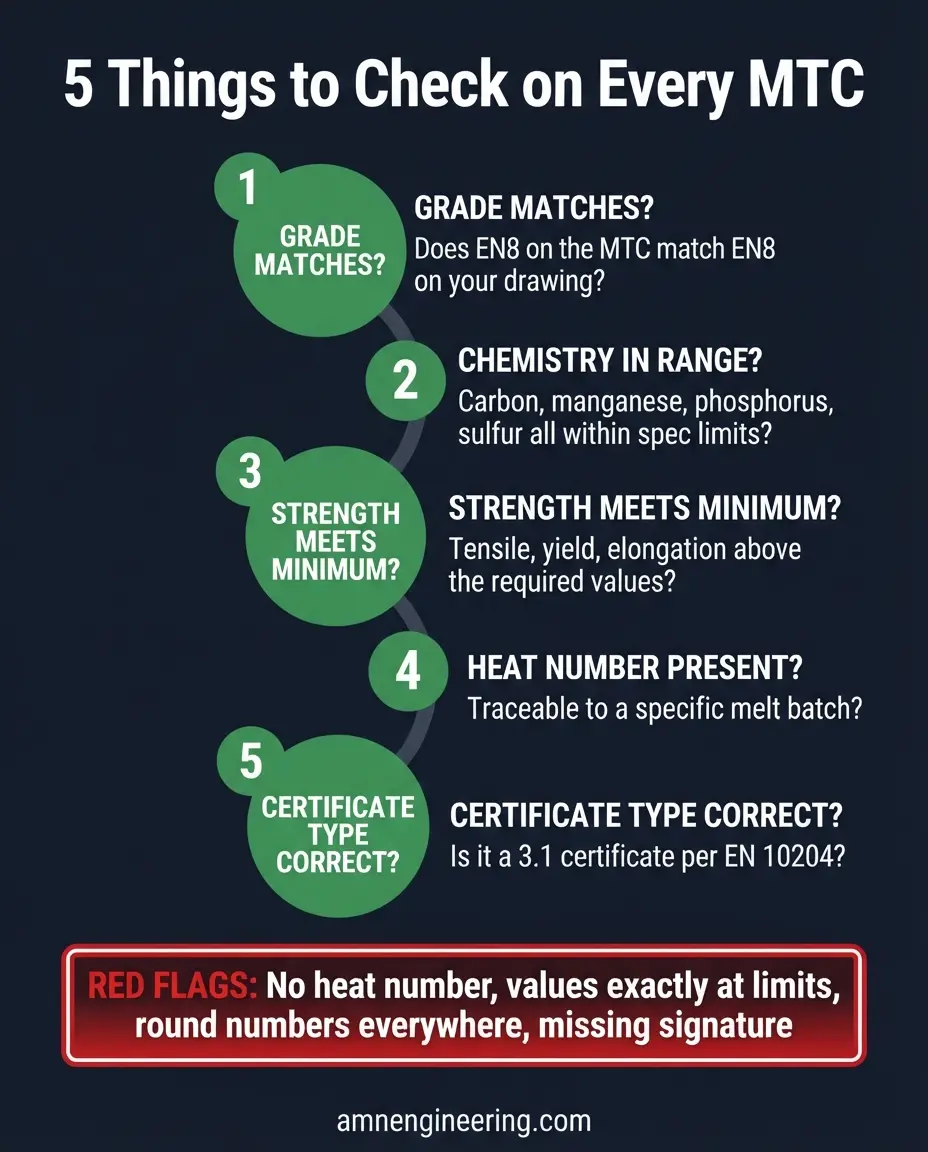
When you receive an MTC, check these five things in order:
Check 1: Does the Grade Match Your Specification?
The material grade on the MTC must match what you ordered. If you specified EN8, the MTC should say 080M40, EN8, C40, or the equivalent designation. If it says something different, stop immediately.
Check 2: Is the Chemical Composition Within Range?
Every element must fall within the specification limits for the grade. Pay special attention to carbon content (affects strength and machinability) and sulfur/phosphorus (high values indicate lower quality steel).
Check 3: Do the Mechanical Properties Meet Minimum Values?
Tensile strength, yield strength, and elongation must all meet or exceed the minimum values specified for the grade and condition. If tensile strength is below the minimum, the material is out of spec.
Check 4: Is There a Heat Number?
The heat number is the traceability link. Without it, the certificate is essentially untraceable and could apply to any batch. Every legitimate MTC has a heat number.
Check 5: Is the Certificate Type Correct?
Confirm it is a 3.1 certificate (or whatever type you requested). A 2.1 "declaration of compliance" looks similar but provides no actual test data.
Red Flags That Indicate a Problem
- No heat number. Without traceability, the certificate could be generic or fabricated.
- Values exactly at the specification limits. Real test results vary. If every value is exactly at the minimum or maximum, the certificate may have been manufactured rather than tested.
- Round numbers everywhere. Real test results include decimal places (e.g., Tensile 628 MPa, not 600 MPa). Suspiciously round numbers suggest the data is estimated.
- Certificate date before the order date. The MTC should correspond to the material used for your order. A certificate dated years before your order may have been reused from a different batch.
- Missing signature or stamp. A legitimate 3.1 certificate has an authorized signature.
- Photocopied or blurry. While photocopies are common, excessively blurry or altered looking documents warrant verification with the mill.
Real Example Walkthrough
You ordered 500 CNC machined shafts in EN8 steel. The MTC arrives with your shipment. Here is what you check:
Grade: "080M40 to BS 970" ✓ (This is the correct designation for EN8)
Heat number: "H24851" ✓ (Traceable to a specific melt)
Chemical composition:
- Carbon: 0.41% ✓ (Within 0.36 to 0.44 range)
- Manganese: 0.78% ✓ (Within 0.60 to 1.00 range)
- Phosphorus: 0.018% ✓ (Below 0.050 max)
- Sulfur: 0.022% ✓ (Below 0.050 max)
Mechanical properties (normalized condition):
- Tensile: 638 MPa ✓ (Above 550 minimum)
- Yield: 352 MPa ✓ (Above 280 minimum)
- Elongation: 19% ✓ (Above 16% minimum)
Certificate type: 3.1 per EN 10204 ✓
Signature: Present with company stamp ✓
Verdict: Material is genuine EN8, meets all specification requirements, and is traceable. Your shafts are made from the right material.
Frequently Asked Questions
A document from the steel mill showing the chemical composition and mechanical properties of a specific batch of material. It proves the material meets the specified grade and is traceable to a specific heat number.
The most commonly requested certificate type. It provides actual test data from the specific material batch, signed by an authorized representative independent of production. It gives reliable, traceable proof of material properties.
Grade matches your specification, chemical composition within range, mechanical properties meet minimums, heat number present, and correct certificate type.
Yes. For any engineering application where material grade matters (which is nearly all of them), request MTCs as standard with every shipment. A manufacturer who does not provide MTCs may not be checking incoming material.
Reject the material or parts immediately. Notify the manufacturer. Do not use parts made from out of spec material, even if they look correct. The wrong grade may have different strength, hardness, or corrosion properties that could cause failure in service.