How CNC Machines Work: A Buyer's Guide to Understanding the Process
By Adil, Managing Director at AMN Engineering · · 8 min read
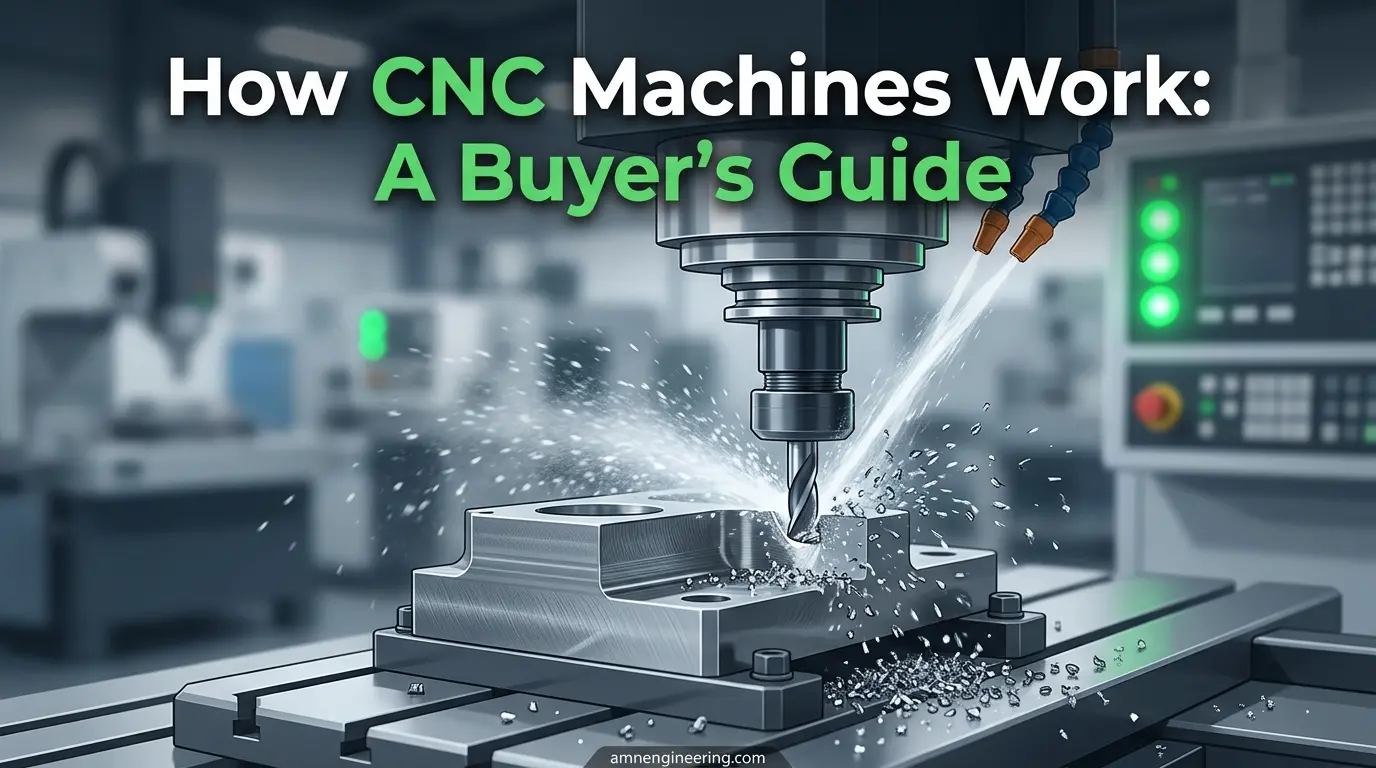
If you source custom manufactured parts, understanding how CNC machines work helps you write better drawings, get faster quotes, and avoid costly mistakes. In simple terms, a CNC machine is a cutting tool controlled by a computer that reads coded instructions and shapes raw material into a finished part with exact, repeatable accuracy.
This guide explains how CNC machines work step by step, the different types of CNC equipment, how a part travels from a CAD file to your hands, and what every buyer should know before placing an order.
At AMN Engineering we have operated CNC turning and CNC milling machines in Lahore, Pakistan since 1999, producing custom parts for clients across the GCC, Europe, and the USA. What follows comes from decades on the shop floor.
What Is CNC Machining?
CNC stands for Computer Numerical Control. In simple terms, a CNC machine is a cutting tool controlled by a computer. The computer reads a set of coded instructions and moves the cutting tool, or the workpiece, to remove material and create the desired shape.
Before CNC, machinists operated machines by hand, turning wheels and levers to move the cutting tool. This was slow and required years of skill. CNC machines do the same job automatically, faster, and with much higher accuracy. A CNC machine can repeat the same part thousands of times with the exact same dimensions every time.
CNC machining is one of the most widely used manufacturing processes in the world. It produces parts for everything from pumps and valves to automotive components, aerospace fittings, and medical devices. At AMN Engineering, we use CNC turning and CNC milling to produce custom parts for clients across the GCC, Europe, and USA.
How CNC Machines Work Step by Step
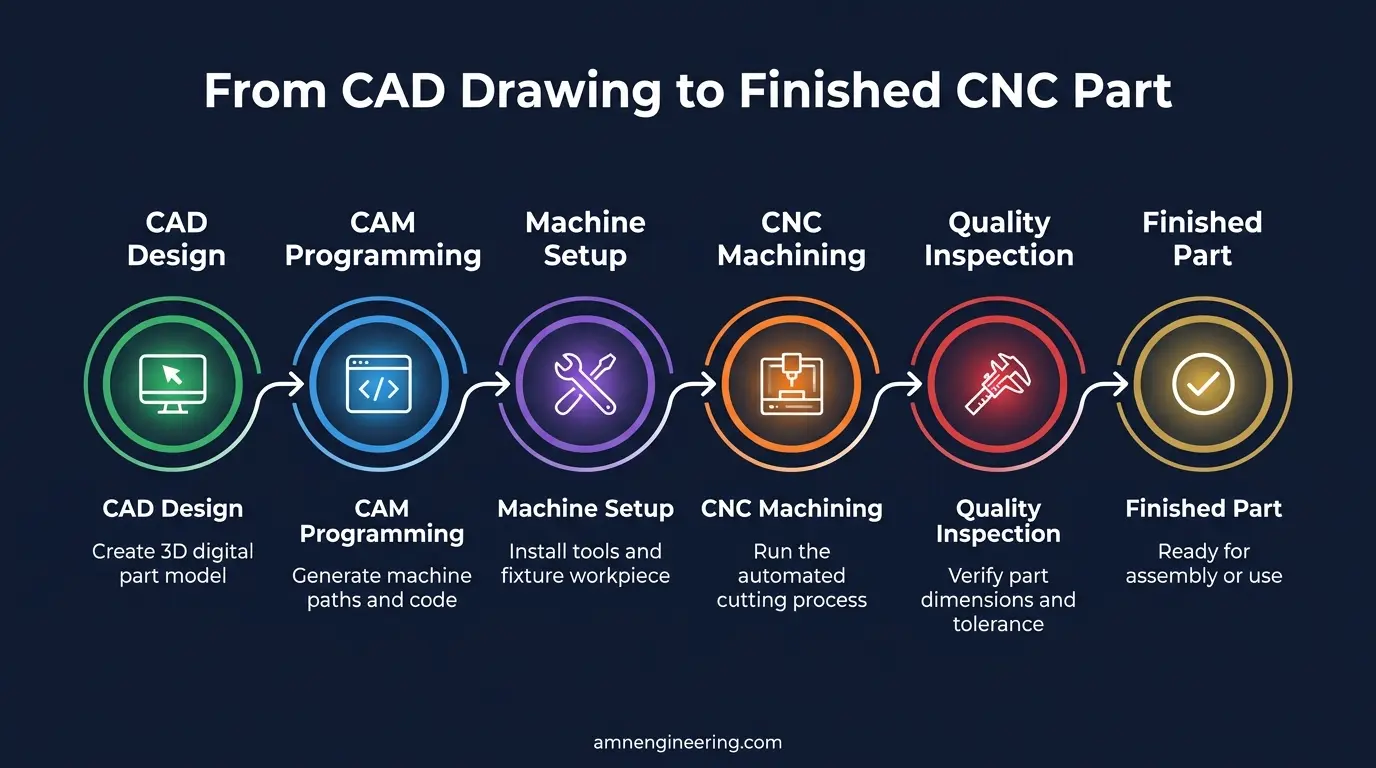
Here is a simplified explanation of how CNC machines work, from the digital file to the finished metal part.
Step 1: Create the Design (CAD)
Everything starts with a computer design. An engineer creates a 3D model of the part using CAD (Computer Aided Design) software such as SolidWorks, AutoCAD, or Fusion 360. This model defines every dimension, angle, hole, and surface of the part.
Step 2: Generate the Toolpath (CAM)
The CAD file is loaded into CAM (Computer Aided Manufacturing) software. The CAM software plans the cutting path, meaning the exact route the cutting tool will follow to shape the raw material into the finished part. It also selects cutting speeds, feed rates, and tool changes.
Step 3: Convert to G Code
The CAM software outputs a G code file. G code is the language CNC machines understand. Each line of G code tells the machine exactly where to move, how fast to move, and what to do (cut, drill, change tools, and so on).
Step 4: Set Up the Machine
The machine operator loads the raw material (a metal bar, block, or plate) into the machine and secures it using a chuck, vise, or fixture. The operator also loads the correct cutting tools into the tool magazine.
Step 5: Run the Program
The operator loads the G code program into the CNC controller and starts the machine. The computer takes over, moving the cutting tool and workpiece precisely according to the programmed instructions. The machine removes material layer by layer until the part reaches its final shape.
Step 6: Inspect the Part
After machining, the part is measured and inspected to verify that all dimensions meet the drawing specifications. At AMN Engineering, we check critical features using calibrated micrometers, calipers, gauges, and other precision instruments.
What Is G Code?
G code is the programming language that tells a CNC machine what to do. Every movement, every cut, and every tool change is controlled by lines of G code.
Here is what a simple G code command looks like:
G01 X50.0 Y25.0 F200
This line tells the machine to move in a straight line (G01) to position X50.0, Y25.0 at a feed rate of 200 millimeters per minute (F200).
As a buyer, you do not need to understand G code. Your manufacturer’s programming team handles this. What you need to provide is a clear CAD file (STEP, IGES, or DXF format) with accurate dimensions and tolerances. The CAM software and the CNC programmer take care of the rest.
Some common G code commands:
| Code | What It Does |
|---|---|
| G00 | Rapid movement (non cutting) |
| G01 | Linear cutting movement |
| G02 | Circular movement (clockwise) |
| G03 | Circular movement (counterclockwise) |
| M03 | Start spindle rotation |
| M05 | Stop spindle rotation |
| M06 | Tool change |
| M30 | End of program |
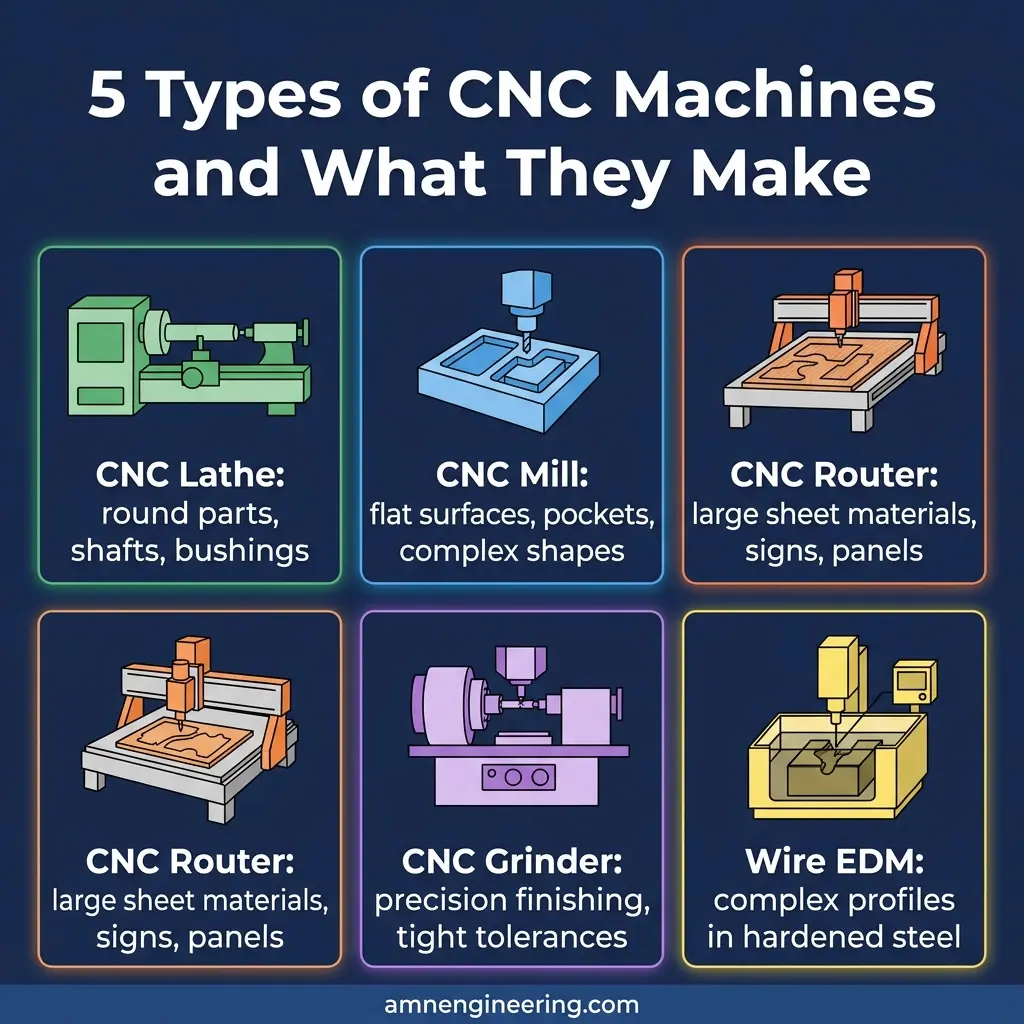
Types of CNC Machines
Different parts require different types of CNC machines. Here are the most common ones you will encounter when sourcing manufactured parts.
CNC Lathe (Turning)
A CNC lathe rotates the workpiece while a cutting tool moves along it to remove material. Lathes are ideal for round or cylindrical parts such as shafts, pins, bushings, couplings, and threaded fittings.
Best for: round parts, shafts, tubes, threaded components. Materials: steel, stainless steel, aluminum, brass, copper. For a full comparison, see CNC turning vs CNC milling.
CNC Milling Machine
A CNC mill holds the workpiece still (or on a rotating table) while the cutting tool rotates and moves across it. Mills are versatile and can create flat surfaces, pockets, slots, holes, and complex 3D shapes.
Best for: flat parts, housings, brackets, plates, complex geometries. Materials: all metals and most engineering plastics.
CNC Router
A CNC router is similar to a milling machine but typically works on larger, flatter workpieces. Routers are common in woodworking, sign making, and cutting sheet materials like aluminum and acrylic.
Best for: large flat panels, signs, sheet cutting. Materials: wood, plastic, aluminum, composite materials.
CNC Grinder
A CNC grinder uses an abrasive wheel to remove very small amounts of material and achieve extremely smooth surfaces and tight tolerances. Grinding is often a finishing operation after initial machining.
Best for: precision surfaces, tight tolerances (plus or minus 0.005mm), hardened materials. Materials: hardened steel, tool steel, ceramic. Read more about our precision grinding service.
Wire EDM (Electrical Discharge Machining)
Wire EDM cuts metal using a thin wire that carries an electrical charge. The wire does not touch the workpiece. Instead, electrical sparks erode the material. EDM can cut extremely hard materials and create intricate shapes that conventional cutting cannot achieve.
Best for: hardened steel, intricate shapes, tight corners, thin walls. Materials: any electrically conductive metal.
From CAD File to Finished Part
As a buyer, here is the typical journey your part takes from your screen to your hands.
- You send a drawing or CAD file. The best formats are STEP (.stp), IGES (.igs), or a 2D drawing in DXF or PDF with dimensions. See how to prepare your CAD file for CNC manufacturing.
- The manufacturer reviews your file. The engineering team checks for manufacturability. Can this part be made on available machines? Are the tolerances achievable? Is the material available?
- You receive a quotation. The quote includes material cost, machining time, setup cost, finishing (if needed), and delivery timeline.
- Programming and setup. Once approved, the CNC programmer creates the G code and the machine operator sets up the raw material and tooling.
- Machining. The CNC machine runs the program. Simple parts may take minutes. Complex parts with multiple operations may take hours.
- Secondary operations. Depending on the part, additional steps may include grinding, threading, heat treatment, or surface finishing.
- Quality inspection. Every critical dimension is measured and documented. At AMN Engineering, we provide material test certificates and inspection reports with every order.
- Packing and shipping. Parts are packed securely and shipped to your location. We ship regularly to the GCC, Europe, and the United States.
What Materials Can CNC Machines Cut?
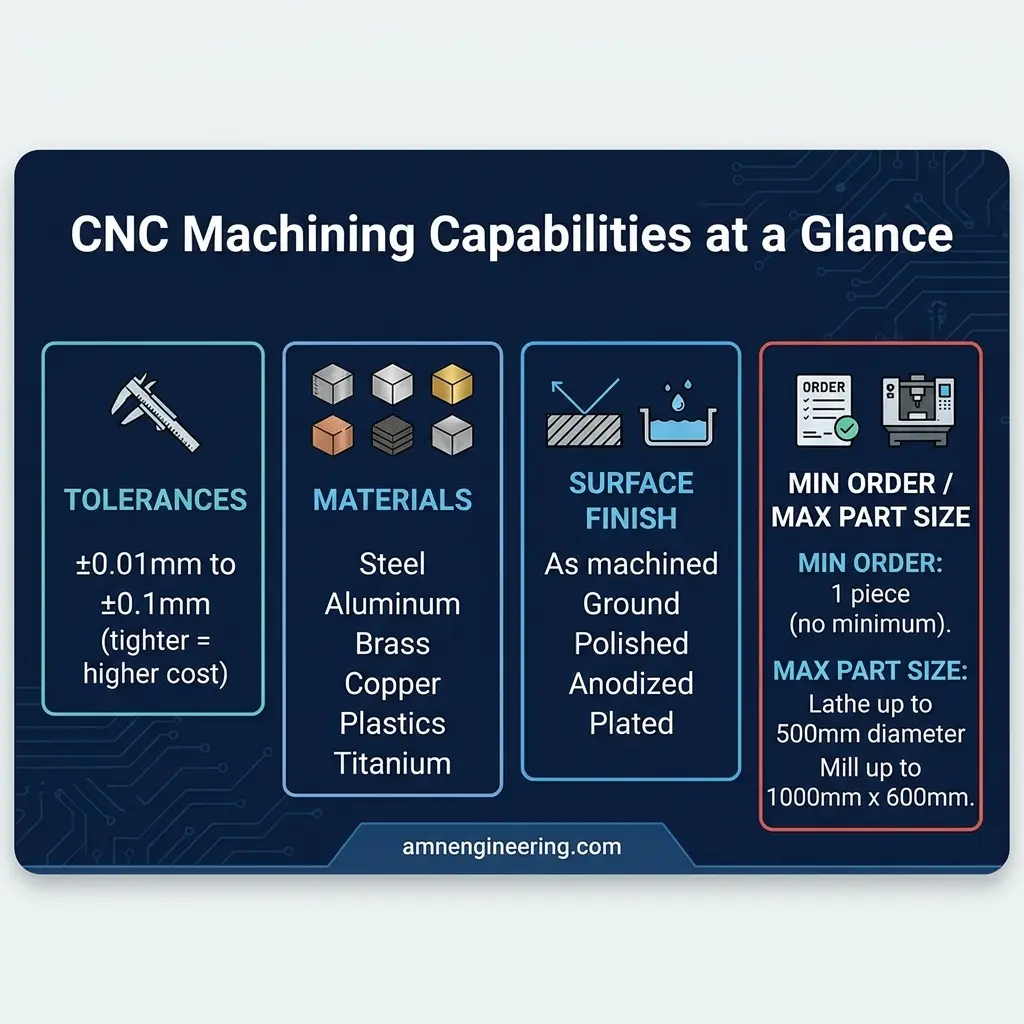
CNC machines can work with a wide range of materials. The most commonly machined materials include:
| Material | Common Applications |
|---|---|
| Mild Steel (EN8, EN3) | Shafts, brackets, general components |
| Alloy Steel (EN24, EN19) | High strength parts, gears, axles |
| Stainless Steel (SS304, SS316) | Corrosion resistant parts, food industry, marine |
| Aluminum (6061, 7075) | Lightweight parts, enclosures, aerospace |
| Brass | Fittings, valves, electrical connectors |
| Copper | Electrical components, heat sinks |
| Nylon, PEEK, Delrin | Bushings, insulators, low friction parts |
The choice of cutting tools and speeds depends on the material. Harder materials cut more slowly and wear tooling faster, which affects both lead time and cost.
Accuracy and Tolerances
One of the biggest advantages of CNC machining is precision. Here is what you can expect.
| Tolerance Level | Typical Range | When Used |
|---|---|---|
| Standard | plus or minus 0.1mm to 0.05mm | General machining, non critical features |
| Precision | plus or minus 0.05mm to 0.02mm | Mating parts, bearing fits, assemblies |
| High Precision | plus or minus 0.02mm to 0.01mm | Aerospace, medical, critical rotating parts |
| Ultra Precision | plus or minus 0.005mm or tighter | Achieved with grinding after CNC machining |
Tighter tolerances cost more because they require slower cutting speeds, more frequent tool changes, and additional inspection time. Our engineers can help you specify the right tolerance for each feature so you get the quality you need without paying for unnecessary precision. For a plain English explanation, read our machining tolerance visual guide.
What Buyers Should Know About CNC
If you are sourcing CNC machined parts for the first time, here are a few tips that will help you get better results and faster quotes.
Send a clear drawing. Include all dimensions, tolerances, material specification, surface finish requirements, and quantity. The more detail you provide, the faster and more accurate your quote will be.
Use standard file formats. STEP (.stp) is the most universal 3D format. For 2D drawings, use DXF or PDF. Avoid proprietary formats that your manufacturer may not be able to open.
Specify only the tolerances you need. Tighter tolerances cost more. If a feature does not affect fit or function, leave it at standard tolerance (plus or minus 0.1mm).
Consider the batch size. CNC machining has a setup cost for each job. A single prototype will cost more per piece than a batch of 100 because the setup cost is spread across more parts. For more ways to save, read how to reduce CNC machining cost.
Ask about secondary operations. Many parts need threading, grinding, heat treatment, or surface finishing after CNC machining. Ask your manufacturer if they offer these in house. At AMN Engineering, we handle all secondary operations under one roof, which saves time and cost.
CNC Machining at AMN Engineering
AMN Engineering has been operating CNC turning and CNC milling machines in Lahore, Pakistan since 1999. We manufacture custom parts from your drawings with no minimum order quantity.
Our CNC capabilities include:
- CNC turning for shafts, pins, couplings, and cylindrical parts
- CNC milling for brackets, housings, plates, and complex shapes
- Threading (BSP, metric, UNC, UNF) on CNC lathes
- Precision grinding for tight tolerance surfaces
What makes us different:
- No minimum order: we machine 1 prototype or 10,000 production parts
- Full service: CNC machining plus welding and fabrication, galvanizing, and more under one roof
- Direct communication via WhatsApp with our factory team
- Material test certificates and inspection reports with every shipment
- Shipping to the GCC in 5 to 7 days, Europe in 14 to 18 days, USA in 20 to 25 days
Frequently Asked Questions
CNC stands for Computer Numerical Control. A computer controls the cutting tool movements based on programmed instructions (G code), replacing the manual operation of each movement.
The most common types are CNC lathes (for round parts), CNC milling machines (for complex shapes), CNC routers (for large flat panels), and CNC grinders (for precision surfaces).
CNC machines run on G code, which is generated from your CAD file. The best formats to send your manufacturer are STEP (.stp), IGES (.igs), DXF, or DWG.
Modern CNC machines hold tolerances as tight as plus or minus 0.01mm for precision work and plus or minus 0.05mm for standard machining. Accuracy depends on the machine, tooling, material, and part design.
A simple part can be machined in minutes. A typical order takes 2 to 4 weeks from drawing approval to delivery, including programming, machining, and inspection.
