How to Reduce CNC Machining Cost: 8 Design Tips That Save Money
By Adil, Managing Director at AMN Engineering · · 7 min read
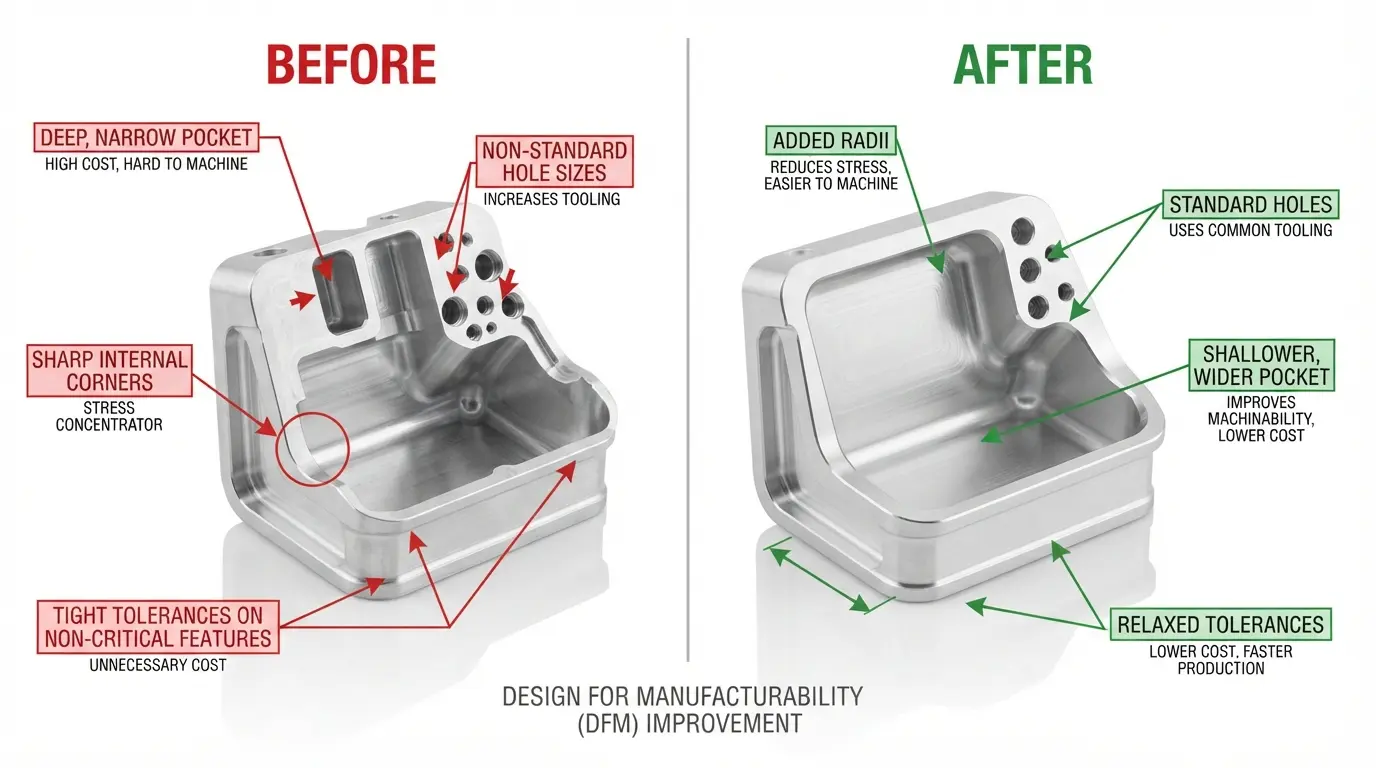
The fastest way to reduce CNC machining cost is not to find a cheaper manufacturer. It is to change the design. Eight simple design adjustments can reduce machining cost by 15 to 40 percent without changing how the part functions.
These tips come from quoting thousands of parts at AMN Engineering. In most cases, the engineer did not realize a small design change would save significant money. Once they did, the result was a better part at a lower price.
Why Design Affects Machining Cost
CNC machining cost is driven by three things: time on the machine (cutting time + setup time), tooling (number of tool changes, special tools), and material (how much billet you start with vs how much becomes the finished part).
Every design feature affects one or more of these cost drivers. A deep pocket takes longer to cut. A tight tolerance requires slower passes. A non standard hole needs a special drill. These small additions compound into significant cost.
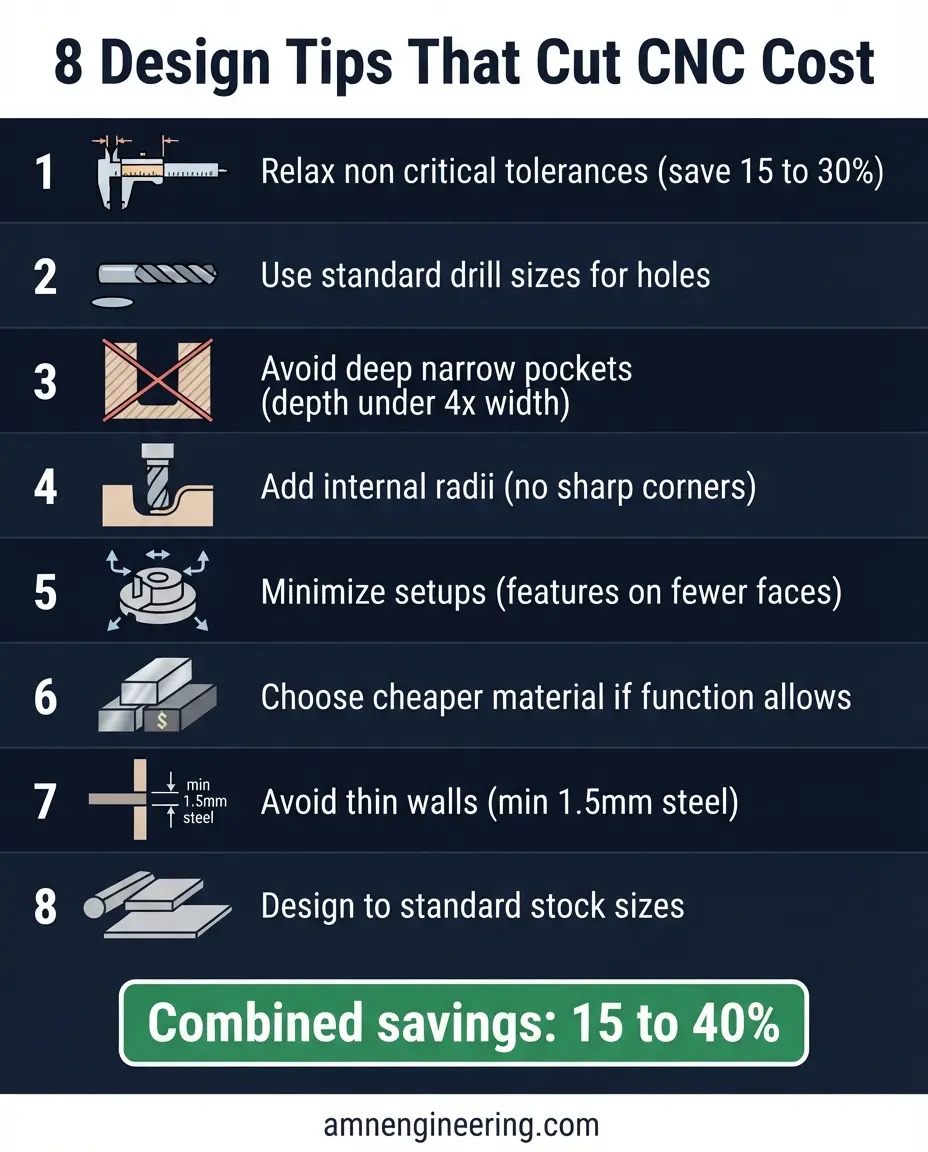
Tip 1: Relax Tolerances on Non Critical Features
This is the single biggest cost saver. Specifying plus or minus 0.02mm on every dimension when only 2 out of 15 dimensions actually need it can double the machining time.
What to do: Specify tight tolerances ONLY on functional surfaces (bearing seats, seal faces, mating surfaces). Use a general tolerance note of plus or minus 0.1mm for everything else.
Savings: 15 to 30 percent reduction in machining time on the tightly toleranced features.
Tip 2: Use Standard Tool Sizes for Holes and Radii
A 10mm hole uses a standard drill. A 10.3mm hole requires a boring operation (slower and more expensive) or a special drill. Standard drill sizes follow a specific progression (1, 2, 3, 4, 5, 6, 8, 10, 12, 14, 16, 18, 20mm etc.).
Similarly, internal corner radii should match standard end mill sizes. A 4mm radius corner is cut with an 8mm end mill (standard). A 4.5mm radius requires a 9mm end mill (non standard, may not be in stock).
What to do: Use standard metric drill sizes for holes. Use radii that match standard end mill diameters (R3 for 6mm mill, R4 for 8mm mill, R5 for 10mm mill).
Savings: Eliminates tool changes to special sizes. Saves 5 to 10 percent on machining time.
Tip 3: Avoid Deep Narrow Pockets
A pocket that is 4 times deeper than it is wide requires a long, thin end mill. Long thin tools deflect, vibrate, and break. The machinist must run at very slow speeds to avoid tool failure, dramatically increasing cycle time.
Rule of thumb: Keep pocket depth less than 4 times the pocket width. If you need a deeper pocket, make it wider.
What to do: If you need a 40mm deep pocket, make it at least 10mm wide. If the pocket must be narrower, consider splitting the part into two pieces and bolting or welding them together.
Savings: Reducing depth to width ratio from 6:1 to 3:1 can cut pocket machining time by 50 percent or more.
Tip 4: Add Internal Radii (No Sharp Corners)
A sharp 90 degree internal corner in a milled pocket is physically impossible to produce with a rotating end mill. The mill is round and always leaves a radius. To achieve a "sharp" corner, the machinist must use a smaller tool and make multiple passes, or use EDM (electrical discharge machining), both of which are expensive.
What to do: Add a radius to every internal corner. A radius equal to the pocket depth divided by 8 is a good starting point. For a 16mm deep pocket, a 2mm corner radius works well.
Savings: Eliminates secondary operations. Saves 10 to 20 percent on pocket features.
Tip 5: Minimize the Number of Setups
Every time the machinist re clamps the part in a different orientation, it adds setup time (5 to 30 minutes depending on complexity). A part with features on 6 faces requires up to 6 setups on a 3 axis mill (or 1 to 2 setups on a 5 axis mill, which costs more per hour but saves overall).
What to do: Design features on as few faces as possible. If holes can be on the same face, put them there. If a feature can be on the top instead of the side without affecting function, move it.
Savings: Eliminating one setup saves 10 to 30 minutes of non cutting time per batch. On a 500 piece order, this adds up.
Tip 6: Choose the Right Material
EN8 machines roughly twice as fast as SS304 and costs one third as much per kg. If your part does not need corrosion resistance or high strength, using EN8 instead of SS304 saves 50 to 60 percent on the combined material and machining cost.
Similarly, free cutting steels (like EN1A / 230M07) machine 30 percent faster than standard grades with better surface finish. If strength requirements allow, specify a free cutting grade.
What to do: Match the material to the actual requirements, not the worst case. Read more: EN8 vs EN24 vs SS304.
Tip 7: Avoid Thin Walls
Thin walls (less than 1mm) deflect under cutting forces, causing vibration (chatter), poor surface finish, and dimensional inaccuracy. The machinist must use very light cuts and slow speeds to avoid these problems.
Rule of thumb: Minimum wall thickness of 1.5mm for steel, 1mm for aluminum. Thicker walls are faster and cheaper to machine.
What to do: If your design has thin walls, consider whether the wall can be thicker without affecting function. Even 0.5mm extra wall thickness can cut machining time by 20 percent on thin wall features.
Tip 8: Design for Standard Stock Sizes
If your part is 52mm in diameter, the manufacturer must start with 55mm or 60mm round bar and machine off the excess. If you can accept 50mm diameter (standard stock size), there is almost zero waste.
Common round bar sizes: 10, 12, 16, 20, 25, 30, 32, 35, 40, 45, 50, 55, 60, 65, 70, 75, 80, 90, 100mm
What to do: Check standard stock sizes for your material and adjust non critical dimensions to fit. A 1mm change in outside diameter can save 5 to 10 percent on material cost and reduce machining time.
Frequently Asked Questions
Relaxing tolerances on non critical features. This single change can reduce machining time by 15 to 30 percent. Specify tight tolerances only on functional surfaces and use a general tolerance note for everything else.
Yes, significantly. SS304 costs 3 to 4 times more than EN8 for material and takes 30 to 50 percent longer to machine. Choose the cheapest material that meets your functional requirements.
15 to 40 percent depending on how many of these tips apply to your part. The combined effect of relaxed tolerances, standard tool sizes, and optimized features can cut costs dramatically.
Yes. A good manufacturer will review your drawing and suggest changes that reduce cost without affecting function. At AMN Engineering, we provide this feedback as part of our quoting process.