Heat Treatment of Steel Explained: Hardening, Tempering, Annealing, and Normalizing
By Adil, Managing Director at AMN Engineering · · 9 min read
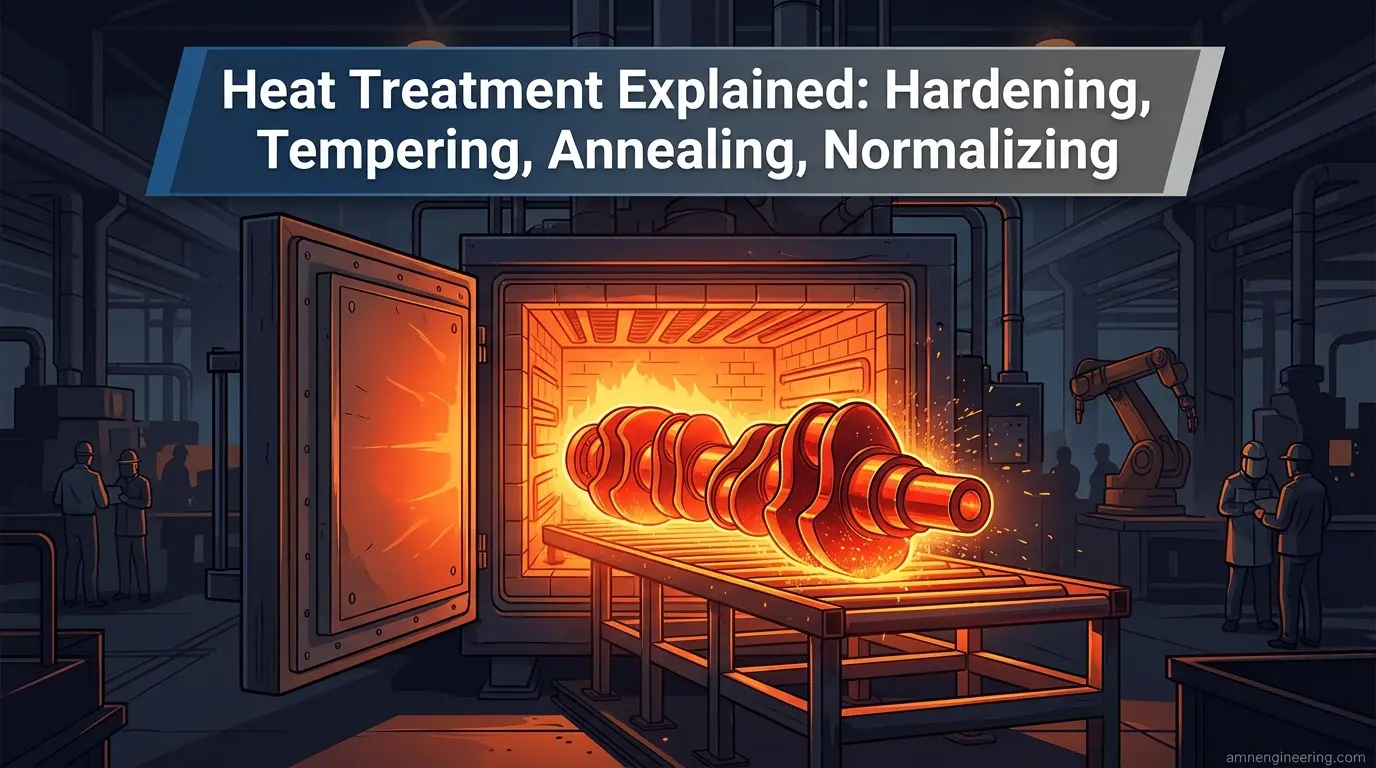
Heat treatment is the controlled heating and cooling of steel that transforms a soft, easily machined bar into a hard, wear resistant, or tough component. Getting it right is the difference between a part that lasts for years and one that cracks under load or wears out in months.
This guide explains the four main heat treatment processes used in manufacturing, hardening, tempering, annealing, and normalizing, with temperature ranges, real steel grades, and practical advice on when to specify each one.
If you are a buyer ordering CNC machined parts or forged components, understanding heat treatment helps you specify the right process for your application. Choosing the wrong treatment can lead to parts that crack under load, wear out too fast, or cost more to machine than necessary.
What Is Heat Treatment and Why Does It Matter?
Heat treatment of steel, in simple terms, means heating metal to a specific temperature, holding it there for a set period, and then cooling it in a controlled way. The goal is to change the internal structure of the steel to improve its properties such as hardness, strength, toughness, or machinability.
The same bar of steel can be made hard and brittle, soft and workable, or tough and strong, depending entirely on how it is heated and cooled. This is why heat treatment appears on almost every engineering drawing for a loaded or wearing component.
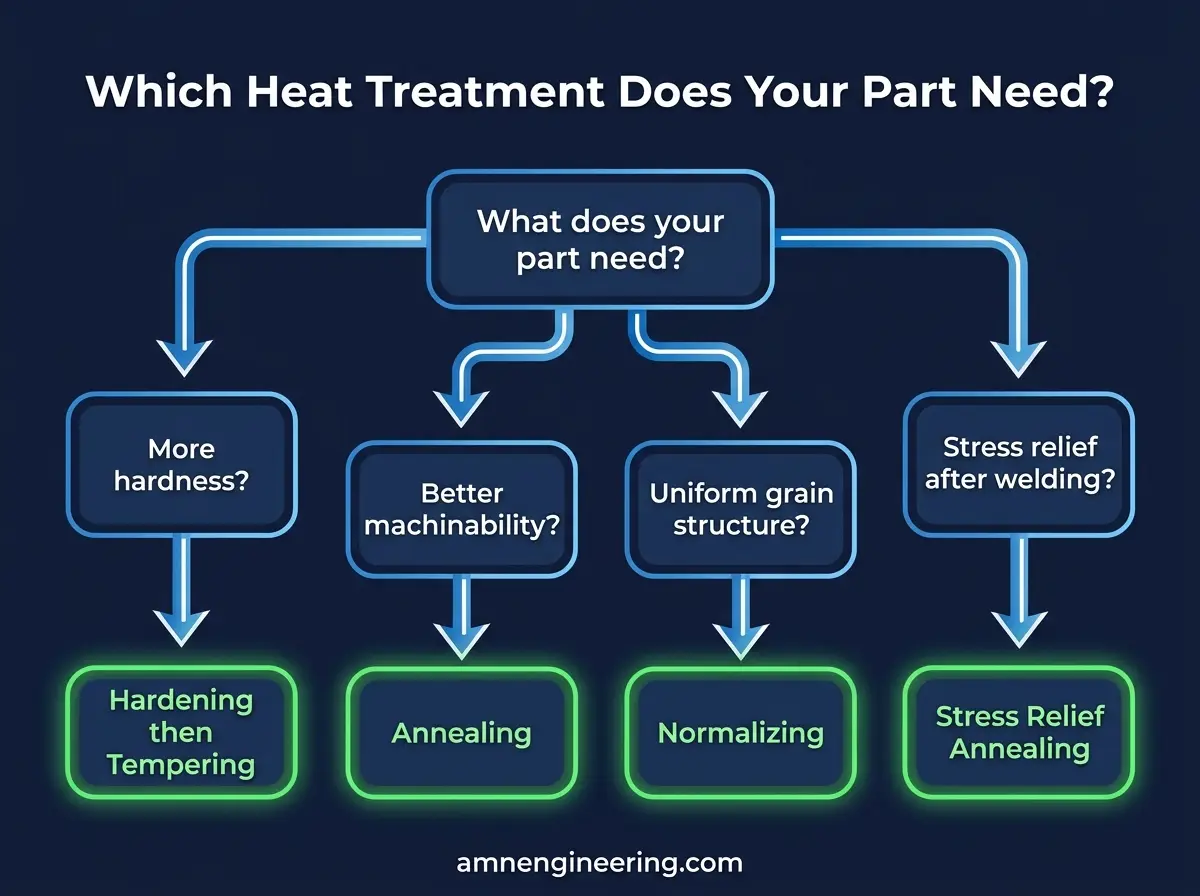
There are four main heat treatment processes used in manufacturing:
- Hardening increases surface and core hardness for wear resistance.
- Tempering follows hardening to reduce brittleness and improve toughness.
- Annealing softens steel to make it easier to machine or form.
- Normalizing refines the grain structure for uniform mechanical properties.
Each process uses different temperatures and cooling methods. Let us look at each one in detail.
Hardening: Making Steel Wear Resistant
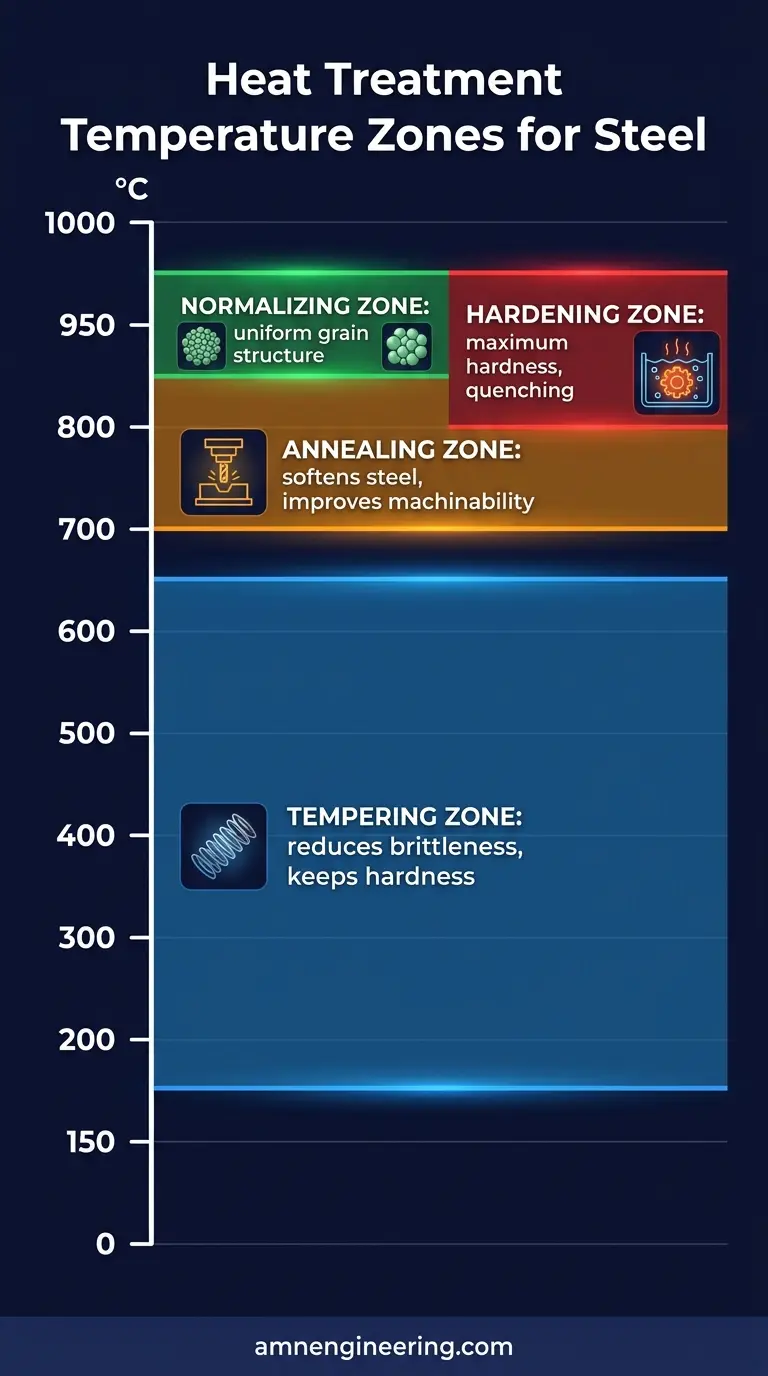
Hardening is the process of heating steel above its critical temperature (typically 800°C to 900°C depending on the grade) and then cooling it rapidly by quenching in water, oil, or air.
How It Works
When steel is heated above its critical temperature, its internal structure transforms into a phase called austenite. Rapid cooling locks the carbon atoms in place, creating a very hard structure called martensite. This makes the steel extremely hard but also brittle.
Temperature Ranges by Steel Grade
| Steel Grade | Hardening Temperature | Quench Medium | Resulting Hardness |
|---|---|---|---|
| EN8 (080M40) | 830°C to 860°C | Water or oil | 45 to 55 HRC |
| EN9 (070M55) | 810°C to 840°C | Water or oil | 50 to 58 HRC |
| EN24 (817M40) | 830°C to 860°C | Oil | 50 to 55 HRC |
| EN19 (709M40) | 840°C to 870°C | Oil | 48 to 55 HRC |
The correct grade matters as much as the correct temperature. For a deeper comparison of the most common machining grades, read EN8 vs EN24 vs SS304.
When to Specify Hardening
You should specify hardening when your part needs to resist wear, such as gears, shafts, pins, bushings, or any component that slides or rotates against another surface. At AMN Engineering, we commonly harden CNC turned shafts for pump manufacturers who need long service life in abrasive environments.
Tempering: Reducing Brittleness After Hardening
Hardened steel is very hard but also very brittle. If you use it as is, it can crack under impact or vibration. Tempering solves this problem by reheating the hardened steel to a lower temperature (typically 150°C to 650°C) and then allowing it to cool slowly.
How Tempering Temperature Affects Properties
The higher the tempering temperature, the more toughness you gain but the more hardness you lose. Choosing the right tempering temperature is a balance between hardness and toughness based on your application.
| Tempering Range | Resulting Hardness | Best For |
|---|---|---|
| 150°C to 250°C | 58 to 62 HRC | Cutting tools, dies, high wear parts |
| 250°C to 400°C | 45 to 55 HRC | Springs, gears, shafts |
| 400°C to 650°C | 30 to 45 HRC | Structural parts, bolts, axles |
The Hardening Plus Tempering Combination
In practice, hardening and tempering are almost always done together. This combination is often called quench and temper and is the most common heat treatment specification we see on engineering drawings. When a drawing says “hardened and tempered to 280 to 320 BHN,” it means the manufacturer must harden the steel first and then temper it to achieve that specific Brinell hardness range.
Annealing: Softening Steel for Easier Machining
Annealing is the opposite of hardening. The goal is to make the steel as soft and workable as possible. This is done by heating the steel above its critical temperature (similar to hardening) but then cooling it very slowly inside the furnace.
Why Annealing Matters for Machined Parts
When steel comes from the mill, it often has internal stresses and an uneven grain structure from the rolling or forging process. These internal stresses can cause parts to warp during CNC machining or develop cracks during welding.
Annealing removes these stresses and creates a soft, uniform structure that machines easily and produces a better surface finish. If you are ordering complex parts that require a lot of material removal, starting with annealed material can reduce machining time by 20 to 30 percent.
Types of Annealing
- Full annealing heats the steel above its critical temperature and cools it inside the furnace over 8 to 24 hours. This produces the softest possible structure.
- Stress relief annealing uses a lower temperature (550°C to 650°C) and is used to remove stresses from welding, machining, or cold forming without significantly changing the hardness.
- Spheroidize annealing is used for high carbon steels to form spherical carbides, making them much easier to machine and form.
Normalizing: Creating a Uniform Grain Structure
Normalizing is similar to annealing but with one key difference: the steel cools in open air instead of inside the furnace. This results in a finer grain structure and slightly higher strength compared to annealing.
When to Use Normalizing Instead of Annealing
Normalizing is the right choice when you need:
- Uniform properties throughout the part. Forged components often have uneven grain structures because different sections cool at different rates. Normalizing evens this out, which is one reason forged parts are stronger once properly treated.
- Better mechanical properties than annealed steel. Normalized steel is stronger and harder than annealed steel while still being machinable.
- A cost effective treatment. Because the steel cools in air instead of spending hours in a furnace, normalizing is faster and cheaper than full annealing.
Temperature Range
Normalizing is typically done at 30°C to 50°C above the steel’s upper critical temperature. For most carbon steels, this means 850°C to 950°C. The steel is held at this temperature until it is uniformly heated throughout and then removed from the furnace to cool in still air.
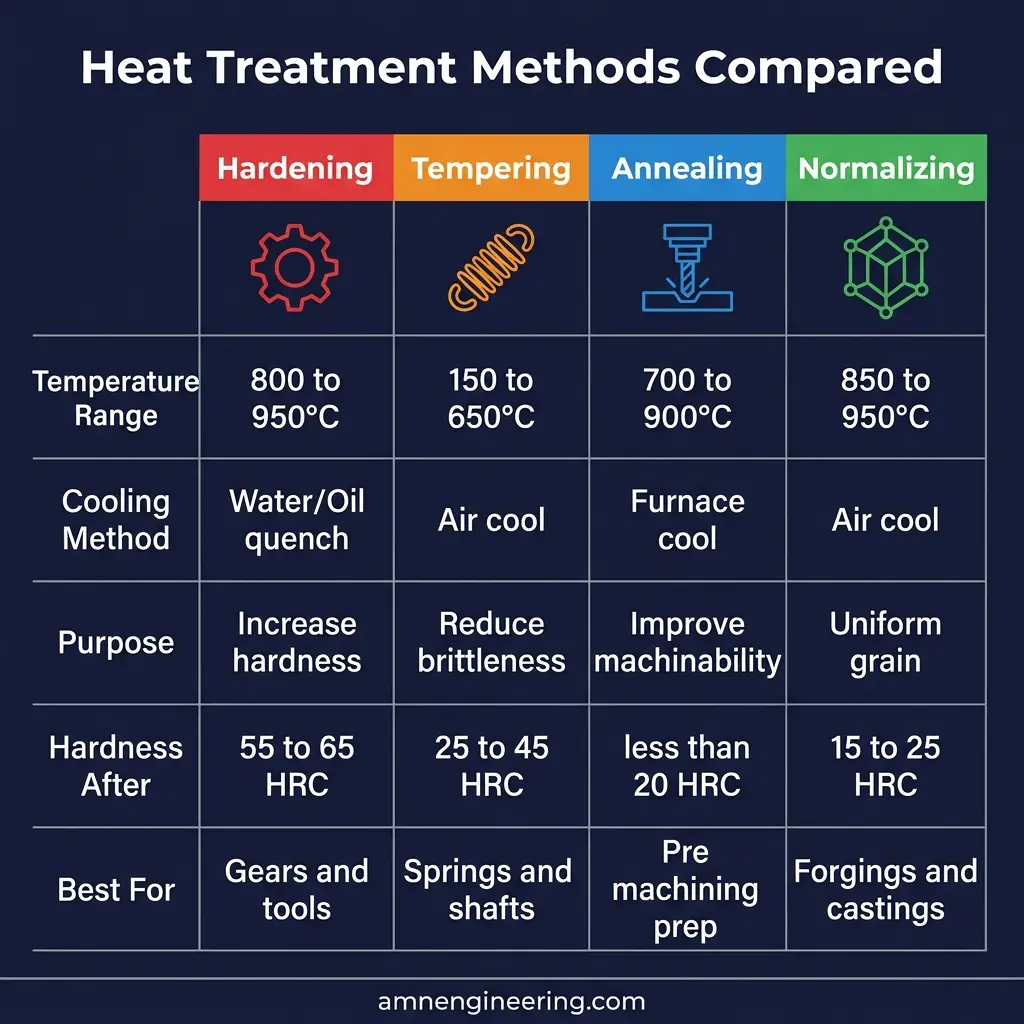
Comparison Table: All Four Heat Treatment Processes at a Glance
| Factor | Hardening | Tempering | Annealing | Normalizing |
|---|---|---|---|---|
| Purpose | Increase hardness | Reduce brittleness | Soften material | Uniform grain structure |
| Temperature | 800°C to 900°C | 150°C to 650°C | 800°C to 900°C | 850°C to 950°C |
| Cooling | Rapid (quench) | Slow (air or furnace) | Very slow (furnace) | Medium (still air) |
| Hardness Result | Very high | Reduced from hardened | Very low (soft) | Moderate |
| Machinability | Poor | Improved | Excellent | Good |
| Cost | Moderate | Low (add on) | Higher (long furnace time) | Lower (air cooling) |
| Used With | Medium/high carbon steel | Always after hardening | Any steel | Carbon and alloy steels |
How Heat Treatment Fits Into CNC Manufacturing
The timing of heat treatment in the manufacturing sequence is critical. Here is the typical workflow for a precision machined part that requires hardening:
- Raw material inspection. Check the material certificate to confirm the grade and composition.
- Rough CNC machining. Machine the part to near final dimensions, leaving 0.2mm to 0.5mm of extra material on critical surfaces.
- Heat treatment. Send the rough machined part for hardening and tempering to the specified hardness.
- Finish grinding. Use precision grinding to bring hardened surfaces to final dimensions and tolerances.
- Final inspection. Check dimensions, hardness, and surface finish before shipping.
This sequence is important because hardening causes slight dimensional changes (typically 0.01 to 0.03 percent growth). By leaving extra material before treatment and finishing after, we achieve tight tolerances even on hardened parts. The same discipline applies to die cast and fabricated components that need post treatment finishing.
Common Mistakes Buyers Make With Heat Treatment
- Specifying hardness without a range. A drawing that says “50 HRC” without a tolerance is impossible to achieve exactly. Always specify a range such as “48 to 52 HRC.”
- Forgetting to account for dimensional changes. If you need tight tolerances on hardened surfaces, plan for finish grinding after heat treatment. Do not expect heat treated parts to hold ±0.02mm without post treatment finishing.
- Using the wrong steel grade. Low carbon steels like mild steel (EN3) cannot be through hardened. If your part needs hardness above 40 HRC, you need at least a medium carbon steel like EN8 or EN24.
- Over specifying hardness. Not every part needs to be hardened. Hardening adds cost and lead time. If your part does not experience wear or high contact stress, normalized or as machined steel may be perfectly adequate.
How AMN Engineering Handles Heat Treatment
At AMN Engineering, we manage the complete manufacturing process including heat treatment for every part we produce. Here is what that means for you as a buyer:
- Single point of contact. You send us your drawing and we handle everything: material procurement, machining, heat treatment, grinding, inspection, and shipping. You do not need to coordinate between multiple suppliers.
- Certified heat treatment partners. We work with ISO certified heat treatment facilities that provide documented temperature records and hardness verification for every batch.
- Material test certificates. Every order comes with a full material test certificate that includes chemical composition, mechanical properties, and heat treatment records. Learn how to read a material test certificate before your next order.
- Post treatment finishing. Our CNC machining and grinding capabilities allow us to finish parts to final tolerances after heat treatment, backed by full manufacturing quality control.
Whether you need hardened shafts for pumps, tempered gears for gearboxes, or annealed blanks for forming, we have the process knowledge to deliver parts that perform in the real world.
Frequently Asked Questions
Hardening heats steel above its critical temperature and quenches it rapidly to make it very hard but brittle. Tempering is a follow up process that reheats the hardened steel to a lower temperature to reduce brittleness and improve toughness. The two processes are almost always used together.
Annealing is best when you need the softest possible material for easier machining or forming. Normalizing is used when you need a uniform grain structure and moderate strength without making the steel as soft as annealing does. Normalizing is also faster and cheaper because the steel cools in open air instead of inside a furnace.
Yes. Heat treatment can cause slight dimensional changes due to thermal expansion and phase transformation. This is why precision parts are often machined slightly oversized before heat treatment and then finish ground to final tolerances after treatment is complete.
Only steels with enough carbon content can be hardened through quenching. Medium carbon steels (0.3 to 0.6 percent carbon) like EN8 and high carbon steels (above 0.6 percent carbon) like EN9 and EN24 respond well to hardening. Low carbon steels like mild steel cannot be hardened this way and need case hardening instead.
It depends on the required hardness and tolerances. For most parts, rough machining is done first, then heat treatment, and then finish machining or grinding to achieve final dimensions. For parts that need high surface hardness only, machining is completed first and then surface hardening is applied.
