How Forging Reduces Material Waste Compared to Machining from Billet
By Adil, Managing Director at AMN Engineering · · 5 min read
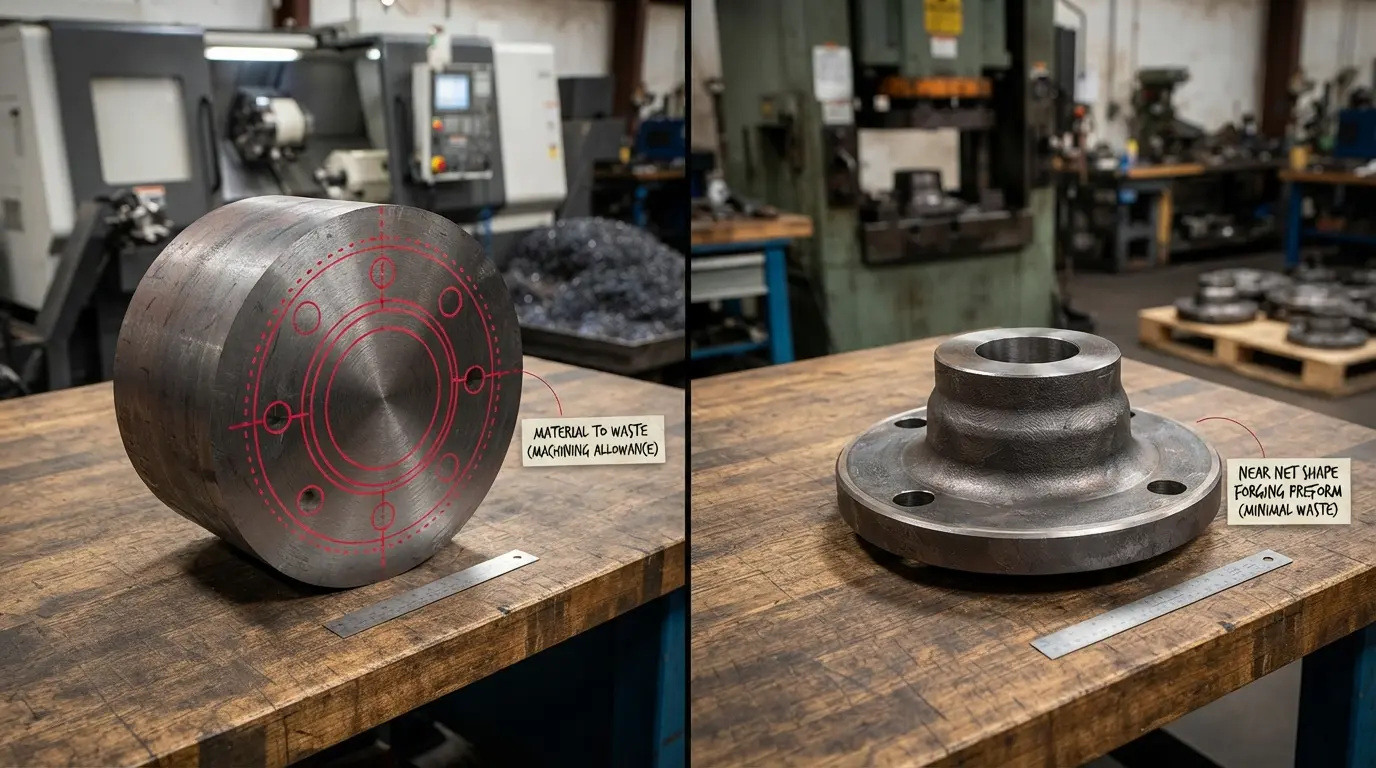
When you CNC machine a part from solid billet, all the material you cut away becomes chips on the floor. For a complex part like a flange, crankshaft, or housing, 50 to 80 percent of the starting material ends up as waste.
Forging produces a near net shape that requires only minimal machining to finish. The material savings can be 30 to 60 percent compared to machining from billet. On expensive alloy steels like EN24, these savings add up fast.
The Material Waste Problem in CNC Machining
CNC machining is a subtractive process. You start with a block or bar of metal and cut away everything that is not the finished part. The removed material becomes chips.
For simple parts (a straight shaft from round bar), material utilization is high (80 to 90 percent of the material becomes the finished part). But for complex shapes (flanges, housings, connecting rods), utilization drops dramatically:
| Part Type | Starting Billet Weight | Finished Part Weight | Material Utilization | Waste |
|---|---|---|---|---|
| Simple shaft | 5 kg | 4.2 kg | 84% | 16% |
| Stepped shaft | 8 kg | 4.5 kg | 56% | 44% |
| Flange | 12 kg | 4 kg | 33% | 67% |
| Complex housing | 25 kg | 6 kg | 24% | 76% |
| Crankshaft | 40 kg | 12 kg | 30% | 70% |
A flange machined from billet wastes two thirds of the material. A complex housing wastes three quarters. That wasted material is money thrown away.
How Forging Solves It
Forging shapes the metal before machining. The heated billet is compressed into a die that produces a part very close to the final shape (near net shape). Only a small machining allowance (1 to 3mm per surface) remains to be removed by CNC machining to achieve final dimensions.
The same flange that wastes 67% of material when machined from billet wastes only 15 to 25% when forged first and then finish machined.
Material Utilization Comparison
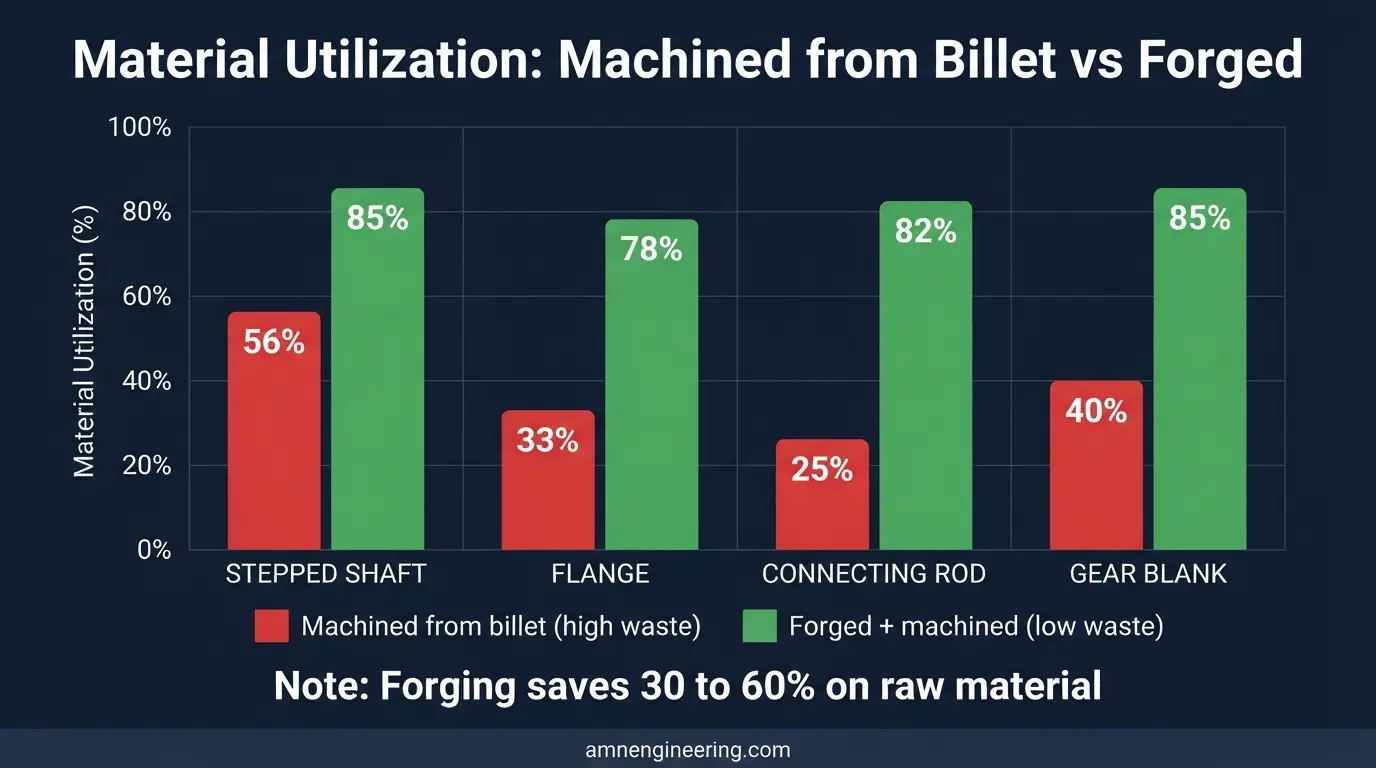
| Part | Machined from Billet | Forged + Machined | Material Saved |
|---|---|---|---|
| Stepped shaft | 56% utilization | 85% utilization | 29% less material |
| Flange | 33% utilization | 78% utilization | 45% less material |
| Connecting rod | 25% utilization | 82% utilization | 57% less material |
| Gear blank | 40% utilization | 85% utilization | 45% less material |
When Material Savings Justify Forging
Material savings alone do not always justify forging because forging has die costs ($2,000 to $20,000+). The economics work when:
Expensive material. EN24, stainless steel, titanium, and specialty alloys cost $5 to $50+ per kg. Saving 10 kg of EN24 per part saves $50 to $100 per part in material alone.
Large parts. A 40 kg billet machined to a 12 kg crankshaft wastes 28 kg of steel. At $3 per kg, that is $84 of wasted material per part. Over 500 parts, that is $42,000 in material waste that forging eliminates.
Medium to high volumes. Die cost is amortized across all parts. At 500+ parts, the die cost per part becomes small compared to the material savings. Read more: Open Die vs Closed Die Forging.
Environmental goals. Less waste means less energy spent melting and recycling chips, lower carbon footprint, and less industrial waste.
Real Example: Flange Production
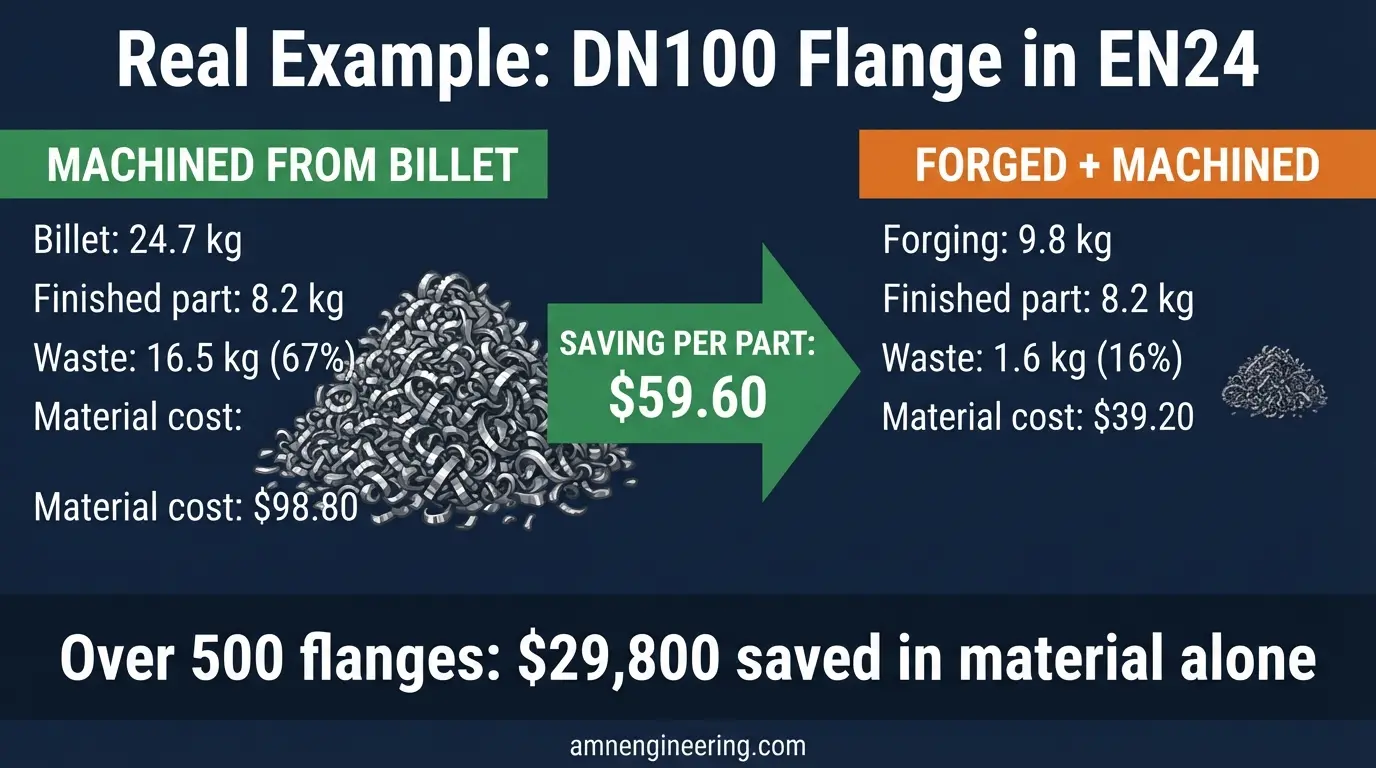
Part: DN100 weld neck flange in EN24 steel
Machined from Billet
- Starting billet: 200mm diameter x 100mm thick = 24.7 kg
- Finished flange: 8.2 kg
- Material wasted: 16.5 kg (67%)
- Material cost at $4/kg: $98.80 raw material per flange (of which $66 becomes chips)
Forged + Machined
- Forged preform: 9.8 kg (near net shape with 2mm machining allowance)
- Finished flange: 8.2 kg
- Material wasted: 1.6 kg (16%)
- Material cost at $4/kg: $39.20 raw material per forging
Material saving per flange: $59.60
Over 500 flanges: $29,800 saved in material alone
The forging die for this flange costs approximately $5,000 to $8,000. At 500 flanges, the die cost is $10 to $16 per part. The material saving of $59.60 per part far exceeds the die cost. The forging pays for itself within the first 100 parts.
Add the strength benefit (forging creates aligned grain for better fatigue resistance) and the economics become even more compelling.
Frequently Asked Questions
30 to 60 percent less raw material compared to machining from solid billet, depending on part complexity. Simple parts save less. Complex parts save more.
Yes. Forging produces a near net shape with 1 to 3mm of machining allowance. CNC machining removes this allowance to achieve final dimensions and surface finish. But the amount of machining is dramatically less than starting from billet.
For small quantities (under 100 parts) where the forging die cost cannot be justified, and for simple shapes (straight shafts, simple blocks) where material utilization from billet is already high (above 70%).
Yes, but at a fraction of the original material cost. Steel chips are sold as scrap at $0.30 to $0.80 per kg compared to buying new bar at $2 to $5+ per kg. Recycling recovers some value but nowhere near the cost of the original material.