Open Die vs Closed Die Forging: Which Method Fits Your Part?
By Adil, Managing Director at AMN Engineering · · 5 min read
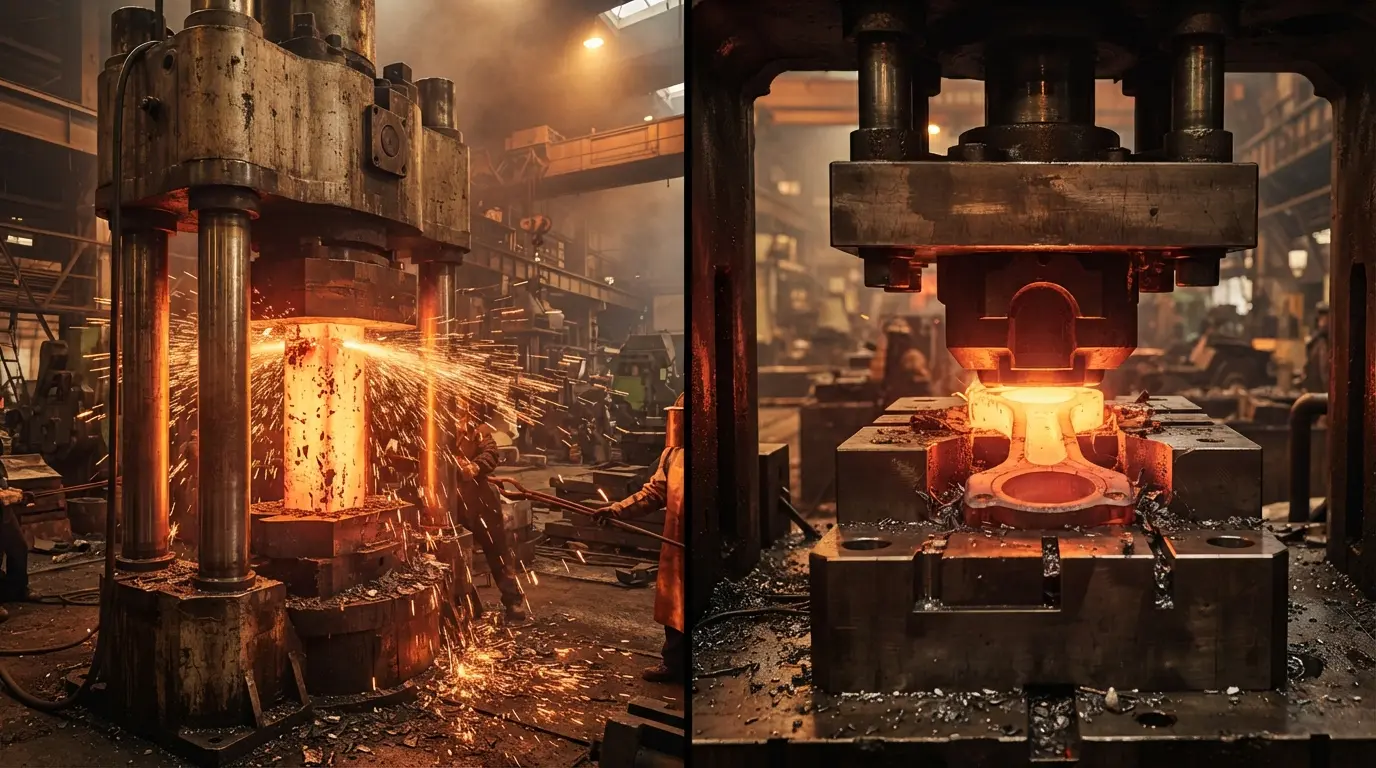
Forging comes in two main methods: open die and closed die. Both compress heated metal to shape it, but they produce very different types of parts at very different costs. Choosing the wrong method means overpaying for simple parts or getting poor results on complex ones.
This guide explains both methods simply and helps you decide which one fits your part.
The Quick Difference
Open die forging: The metal is hammered between flat (or simple shaped) dies. The dies do not enclose the workpiece. The operator controls the shape by rotating and repositioning the billet between hammer blows. Best for large, simple shapes: shafts, rings, discs, blocks.
Closed die forging (impression die): The metal is pressed into a precisely machined die cavity that has the shape of the finished part. The dies enclose the workpiece and force the metal to fill the cavity. Best for complex shapes at higher volumes: connecting rods, gears, flanges, fittings.
How Open Die Forging Works
In open die forging (also called free forging), a heated billet is placed on a flat bottom die and struck by a flat top die (the hammer). The operator rotates and moves the billet between blows to shape it progressively.
The dies are simple (flat, V shaped, or slightly contoured) and do not contain the finished part shape. The shape comes from the operator's skill and the sequence of hammer blows.
Open Die Strengths
- No expensive custom dies needed (uses standard tooling)
- Can produce very large parts (shafts up to several meters, rings up to 3+ meters)
- Excellent grain flow aligned along the part length
- Economical for small quantities (even 1 piece)
- Short lead time (no die manufacturing)
- Material savings over machining from billet
Open Die Limitations
- Limited to simple shapes (cylinders, rings, discs, blocks, tapered shafts)
- Lower dimensional accuracy (plus or minus 3 to 5mm typical, needs CNC machining to final dimensions)
- More material waste than closed die (less near net shape)
- Slower production rate (each piece is individually hammered)
How Closed Die Forging Works
In closed die forging (impression die forging), the heated billet is placed in a die set that contains the mirror image of the finished part shape. The press forces the metal to fill the die cavity, producing a part that is very close to the final shape (near net shape).
Excess metal (flash) squeezes out between the die halves and is trimmed off afterward.
Closed Die Strengths
- Complex shapes with close tolerances (plus or minus 0.5 to 1mm)
- Near net shape (less machining needed afterward)
- Excellent grain flow following part contour
- High production rate (one part per press stroke)
- Consistent part to part dimensions
- Superior surface finish compared to open die
Closed Die Limitations
- Expensive die tooling ($2,000 to $20,000+ per die set)
- Die lead time (2 to 6 weeks for die manufacturing)
- Part size limited by press capacity
- Not economical for small quantities (need 100+ parts to justify die cost)
- Design changes require new or modified dies
The Full Comparison
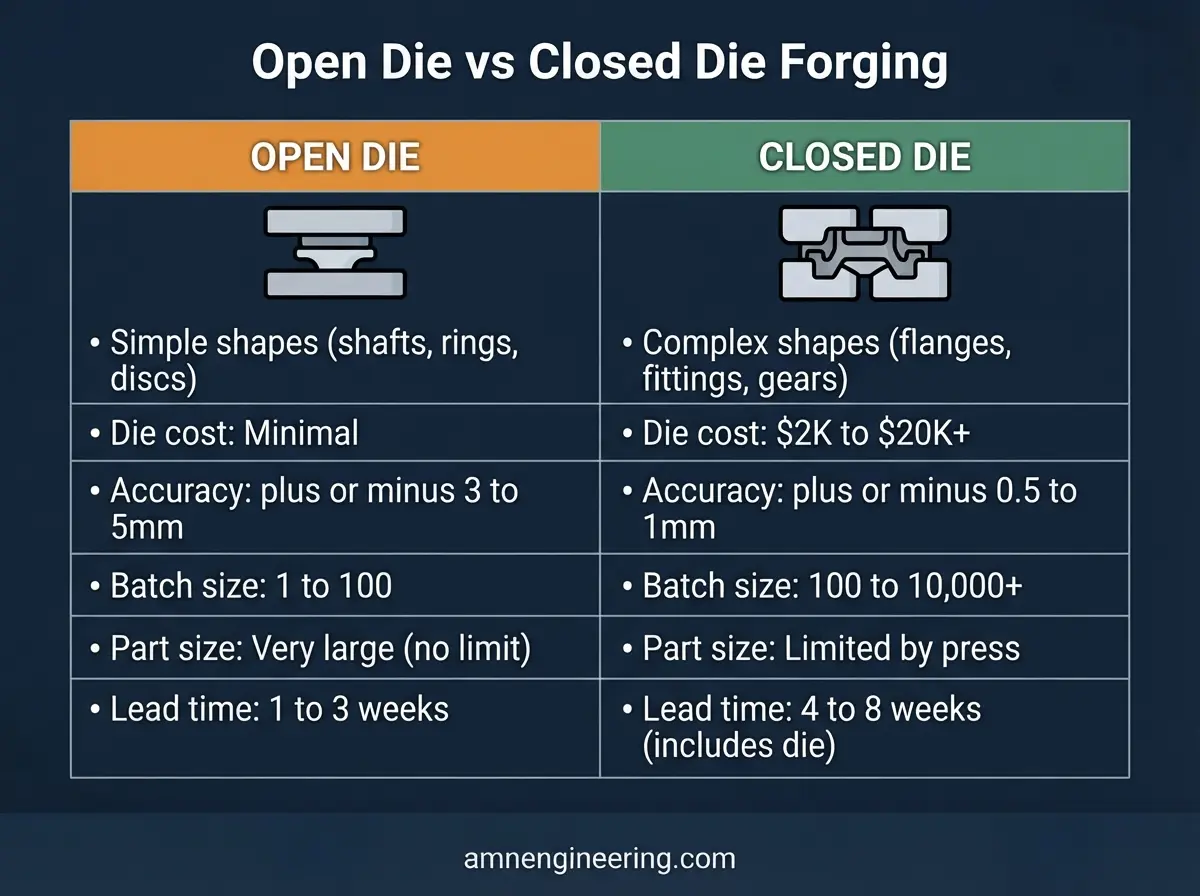
| Factor | Open Die Forging | Closed Die Forging |
|---|---|---|
| Die Cost | Minimal (standard flat dies) | High ($2K to $20K+) |
| Part Complexity | Simple (cylinders, rings, discs) | Complex (any shape die can hold) |
| Dimensional Accuracy | Plus or minus 3 to 5mm | Plus or minus 0.5 to 1mm |
| Near Net Shape | No (significant machining needed) | Yes (minimal machining) |
| Maximum Part Size | Very large (no practical limit) | Limited by press tonnage |
| Minimum Quantity | 1 piece | 100+ (to justify die cost) |
| Ideal Batch Size | 1 to 100 | 100 to 10,000+ |
| Production Speed | Slow (individual hammering) | Fast (one stroke per part) |
| Grain Flow | Good (along length) | Excellent (follows part contour) |
| Lead Time (first order) | 1 to 3 weeks | 4 to 8 weeks (includes die making) |
| Surface Finish | Rough | Better (die surface transfers) |
| Best For | Large shafts, rings, simple shapes | Flanges, fittings, connecting rods, gears |
When to Choose Each Method
Choose Open Die When:
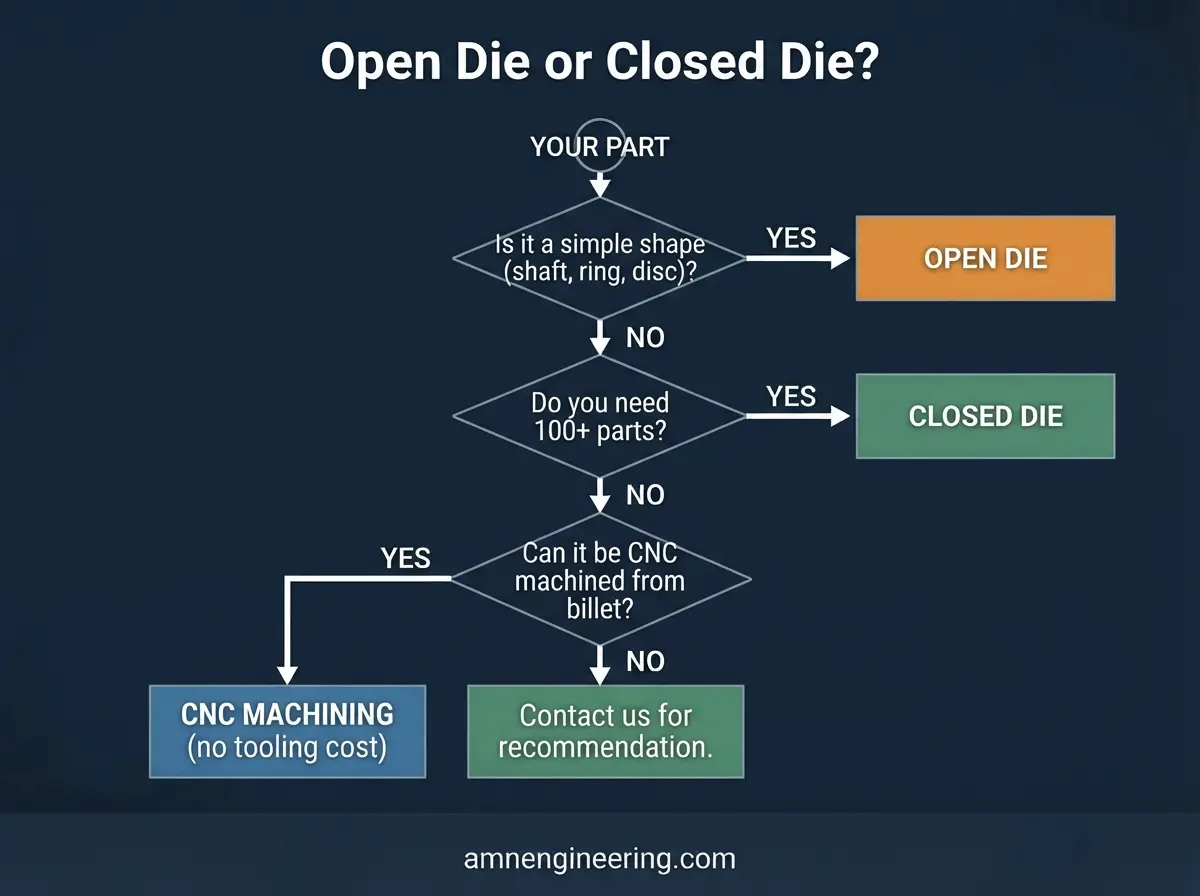
- Your part is a simple shape (shaft, ring, disc, block, cylinder)
- You need 1 to 100 pieces and cannot justify die tooling
- The part is very large (beyond the capacity of closed die presses)
- You need parts quickly (no die lead time)
- The part will be CNC machined to final dimensions anyway
Choose Closed Die When:
- Your part has complex geometry that cannot be achieved with flat dies
- You need 100+ identical parts (die cost is amortized)
- Dimensional accuracy matters (less machining needed)
- Production speed matters (high output per hour)
- The part is a standard forging shape: flanges, fittings, connecting rods, gear blanks
Can You Combine Both?
Yes. For some parts, the billet is first rough shaped by open die forging (to reduce it from a large block to an approximate shape), then finish forged in closed dies. This is called a preform operation and is common for large complex forgings.
At AMN Engineering, we offer both open die and closed die forging, followed by CNC machining and optional hot dip galvanizing or heat treatment.
Frequently Asked Questions
Open die uses flat dies and produces simple shapes. Closed die uses shaped cavities and produces complex near net shape parts. Open die is cheaper for small quantities. Closed die is better for complex shapes at higher volumes.
Both produce parts with superior grain structure compared to casting or machining. Closed die forging has a slight edge because the grain follows the complex part contour more precisely.
Typically 100+ parts to amortize the die cost. For high value or safety critical parts, even 50 pieces may justify the investment.
2 to 6 weeks depending on complexity. The dies are precision machined from tool steel and hardened for durability.