Stainless Steel Grades Compared: 304 vs 316 vs 410 vs 430
By Adil, Managing Director at AMN Engineering · · 9 min read
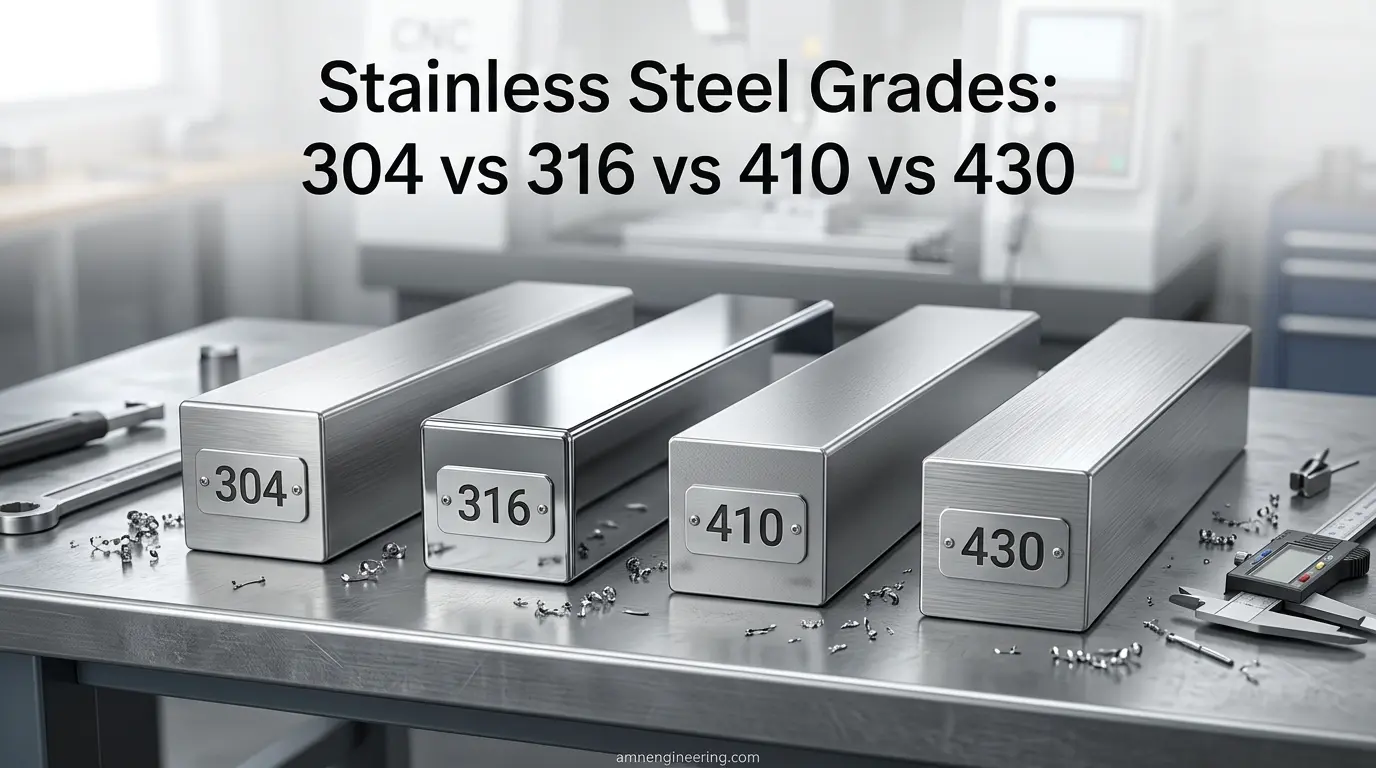
Stainless steel 304 vs 316 vs 410 vs 430: these four grades cover the vast majority of stainless steel applications in manufacturing. Choosing the wrong grade can mean parts that corrode too quickly, cost more than necessary, or cannot be hardened when they need to be.
When you send a drawing to a CNC machining or metal fabrication supplier, specifying the correct stainless steel grade saves time, avoids costly remakes, and ensures your parts perform as expected in service.
This guide compares all four grades on composition, corrosion resistance, mechanical properties, machinability, weldability, cost, and real world applications. By the end, you will know exactly which grade fits your project.
Why Choosing the Right Stainless Steel Grade Matters
The four grades in this guide, 304, 316, 410, and 430, each belong to a different family with different behaviour. Pick the wrong one and you risk premature corrosion, an inflated material bill, or a part that simply cannot be hardened when the design demands it.
Specifying the grade on the drawing, rather than writing a vague “stainless steel,” removes guesswork from the shop floor and locks in the properties your application needs. The sections below give you everything required to make that call with confidence.
Understanding Stainless Steel Families
Before comparing individual grades, it helps to understand the three main families these grades belong to. The family tells you the magnetic behaviour, heat treatment response, and general cost level at a glance.
Austenitic (304 and 316)
Austenitic grades are the most common stainless steels. They are non magnetic, have excellent corrosion resistance, and are very easy to weld. They cannot be hardened by heat treatment, only by cold working. They contain high levels of chromium (16 to 26 percent) and nickel (6 to 22 percent).
Martensitic (410)
Martensitic grades are magnetic and can be hardened by heat treatment to achieve high strength and hardness. They contain 11.5 to 18 percent chromium with little or no nickel. Their corrosion resistance is lower than austenitic grades, but their strength is much higher.
Ferritic (430)
Ferritic grades are magnetic, have moderate corrosion resistance, and are the most affordable stainless steels because they contain little or no nickel. They cannot be hardened by heat treatment.
Grade 304: The General Purpose Workhorse
Grade 304 (also known as 18/8 because of its 18 percent chromium and 8 percent nickel content) is the world’s most widely used stainless steel. If a drawing says “stainless steel” without specifying a grade, 304 is usually the assumed material.
Composition
| Element | Percentage |
|---|---|
| Chromium | 18 to 20% |
| Nickel | 8 to 10.5% |
| Carbon | 0.08% max |
| Manganese | 2% max |
| Iron | Balance |
Key Properties
- Corrosion resistance: Excellent in most atmospheric and mild chemical environments
- Magnetic: No (austenitic structure)
- Heat treatable: No (work hardening only)
- Tensile strength: 515 to 620 MPa
- Max service temperature: Up to 870°C intermittent
- Weldability: Excellent with all standard methods (TIG, MIG, spot)
Common Applications
- Food and beverage processing equipment
- Kitchen sinks and commercial kitchen surfaces
- Chemical containers and storage tanks
- Architectural trim and handrails
- Medical instruments (non implant)
- Dairy and brewery equipment
Machinability and Fabrication
304 is easy to laser cut, bend, and weld. It work hardens during CNC machining, which means sharp tools and consistent feeds are important. At AMN Engineering, we use carbide tooling with proper coolant flow to achieve clean finishes on 304 parts. It is also the default grade for custom parts in the food and beverage industry.
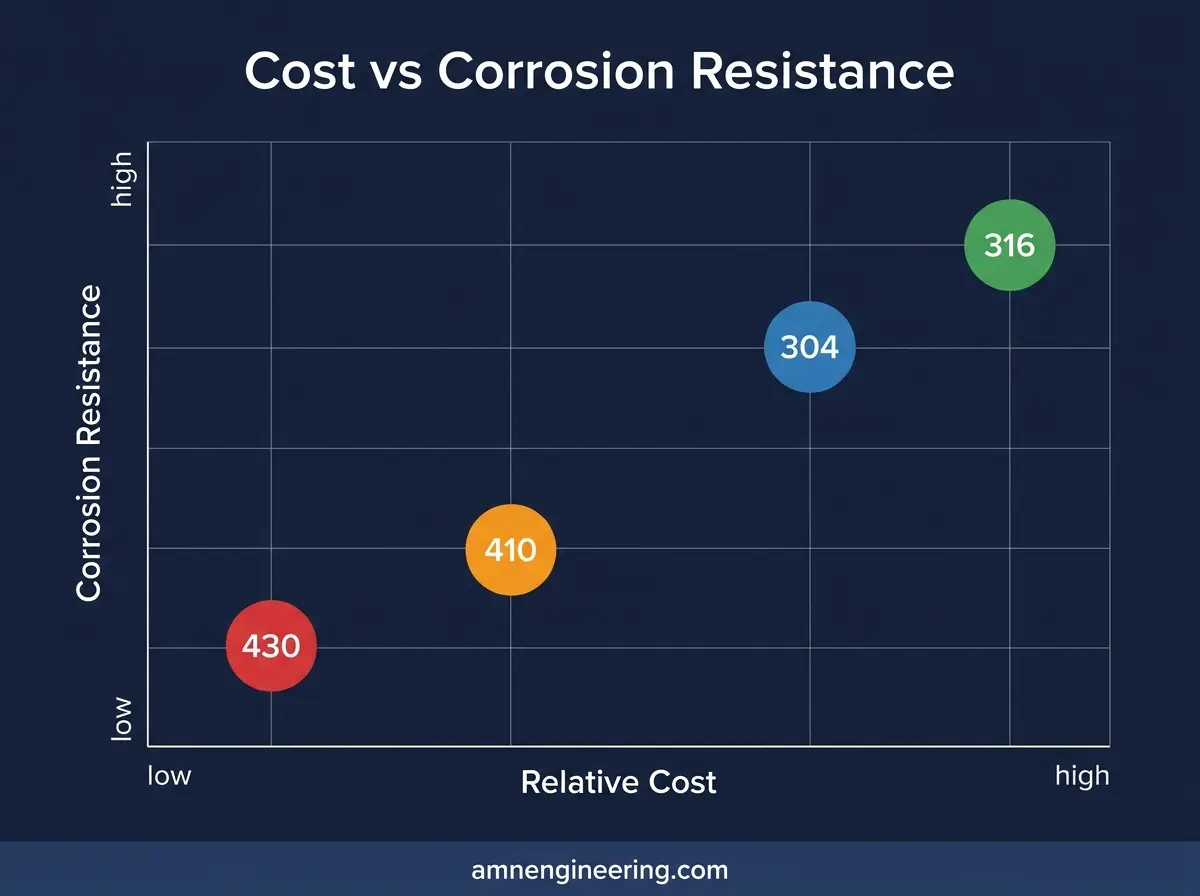
Cost level: Moderate. Approximately 20 to 30 percent less than 316.
Grade 316: Superior Corrosion Resistance
Grade 316 adds molybdenum (2 to 3 percent) to the 304 formula. This addition dramatically improves resistance to chloride corrosion, pitting, and crevice corrosion. Whenever parts will be exposed to saltwater, chlorinated solutions, or aggressive chemicals, 316 is the standard choice.
Composition
| Element | Percentage |
|---|---|
| Chromium | 16 to 18% |
| Nickel | 10 to 14% |
| Molybdenum | 2 to 3% |
| Carbon | 0.08% max |
| Iron | Balance |
Key Properties
- Corrosion resistance: Superior, especially against chlorides and marine environments
- Magnetic: No
- Heat treatable: No
- Tensile strength: 515 to 620 MPa
- Max service temperature: Up to 870°C intermittent
- Weldability: Excellent
Common Applications
- Marine hardware and boat fittings
- Chemical and pharmaceutical processing
- Coastal architectural elements
- Medical implants (316L variant)
- Desalination plant components
- Swimming pool equipment
When to Choose 316 Over 304
Choose 316 when your parts will be exposed to:
- Saltwater or coastal atmospheres
- Chlorinated cleaning chemicals
- Acidic solutions (sulfuric, hydrochloric, acetic acid)
- Environments above 60°C with chloride exposure
For inland applications with no chemical exposure, 304 performs just as well at a lower cost. For a broader look at how stainless compares to coated carbon steel outdoors, see galvanized vs stainless steel for outdoor use.
Cost level: Highest of the four grades. The molybdenum and higher nickel content drive the price up.
Grade 410: Hardenable Martensitic Steel
Grade 410 is fundamentally different from 304 and 316. It is a martensitic grade that can be heat treated to achieve high hardness (up to 40 HRC). This makes it the choice when you need both some corrosion resistance and high wear resistance or strength.
Composition
| Element | Percentage |
|---|---|
| Chromium | 11.5 to 13.5% |
| Carbon | 0.15% max |
| Nickel | None required |
| Iron | Balance |
Key Properties
- Corrosion resistance: Moderate (good in mild environments, not suitable for chemical or marine exposure)
- Magnetic: Yes
- Heat treatable: Yes (can reach 40 HRC hardened and tempered)
- Tensile strength: 450 MPa (annealed), up to 1225 MPa (hardened)
- Weldability: Fair. Requires preheating and post weld heat treatment
Common Applications
- Pump shafts and valve stems
- Turbine blades
- Cutlery and knife blades
- Springs and fasteners requiring corrosion resistance
- Bushings and wear rings
- CNC turned shafts for rotating equipment
Machinability
In the annealed (soft) condition, 410 machines very well on CNC lathes and mills. After heat treatment, it becomes much harder and requires carbide or ceramic tooling. Many of our clients order 410 parts machined in the annealed condition, then send them for heat treatment and final grinding to achieve the finished dimensions.
Cost level: Moderate. No nickel means lower raw material cost than 304 or 316, but heat treatment adds processing cost.
Grade 430: The Budget Ferritic Option
Grade 430 is a ferritic stainless steel that offers decent corrosion resistance at the lowest cost of the four grades. It contains no nickel, which keeps the price down significantly.
Composition
| Element | Percentage |
|---|---|
| Chromium | 16 to 18% |
| Carbon | 0.12% max |
| Nickel | None |
| Iron | Balance |
Key Properties
- Corrosion resistance: Good in mild environments, inferior to 304 and 316
- Magnetic: Yes
- Heat treatable: No
- Tensile strength: 450 to 600 MPa
- Weldability: Limited. Prone to grain growth and brittleness in heat affected zones
Common Applications
- Decorative trim and panels
- Automotive trim pieces
- Kitchen appliance panels
- Dishwasher liners
- Exhaust system components
- Stamped decorative parts
When 430 Works and When It Does Not
430 is a good choice for visible, decorative applications where appearance matters but the environment is mild. It resists atmospheric corrosion and household chemicals well.
However, it is not suitable for:
- Marine or coastal environments
- Chemical processing
- Welded structures (welding can create brittle zones)
- Applications requiring high impact toughness
Cost level: Lowest. Roughly 30 to 40 percent cheaper than 304 due to zero nickel content.
Side by Side Comparison: 304 vs 316 vs 410 vs 430
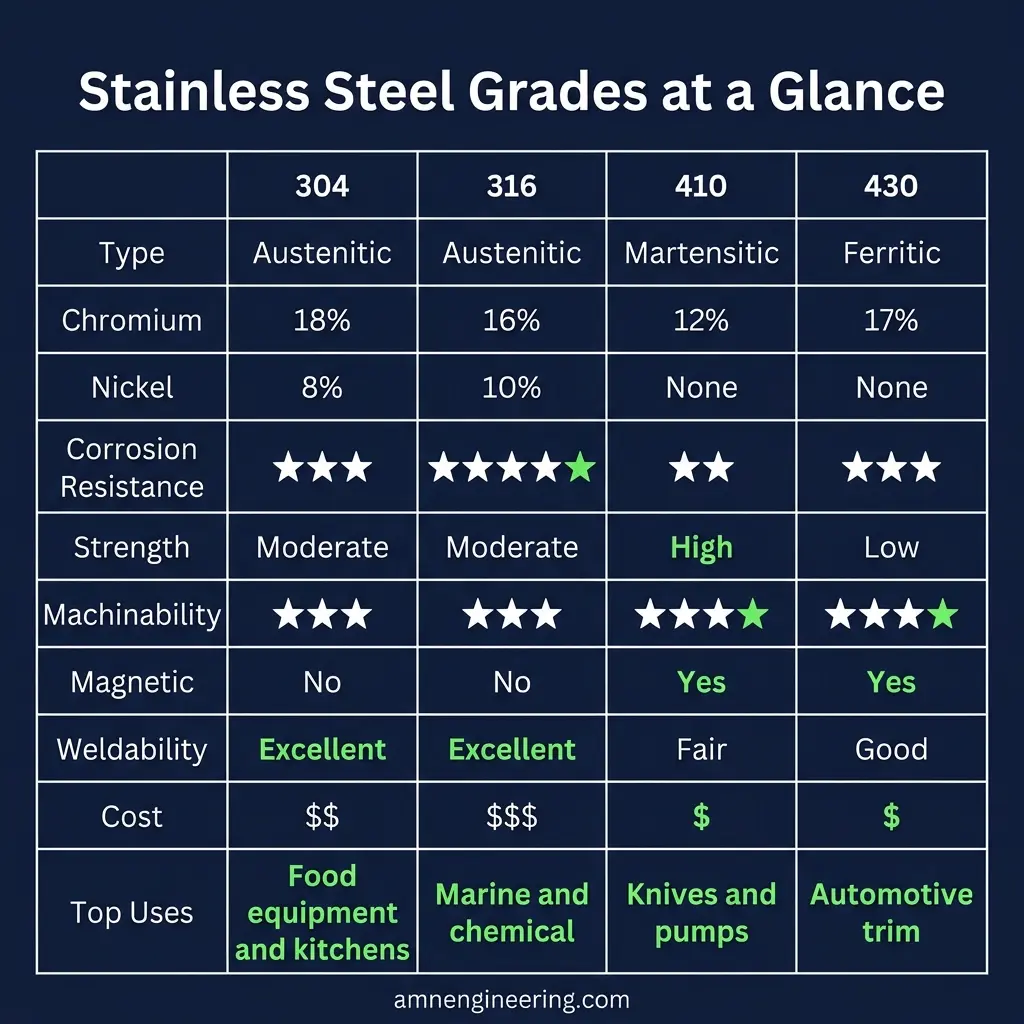
| Property | 304 | 316 | 410 | 430 |
|---|---|---|---|---|
| Family | Austenitic | Austenitic | Martensitic | Ferritic |
| Magnetic | No | No | Yes | Yes |
| Chromium | 18 to 20% | 16 to 18% | 11.5 to 13.5% | 16 to 18% |
| Nickel | 8 to 10.5% | 10 to 14% | None | None |
| Molybdenum | None | 2 to 3% | None | None |
| Corrosion Resistance | High | Highest | Low to moderate | Moderate |
| Strength (annealed) | 515 MPa | 515 MPa | 450 MPa | 450 MPa |
| Hardness (max) | ~25 HRC (cold worked) | ~25 HRC (cold worked) | 40 HRC (heat treated) | ~25 HRC |
| Weldability | Excellent | Excellent | Fair (needs preheat) | Limited |
| Machinability | Good | Good | Very good (annealed) | Good |
| Relative Cost | Moderate | Highest | Moderate | Lowest |
| Best For | General purpose | Marine, chemical | High hardness parts | Decorative, budget |
How to Choose the Right Grade for Your Project
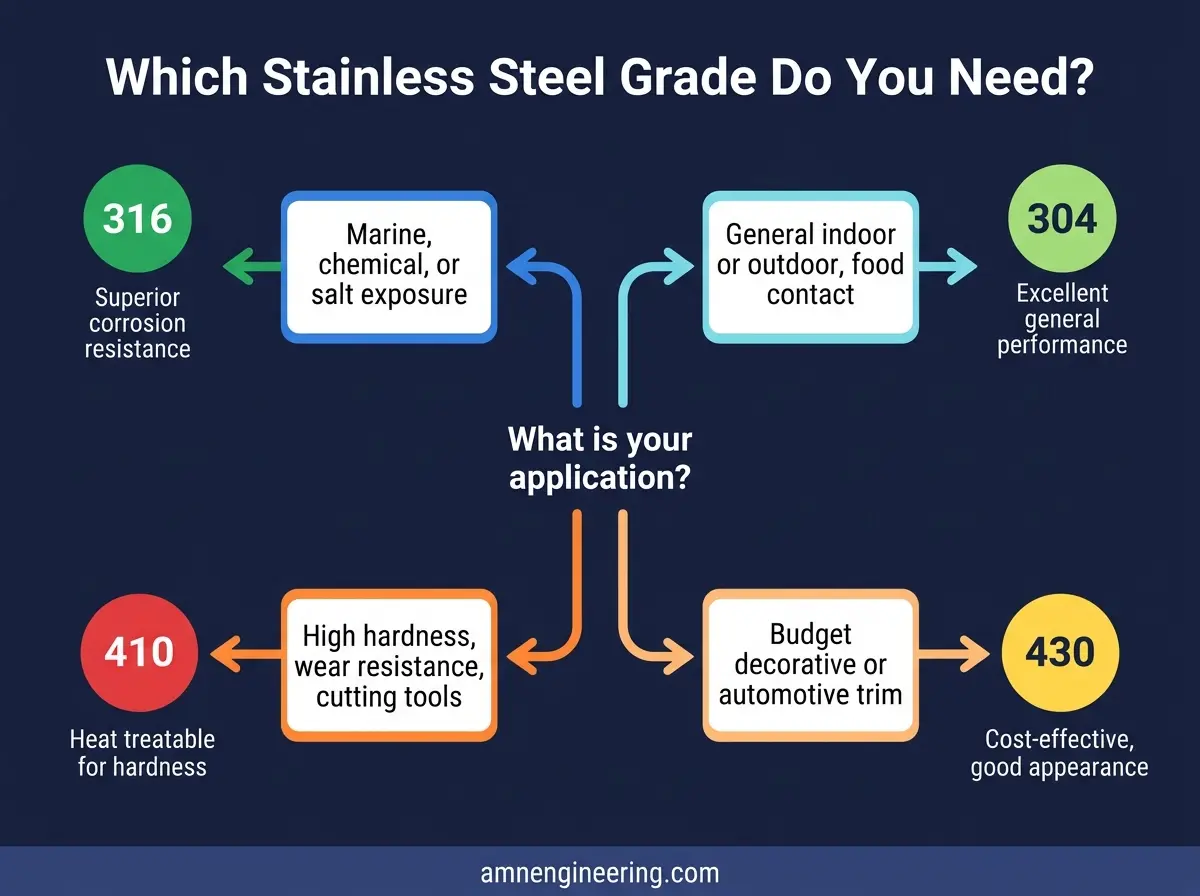
Follow this simple decision process:
Step 1: Does the part need to be hardened by heat treatment? If yes, choose 410. It is the only grade on this list that responds to heat treatment.
Step 2: Will the part be exposed to saltwater, chlorides, or aggressive chemicals? If yes, choose 316. Its molybdenum content provides the chloride resistance that 304 lacks.
Step 3: Does the part need good corrosion resistance in a normal indoor or outdoor environment? If yes, choose 304. It handles atmospheric corrosion, mild chemicals, and food contact with ease.
Step 4: Is the part decorative or cosmetic, with mild environmental exposure and budget constraints? If yes, choose 430. It gives you the stainless look at the lowest material cost.
When in doubt, 304 is almost always a safe starting point. Upgrade to 316 only when the environment demands it, and switch to 410 only when hardness is a requirement.
For help selecting the right material for your project, including how stainless compares with carbon and alloy steels, see our guide on EN8 vs EN24 vs SS304.
How AMN Engineering Works with Stainless Steel
At AMN Engineering, we work with all four grades daily. Our capabilities include:
- CNC machining of 304, 316, 410, and 430 on CNC lathes and milling centres
- Laser cutting of stainless steel sheet and plate up to 20mm thick
- Welding using TIG and MIG processes with grade matched filler materials
- Bending and forming on CNC press brakes
- Surface finishing including brushing, polishing, and passivation
We source our stainless steel from certified mills and provide Material Test Certificates (MTCs) with every order. Our team also helps with material selection: if your drawing says “stainless steel” without specifying a grade, we will recommend the most suitable and cost effective option based on your application. For larger assemblies, our metal fabrication team brings machining, cutting, and welding together under one roof.
Frequently Asked Questions
The main difference is that 316 contains 2 to 3 percent molybdenum, giving it much better resistance to chloride corrosion and saltwater. 304 is the general purpose grade and costs about 20 to 30 percent less.
Yes. 410 is a martensitic stainless steel, so it is magnetic and can be hardened through heat treatment. This suits applications like pump shafts and valve components that need both corrosion resistance and high hardness.
304 is the standard choice for food processing. If the equipment contacts salt, acidic foods, or chlorinated cleaning chemicals, upgrade to 316 for longer service life.
Yes. Fiber laser cutting works on 304, 316, 410, and 430. However, cutting parameters differ for each grade. AMN Engineering laser cuts stainless steel up to 20mm thick.
430 is typically the cheapest because it contains no nickel. 304 is next, then 410. 316 is the most expensive of these four due to its molybdenum content.
