Galvanized Steel vs Stainless Steel for Outdoor Applications: Which One Do You Need?
By Adil, Managing Director at AMN Engineering · · 6 min read
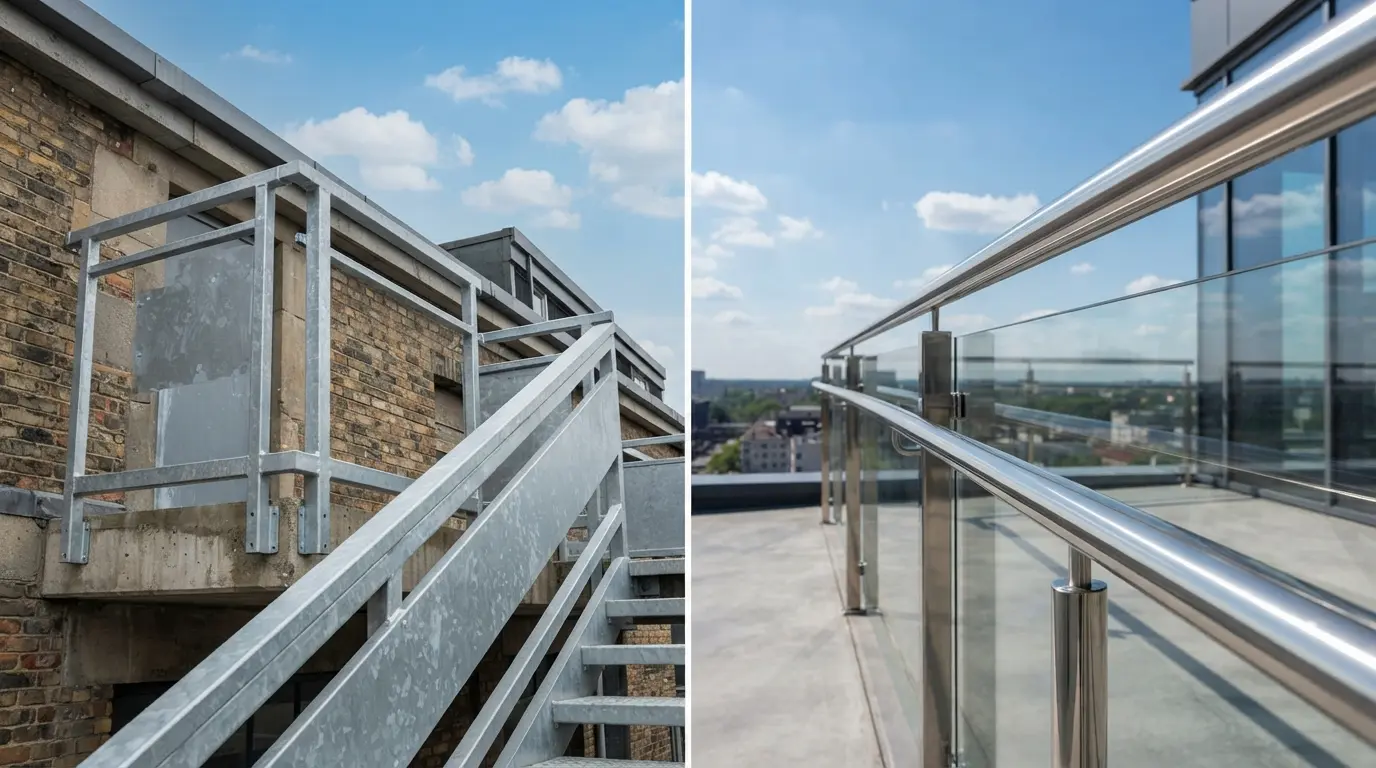
Galvanized steel vs stainless steel for outdoor applications. Two reliable ways to prevent steel from rusting outdoors, but with very different costs, strengths, appearances, and lifespans.
Choosing wrong means either overspending on stainless when galvanized would have been fine, or using galvanized in an environment where only stainless survives. This guide helps you make the right call based on your application, environment, and budget.
The Quick Answer
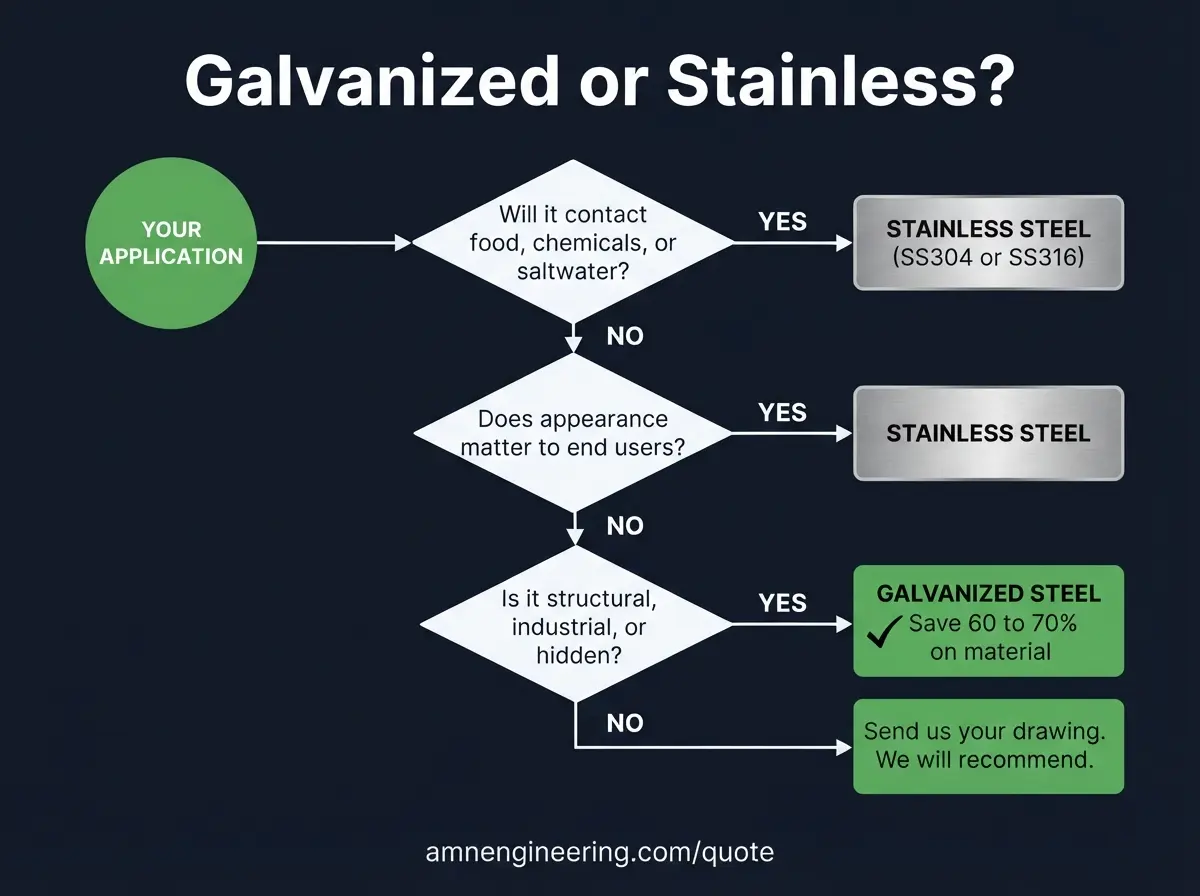
Choose galvanized steel when cost matters, the structure is not visible to end users, maximum strength is needed, and the environment is not severely corrosive. Best for: structural frameworks, conduits, fencing, poles, industrial infrastructure.
Choose stainless steel (SS304 or SS316) when appearance matters, the application involves food, chemical, or marine environments, maintenance must be zero, and the part must look clean for decades. Best for: architectural features, marine hardware, food processing, pharmaceutical, and chemical plants.
How Galvanized Steel Survives Outdoors
Hot dip galvanizing coats carbon steel with a thick layer of zinc (45 to 85 micrometers) that protects the steel through two mechanisms: barrier protection (zinc physically covers the steel) and sacrificial protection (zinc corrodes instead of the steel, even if scratched).
Outdoor lifespan: 50 to 100 years in mild environments, 20 to 50 years in harsh industrial or coastal conditions.
Appearance: Matte gray, spangled texture. Not visually attractive for architectural applications. Darkens to a uniform gray over time as the zinc patina develops.
Maintenance: Zero. No painting, no recoating, no inspection needed for decades.
How Stainless Steel Survives Outdoors
Stainless steel (SS304 or SS316) contains chromium which forms an invisible oxide layer on the surface. This oxide layer is self healing: if scratched, it reforms within hours when exposed to oxygen. This passive layer prevents the iron in the steel from corroding.
Outdoor lifespan: Essentially unlimited in mild environments. SS316 can last decades even in coastal and marine conditions. SS304 may show surface staining (tea staining) near the coast but does not structurally degrade.
Appearance: Bright, metallic, modern. Maintains its appearance for decades with occasional cleaning.
Maintenance: Occasional cleaning to maintain appearance. No coating or painting needed.
The Full Comparison
| Factor | Galvanized Steel | Stainless Steel (SS304/316) |
|---|---|---|
| Material Cost | 1x (baseline) | 3 to 5x |
| Machining Cost | 1x | 1.3 to 1.5x |
| Total Part Cost | 1x | 2.5 to 4x |
| Corrosion Protection | Excellent (zinc sacrificial) | Excellent (passive oxide layer) |
| Outdoor Lifespan | 50 to 100 years (mild) | Essentially unlimited |
| Coastal/Marine | Good (20 to 40 years) | Excellent (SS316 preferred) |
| Chemical Resistance | Limited (zinc dissolves in acids) | Excellent |
| Appearance | Matte gray, industrial | Bright, modern, attractive |
| Strength | High (carbon steel base) | Moderate (lower yield than carbon steel) |
| Weldability | Good (weld before galvanize) | Excellent (TIG welding) |
| Maintenance | Zero | Occasional cleaning |
| Scratch Behavior | Self healing (zinc sacrificial) | Self healing (oxide reforms) |
| Weight | Standard steel + zinc coating | Similar to standard steel |
| Best For | Industrial, structural, infrastructure | Architectural, marine, food, chemical |
Cost: The Real Numbers
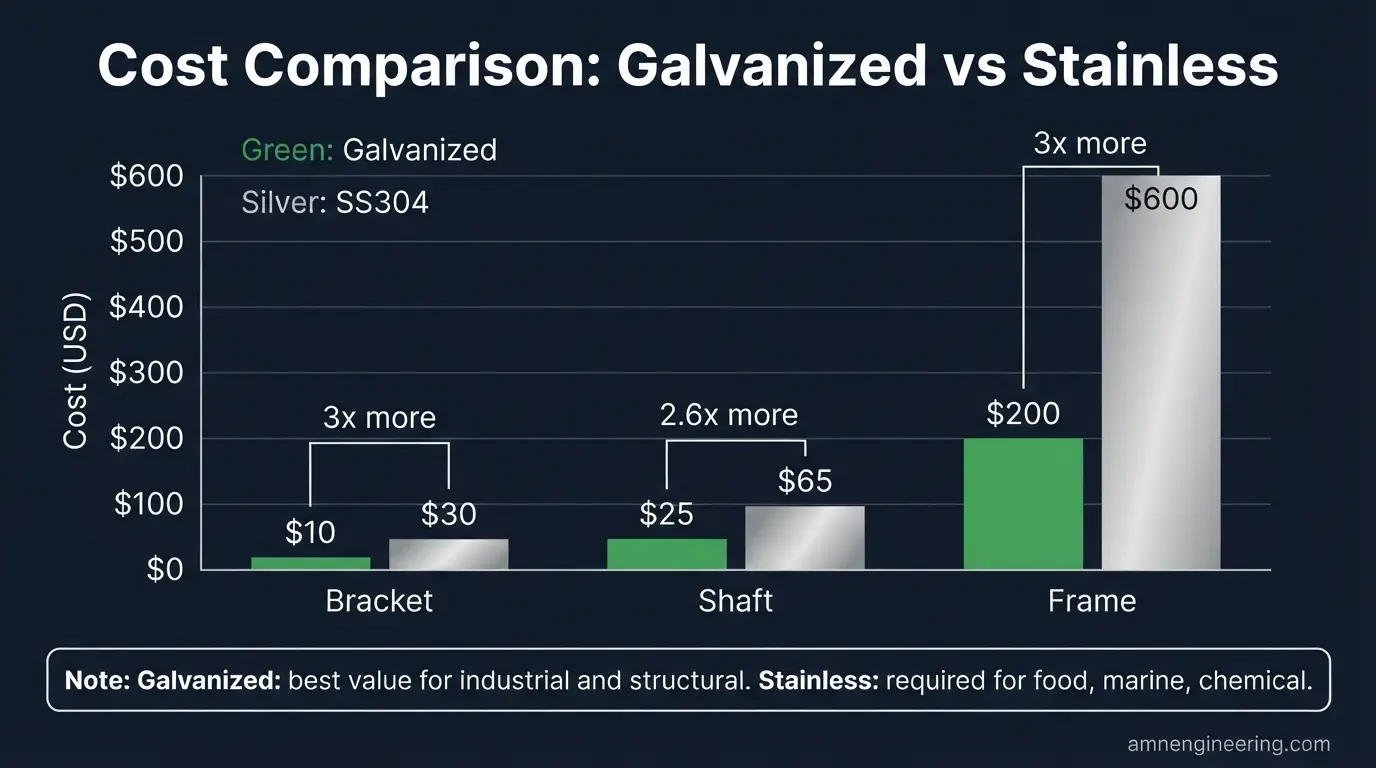
The cost difference between galvanized and stainless is significant:
| Part Example | Galvanized Steel | SS304 | SS316 |
|---|---|---|---|
| Bracket (simple) | $10 | $30 | $38 |
| Shaft (CNC machined) | $25 | $65 | $80 |
| Fabricated frame | $200 | $600 | $750 |
| Conduit (per meter) | $3 | $12 | $15 |
Stainless steel costs 3 to 4 times more than galvanized for the same part. For large structural projects (frameworks, platforms, guardrails), this cost difference is enormous. For small visible parts (handrails, signage brackets, architectural fittings), the premium may be justified for appearance.
When to Choose Each Material
Choose Galvanized Steel When:
- The application is structural and industrial (frameworks, conduits, poles, fencing)
- Cost is a primary factor and the budget cannot support stainless
- The environment is mild to moderate outdoor (urban, suburban, inland)
- Appearance is secondary (hidden structure, utility infrastructure)
- You need high strength (galvanized carbon steel is stronger than stainless in yield strength)
- Your project involves steel conduits, guardrails, poles, or industrial platforms
Choose Stainless Steel When:
- The application involves food, beverage, or pharmaceutical processing
- The environment is marine, coastal, or high chloride (SS316 required)
- The part is visible to end users and appearance matters (architectural, public facing)
- Chemical exposure is present (acids, alkalis, cleaning chemicals)
- The part must maintain a clean, modern appearance for decades
- Hygiene and cleanability are requirements (food factories, hospitals, clean rooms)
The Hybrid Approach
For projects where some parts are visible and others are hidden, use stainless for the visible elements and galvanized for the structure. This gives the best of both worlds at a reasonable cost. For example: galvanized steel framework with stainless steel handrails and cladding.
Frequently Asked Questions
Both last decades. Galvanized lasts 50 to 100 years in mild conditions. Stainless is essentially unlimited. In severe coastal or chemical environments, stainless (SS316) outlasts galvanized significantly.
No. Zinc can dissolve in acidic conditions and contaminate food. Food contact applications require stainless steel (SS304 minimum, SS316 for acidic products).
No. Galvanizing is for carbon steel only. Stainless steel does not need galvanizing because it is inherently corrosion resistant.
When the application requires zero maintenance over 30+ years, when the environment would destroy galvanizing quickly (marine, high chloride), or when food/pharmaceutical standards require stainless.