Material Selection for Pump Components: A Complete Guide
By Adil, Managing Director at AMN Engineering · · 9 min read
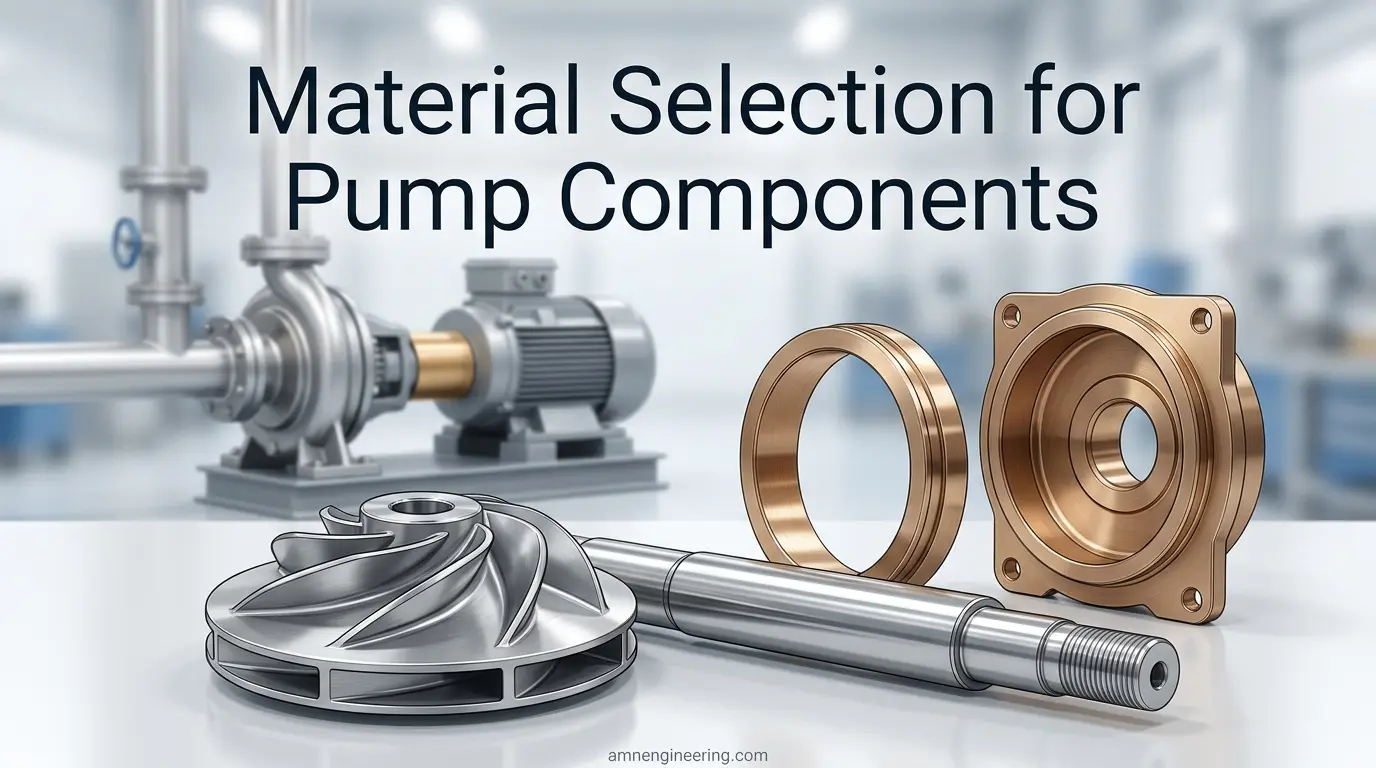
Choosing the right material for pump components is one of the most important decisions in pump design and maintenance. The wrong material leads to premature failure, costly downtime, contaminated fluids, and safety risks. The right material ensures years of reliable service with minimal maintenance.
Pump component material selection depends on several factors including the fluid being pumped, operating temperature, pressure, flow rate, and the surrounding environment. A pump handling clean water in a building needs very different materials than a pump moving sulfuric acid in a chemical plant.
At AMN Engineering, we manufacture custom pump components including impellers, shafts, casings, wear rings, and sleeves using CNC machining, forging, and die casting. In this guide, we break down the most common materials used in pump manufacturing and help you choose the right one for your application.
Why Material Selection Matters for Pump Components
Choosing the right material for pump components is one of the most important decisions in pump design and maintenance. The wrong material leads to premature failure, costly downtime, contaminated fluids, and safety risks. The right material ensures years of reliable service with minimal maintenance.
Pump component material selection depends on several factors including the fluid being pumped, operating temperature, pressure, flow rate, and the surrounding environment. A pump handling clean water in a building needs very different materials than a pump moving sulfuric acid in a chemical plant.
Every component in a pump sees a different combination of these stresses, so a single material rarely suits the whole assembly. The sections below walk through what each part does, which materials suit it, and how to weigh the trade-offs for your own application.
Common Pump Parts and Their Material Needs
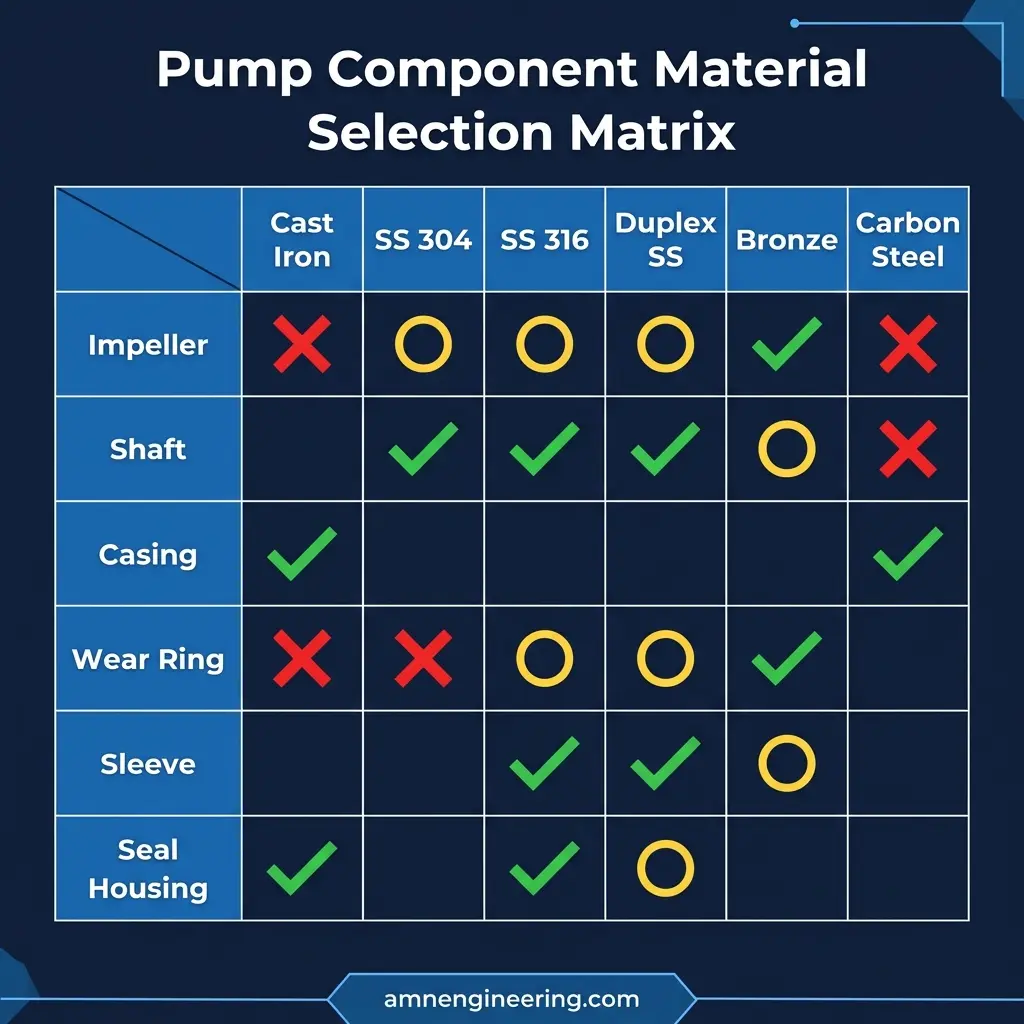
Different pump components face different stresses. Understanding what each part does helps you select the best material for it.
Impellers
The impeller is the rotating component that moves the fluid. It faces constant erosion from the fluid flow and may also face chemical attack from corrosive fluids. Impeller materials must resist both erosion and corrosion while maintaining dimensional accuracy at high rotational speeds.
Shafts
The pump shaft transmits torque from the motor to the impeller. It must handle torsional stress, bending loads, and vibration. Shaft materials need high fatigue strength and, in many cases, corrosion resistance where the shaft passes through seals.
Casings
The casing contains the pressurized fluid and directs flow through the pump. It must resist internal pressure, erosion, and corrosion from the pumped fluid. Casing walls must be thick enough to handle the operating pressure with a safe margin.
Wear Rings and Sleeves
These are sacrificial components designed to protect more expensive parts like the casing and shaft. They are replaced periodically as they wear down. Materials for wear rings and sleeves should be softer than the impeller to prevent damage to the impeller surface.
Popular Materials for Pump Components
Cast Iron (Grey Iron and Ductile Iron)
Cast iron is the most common and affordable material for general purpose pump casings and impellers. Grey cast iron (Grade 250 or ASTM A48 Class 30) is used for standard water pumps, HVAC systems, and irrigation. Ductile iron (ASTM A536) offers better impact resistance and is used for higher pressure applications.
Best for: Clean water, HVAC, irrigation, general industrial use
Limitations: Poor chemical resistance, brittle under impact (grey iron), limited temperature range
Stainless Steel 304
SS 304 is the most widely used stainless steel grade. It offers good corrosion resistance for mild chemicals, food products, and clean fluids. It is commonly used for pump shafts, impellers, and casings in food processing, pharmaceutical, and dairy applications.
Best for: Food and beverage processing, clean chemical applications, potable water
Limitations: Susceptible to chloride pitting in saltwater or high chloride environments
Stainless Steel 316
SS 316 contains 2 to 3 percent molybdenum, which gives it significantly better resistance to chloride corrosion and pitting compared to 304. It is the standard choice for chemical pumps, marine applications, and any fluid containing chlorides, salts, or mild acids. For a full breakdown of grades, see our guide to stainless steel grades 304 vs 316 vs 410 vs 430.
Best for: Chemical processing, marine environments, pharmaceutical production, saltwater
Limitations: More expensive than 304, still limited against strong acids like hydrochloric acid
Duplex Stainless Steel (2205)
Duplex 2205 has roughly twice the yield strength of 304 or 316, combined with excellent resistance to stress corrosion cracking and chloride pitting. It is used in demanding applications like offshore oil and gas, desalination plants, and high pressure chemical processing.
Best for: Seawater desalination, offshore platforms, high pressure chemical pumps
Limitations: More difficult to machine, higher material cost
Bronze (Gunmetal, Aluminum Bronze)
Bronze alloys have been used in pumps for centuries, particularly in marine applications. Gunmetal bronze (BS 1400 LG2) is common for impellers and wear rings in seawater pumps. Aluminum bronze offers higher strength and is used for high performance marine and offshore applications.
Best for: Seawater cooling systems, marine pumps, fire fighting pumps
Limitations: Lower strength than stainless steel, higher cost for large components
Carbon Steel (EN8, EN24)
Carbon steel and alloy steel grades are primarily used for pump shafts. EN8 is suitable for general duty shafts in water pumps. EN24 (also known as AISI 4340) provides higher tensile strength and fatigue resistance for heavy duty and high pressure pump applications. Our comparison of EN8 vs EN24 vs SS304 explains how to pick between them.
Best for: Pump shafts, coupling hubs, bearing housings
Limitations: Requires surface protection (chrome plating or coating) in corrosive environments
Selection Criteria: How to Choose the Right Material
1. Fluid Type and Chemical Compatibility
This is the most important factor. The material must resist chemical attack from the fluid being pumped. Refer to chemical compatibility charts from material suppliers or standards such as ASTM G48 for pitting resistance data.
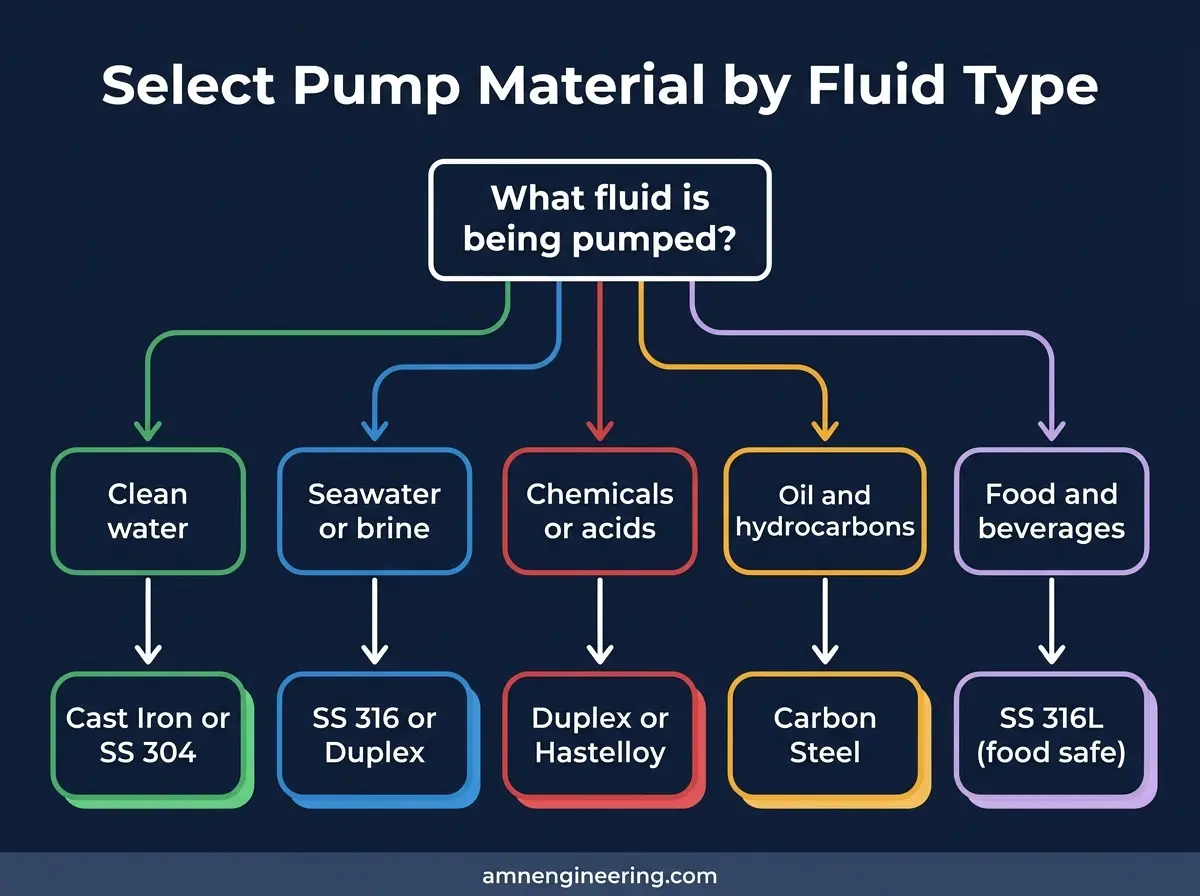
Common fluid categories and recommended materials:
| Fluid Type | Recommended Material |
|---|---|
| Clean water | Cast iron, SS 304 |
| Seawater | Bronze, SS 316, Duplex |
| Mild acids and alkalis | SS 316 |
| Strong acids | Hastelloy, titanium |
| Food and dairy products | SS 304 or SS 316 (electropolished) |
| Slurries with abrasive particles | High chrome cast iron, Ni Hard |
2. Operating Temperature
Every material has a maximum service temperature. Cast iron typically works up to 250°C. Standard stainless steels are good up to 400°C. Above that, you need specialty alloys like Inconel or Hastelloy. Always check the material data sheet and derate for long term service.
3. Operating Pressure
Higher pressure requires stronger materials and thicker walls. Ductile iron handles higher pressures than grey cast iron. Duplex stainless steel allows thinner walls at the same pressure rating compared to 316, which can reduce pump weight and cost.
4. Erosion and Abrasion Resistance
Pumps handling fluids with solid particles (sand, slurry, mineral content) need materials with high surface hardness. High chrome white iron (27 percent Cr) and Ni Hard cast iron are common for slurry pumps. Hardened stainless steels and tungsten carbide coatings are used for severe erosion.
5. Cost and Availability
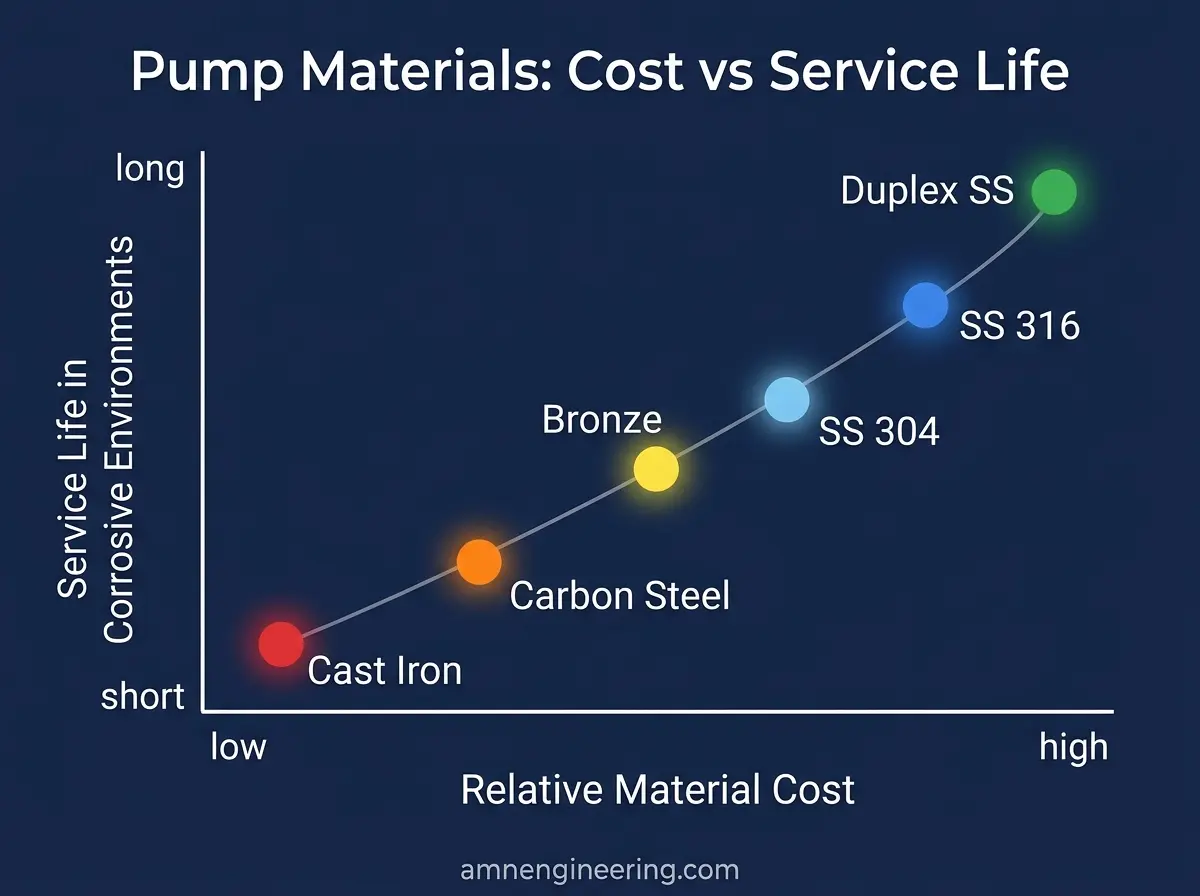
Cast iron and carbon steel are the most affordable and widely available options. Stainless steels are moderately priced with good availability. Duplex, bronze, and specialty alloys cost significantly more and may have longer lead times. Always balance performance requirements against budget and expected service life.
Material Comparison Table
| Property | Cast Iron | SS 304 | SS 316 | Duplex 2205 | Bronze (LG2) |
|---|---|---|---|---|---|
| Corrosion Resistance | Low | Good | Very Good | Excellent | Good (seawater) |
| Strength | Moderate | Good | Good | Very High | Moderate |
| Max Temperature | 250°C | 400°C | 400°C | 300°C | 260°C |
| Machinability | Excellent | Good | Good | Difficult | Good |
| Cost | Low | Moderate | Moderate to High | High | Moderate to High |
| Typical Use | Water pumps | Food processing | Chemical pumps | Offshore, desalination | Marine pumps |
Industry Standards for Pump Materials
When specifying pump component materials, reference these international standards.
Material standards:
- ASTM A48 for grey cast iron
- ASTM A536 for ductile iron
- ASTM A351 / A743 for cast stainless steel
- BS EN 10088 for stainless steel grades
- BS 1400 for bronze castings
Pump design standards:
- API 610 for centrifugal pumps in petroleum and chemical industries
- ISO 5199 for technical specifications of centrifugal pumps
- ASME B73.1 for chemical process pumps
These standards define minimum material properties, testing requirements, and quality controls. At AMN Engineering, we manufacture pump components to these standards and provide Material Test Certificates (MTCs) with every shipment.
Why AMN Engineering Is the Right Partner for Pump Parts
AMN Engineering has been manufacturing custom pump components for over 25 years. Our clients include pump manufacturers and maintenance teams in the GCC, Europe, and North America.
Multi process capability under one roof. We handle CNC machining, forging, die casting, and metal fabrication in house. This means your impeller can be cast, machined, balanced, and inspected without leaving our facility. If you are weighing production routes, our guide to forging vs casting vs machining explains the trade-offs.
Material expertise. We work with cast iron, all grades of stainless steel, duplex, bronze, and carbon steel. We source materials with full mill certificates and can match any material specification you require.
No minimum order. Whether you need a single replacement impeller or 5,000 production shafts, we handle both with the same quality standards.
Full documentation. Every part ships with dimensional inspection reports, Material Test Certificates, and any additional documentation your quality team requires.
Fast turnaround. Prototype pump parts in 7 to 10 days. Production batches in 2 to 4 weeks depending on complexity and material availability.
Frequently Asked Questions
The best material depends on the fluid being pumped. Cast iron works for clean water. Stainless steel 316 is ideal for corrosive or chemical fluids. Bronze is preferred for seawater. Duplex stainless steel offers the best combination of strength and corrosion resistance for demanding applications.
Stainless steel 316 contains molybdenum, which gives it superior resistance to chloride corrosion and pitting. This makes it ideal for pumps handling chemicals, saltwater, food products, and pharmaceutical fluids where contamination must be avoided.
Cast iron is not recommended for most chemical applications. It corrodes quickly when exposed to acids, alkalis, and aggressive chemicals. For chemical pumps, stainless steel 316, duplex stainless steel, or specialty alloys like Hastelloy are better choices.
EN8 carbon steel is suitable for general water pumps. EN24 alloy steel provides higher strength for high pressure applications. Stainless steel 304 or 316 is used when corrosion resistance is needed. The choice depends on operating pressure, fluid type, and temperature.
Duplex stainless steel has a mixed microstructure of austenite and ferrite, giving it roughly twice the yield strength of standard 304 or 316 stainless steel. It is used in pumps handling seawater, chloride rich fluids, or high pressure applications where both strength and corrosion resistance are needed.
