Maximum Laser Cutting Thickness by Metal Type: Quick Reference Guide
By Adil, Managing Director at AMN Engineering · · 5 min read
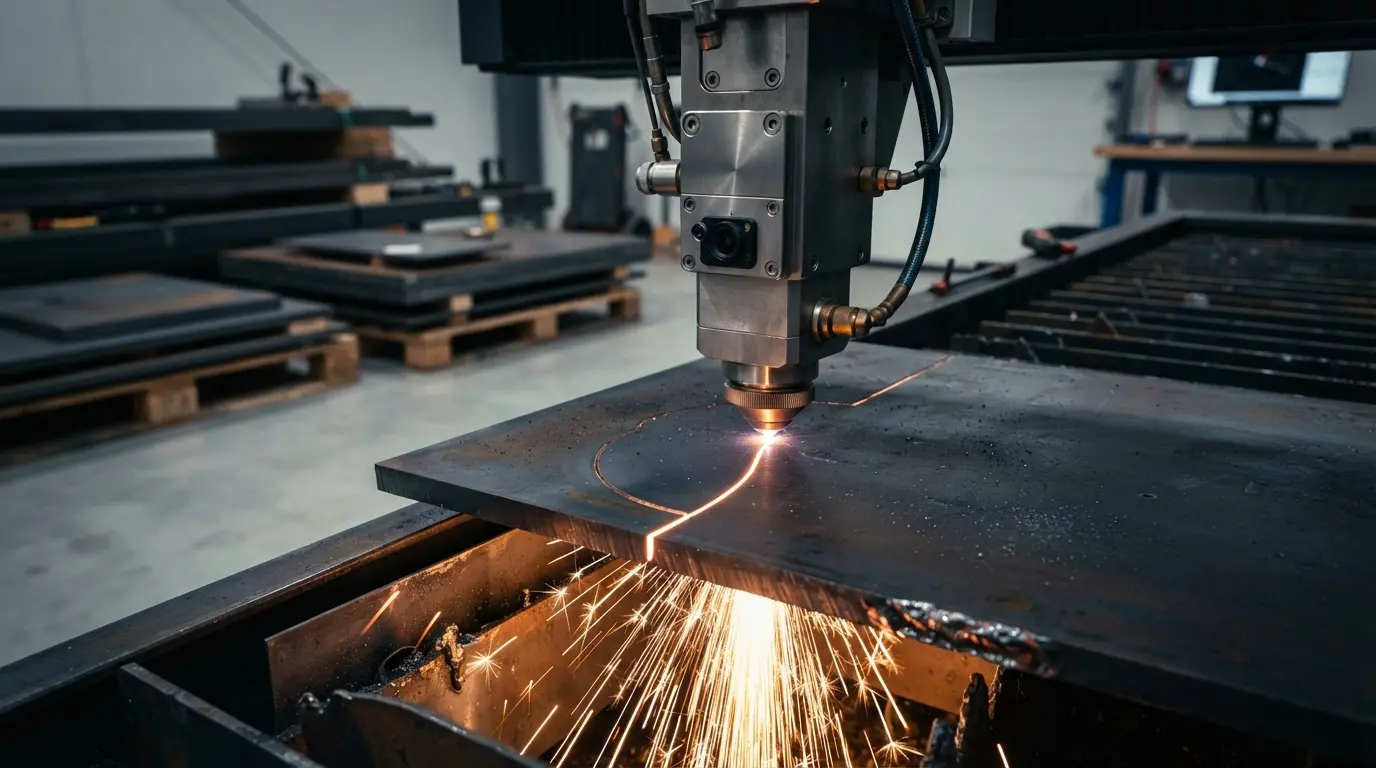
"Can your laser cut this thickness?" is one of the most common questions we receive at AMN Engineering. The answer depends on the material type, the laser power, and whether you need speed or just need it cut.
This guide gives you the maximum laser cutting thickness for every common metal, organized by laser power. Bookmark it and use it as a quick reference before sending your next drawing.
The Quick Reference Chart
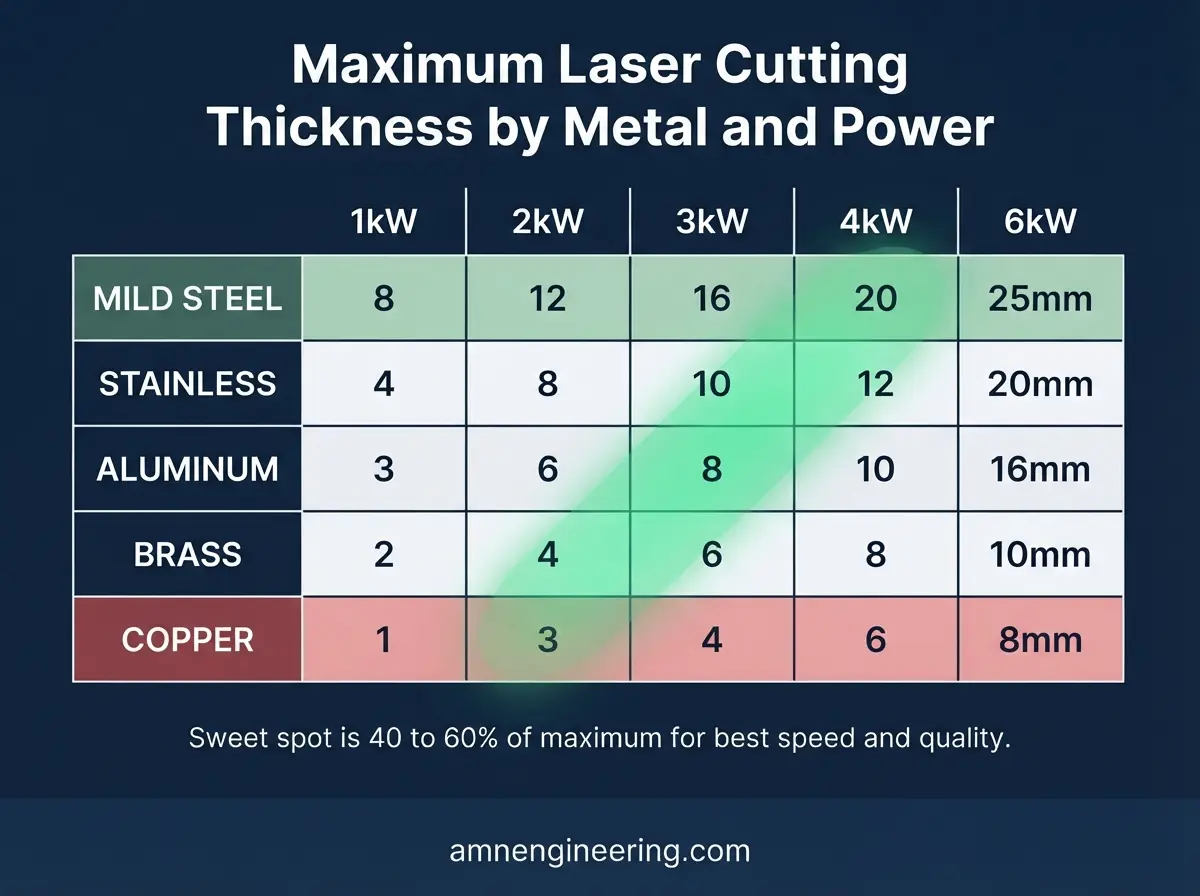
Maximum Cutting Thickness by Laser Power
| Material | 1 kW | 2 kW | 3 kW | 4 kW | 6 kW |
|---|---|---|---|---|---|
| Mild Steel | 8mm | 12mm | 16mm | 20mm | 25mm |
| Stainless Steel | 4mm | 8mm | 10mm | 12mm | 20mm |
| Aluminum | 3mm | 6mm | 8mm | 10mm | 16mm |
| Brass | 2mm | 4mm | 6mm | 8mm | 10mm |
| Copper | 1mm | 3mm | 4mm | 6mm | 8mm |
Important: These are maximum thicknesses. The "sweet spot" where speed, quality, and cost are all optimal is typically 40 to 60 percent of the maximum. For example, a 2kW laser can cut 12mm mild steel, but it works best on material under 8mm.
Mild Steel Thickness Limits
Mild steel is the easiest material to laser cut. It cuts cleanly with oxygen assist gas, which adds energy to the cut through an exothermic reaction (the iron burns in the oxygen stream, helping the laser).
Sweet Spots by Laser Power
| Laser Power | Max Thickness | Sweet Spot (best quality and speed) |
|---|---|---|
| 1 kW | 8mm | 1 to 5mm |
| 2 kW | 12mm | 1 to 8mm |
| 4 kW | 20mm | 1 to 12mm |
| 6 kW | 25mm | 1 to 16mm |
What Happens at Maximum Thickness
At maximum thickness, the laser still cuts but: speed drops dramatically (10 to 20 percent of optimal speed), edge quality degrades (more dross, rougher surface), and the heat affected zone widens. For anything beyond maximum, consider plasma cutting.
Stainless Steel Thickness Limits
Stainless steel is harder to laser cut than mild steel because it does not benefit from the exothermic oxygen reaction. Nitrogen assist gas is used instead to produce a clean, oxide free edge.
| Laser Power | Max Thickness | Sweet Spot |
|---|---|---|
| 1 kW | 4mm | 1 to 3mm |
| 2 kW | 8mm | 1 to 5mm |
| 4 kW | 12mm | 1 to 8mm |
| 6 kW | 20mm | 1 to 12mm |
Why Stainless Is Thinner Than Mild Steel
Nitrogen does not add energy like oxygen does. The laser must do all the work of melting through the material. This reduces the maximum thickness by approximately 30 to 40 percent compared to mild steel at the same power.
Aluminum Thickness Limits
Aluminum is the most challenging common metal to laser cut because it is highly reflective (bounces laser energy) and highly thermally conductive (heat spreads away from the cut zone quickly).
| Laser Power | Max Thickness | Sweet Spot |
|---|---|---|
| 1 kW | 3mm | 1 to 2mm |
| 2 kW | 6mm | 1 to 4mm |
| 4 kW | 10mm | 1 to 6mm |
| 6 kW | 16mm | 1 to 10mm |
Tips for Laser Cutting Aluminum
Nitrogen assist gas is standard. Edge quality is generally rougher than steel at the same thickness. For thicker aluminum (above 10mm), waterjet cutting produces better edge quality with no heat distortion.
Brass and Copper
Brass and copper are highly reflective and thermally conductive, making them the most difficult common metals to laser cut. Higher power lasers (4kW+) handle them much better than lower power machines.
| Material | 2 kW Max | 4 kW Max | 6 kW Max |
|---|---|---|---|
| Brass | 4mm | 8mm | 10mm |
| Copper | 3mm | 6mm | 8mm |
Older CO2 lasers struggle with these materials. Modern fiber lasers (1070nm wavelength) are significantly better at cutting reflective metals.
How Laser Power Affects Capacity
More power means: thicker maximum cut, faster cutting speed at any thickness, and better edge quality on thick material.
Doubling the laser power does not double the maximum thickness. It adds approximately 40 to 60 percent more capacity because the relationship between power and cutting ability is not linear.
Do You Need Maximum Thickness?
If most of your work is sheet metal under 6mm, a 2kW laser is more than adequate and costs far less to operate than a 6kW machine. Higher power is only justified when you regularly cut thick material.
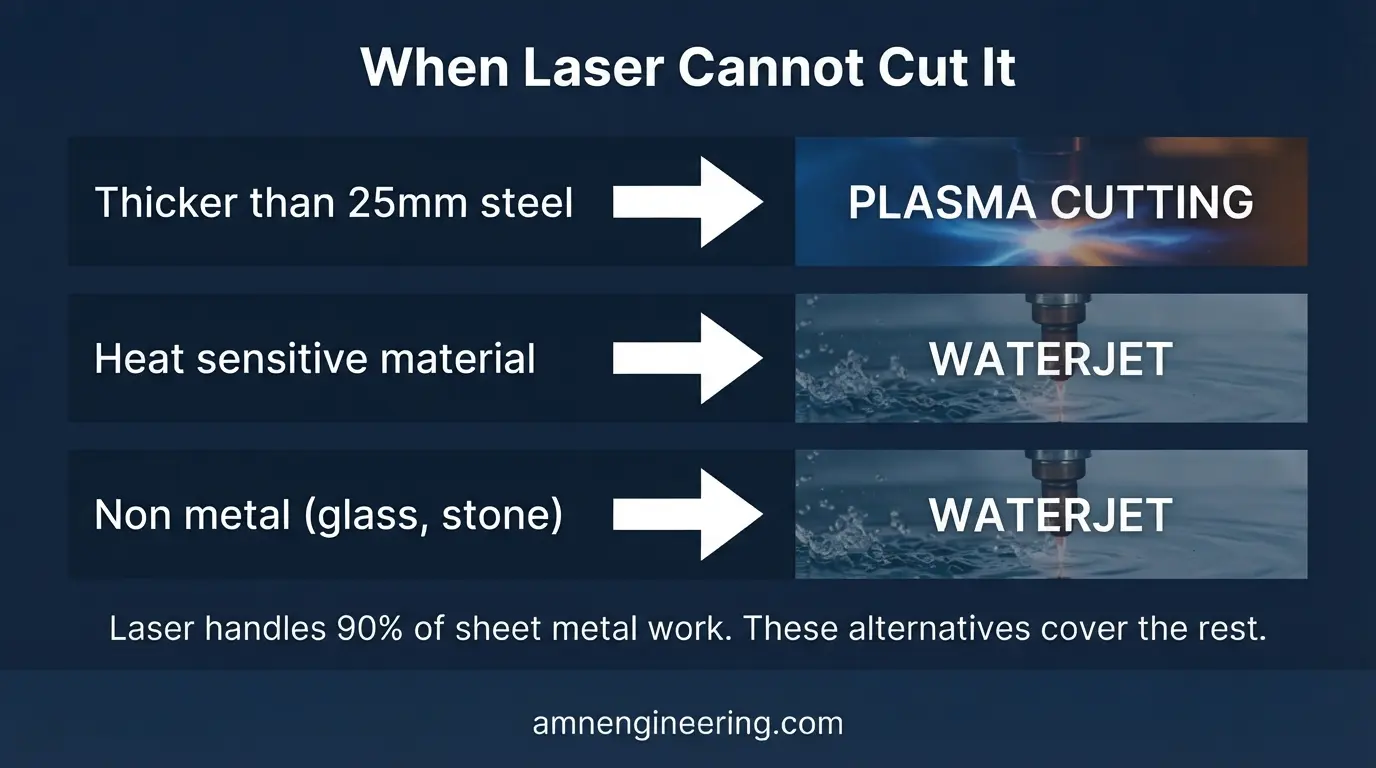
At AMN Engineering, our laser cutting capability handles the vast majority of sheet metal and plate work. For anything beyond our laser capacity, we recommend plasma cutting for thick steel or waterjet for heat sensitive materials.
When Laser Cannot Cut It: Alternatives
| If Your Material Is... | Use Instead |
|---|---|
| Thicker than 25mm mild steel | Plasma cutting |
| Thicker than 20mm stainless | Waterjet or plasma |
| Heat sensitive (no HAZ allowed) | Waterjet |
| Non metal (stone, glass, composites) | Waterjet |
| Very thick aluminum (above 16mm) | Waterjet |
Frequently Asked Questions
A 6kW fiber laser cuts mild steel up to approximately 25mm. A 2kW laser handles up to 12mm. The sweet spot is 40 to 60 percent of maximum for best speed and quality.
Yes. Maximum thickness depends on laser power: 4mm at 1kW up to 20mm at 6kW. Nitrogen assist gas is used for clean oxide free edges.
Aluminum is highly reflective (bounces laser energy) and thermally conductive (heat dissipates quickly). This reduces cutting efficiency compared to steel.
When cutting mild steel thicker than 20 to 25mm, or when edge quality is not critical and cost matters more than precision.