Why Laser Cutting Gives Better Edge Quality Than Stamping
By Adil, Managing Director at AMN Engineering · · 6 min read
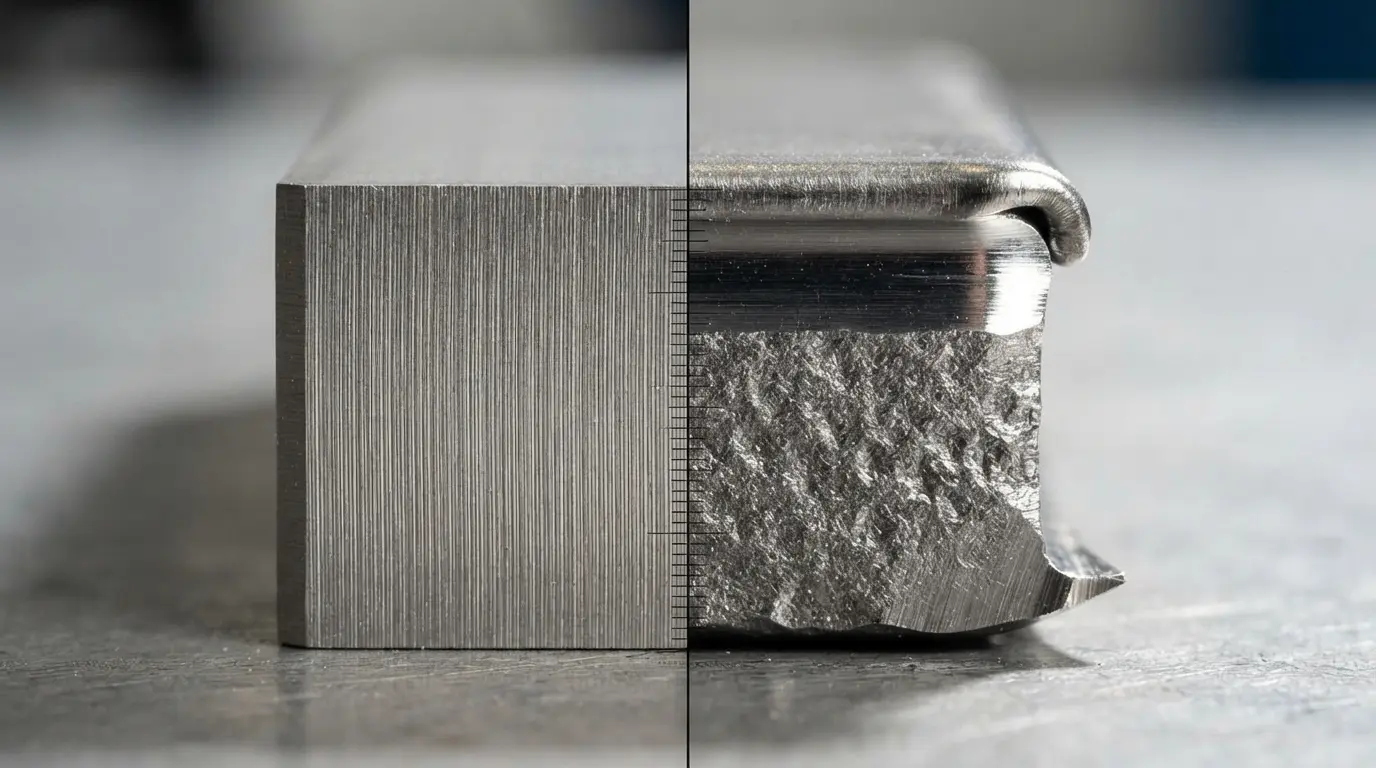
Pick up a laser cut bracket and a stamped bracket. Run your finger along the edges. The difference is immediately obvious.
The laser cut edge is smooth, square, and clean. The stamped edge has a slight rollover on one side, a shear zone, and a burr on the opposite side that can be sharp enough to cut your finger.
This guide explains why these differences exist, when they matter, and when you should choose laser over stamping (or accept stamped edges to save cost).
The Visible Difference
Laser Cut Edge
Smooth, straight, and square to the surface. No rollover, no burr, no breakout. The cut face shows fine vertical lines (striations from the laser beam travel) but feels smooth to touch. On thin material (under 6mm), the edge is ready for welding, painting, or assembly without any secondary finishing.
Stamped Edge
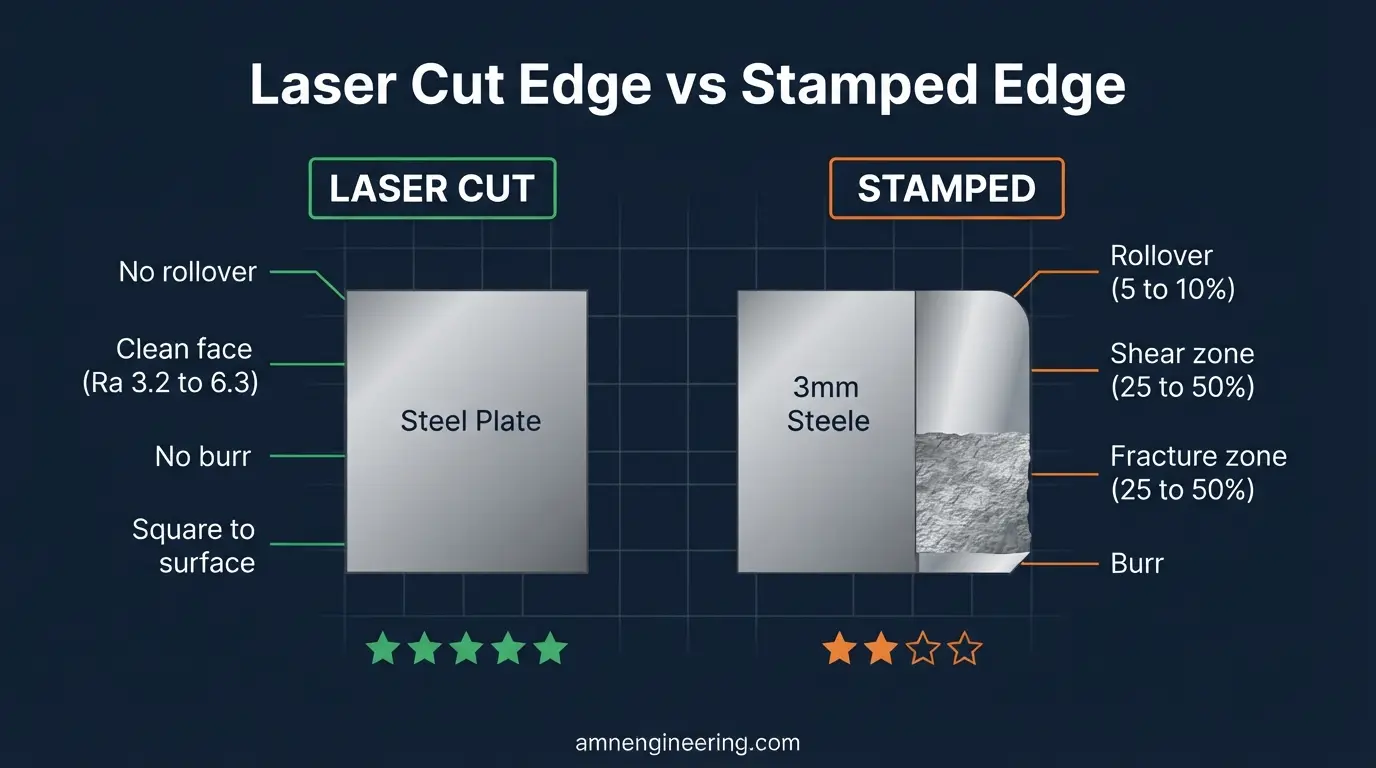
Shows four distinct zones from top to bottom: rollover (slight rounding where the punch first contacts the sheet), shear zone (smooth and shiny where the material was cleanly cut), fracture zone (rough and textured where the material tore apart), and burr (a raised sharp edge on the bottom where material was pushed out). The thicker the material, the more pronounced these zones become.
How Laser Cutting Produces Clean Edges
Laser cutting melts or vaporizes metal along a very narrow path (0.1 to 0.3mm wide). The assist gas (nitrogen or oxygen) blows the molten material out of the cut. The result is a narrow, clean cut with:
- No mechanical force on the material (no rollover, no deformation)
- A very small heat affected zone (0.1 to 0.5mm)
- Consistent edge quality along the entire cut length
- Edge perpendicularity within 1 degree
- Surface roughness of Ra 3.2 to 6.3 on the cut face
Because the laser does not physically touch the material, there is no tool wear and no degradation of edge quality over a production run. The first part and the thousandth part have the same edge.
How Stamping Produces Edges
Stamping shears the material between a punch and a die. The punch pushes down into the sheet, the material deforms, then fractures and separates. This mechanical shearing process creates the characteristic four zone edge:
Rollover (5 to 10% of thickness): The punch pulls the material downward before cutting begins, creating a rounded edge on the punch side.
Shear zone (25 to 50% of thickness): Clean, shiny surface where the material was cut by the shearing action between punch and die.
Fracture zone (25 to 50% of thickness): Rough, textured surface where the material tore apart rather than being cleanly cut.
Burr (variable): A raised lip of material on the die side where the material was pushed out rather than cleanly separated. Burr height depends on punch to die clearance, tool sharpness, and material hardness.
As the stamping die wears over thousands of strokes, the burr gets larger and edge quality degrades. Regular die maintenance (resharpening) is needed to maintain acceptable edges.
Edge Quality Comparison
| Factor | Laser Cut Edge | Stamped Edge |
|---|---|---|
| Rollover | None | Present (top side) |
| Burr | None or negligible | Present (bottom side, can be sharp) |
| Edge Squareness | Within 1 degree | Varies (rollover + fracture angle) |
| Surface Finish (edge) | Ra 3.2 to 6.3 | Varies (smooth shear + rough fracture) |
| Consistency Over Run | Identical first to last | Degrades as die wears |
| Deburring Needed | Rarely | Often (especially on visible parts) |
| Edge Safe to Handle | Yes | No (burr can cut skin) |
When Edge Quality Matters
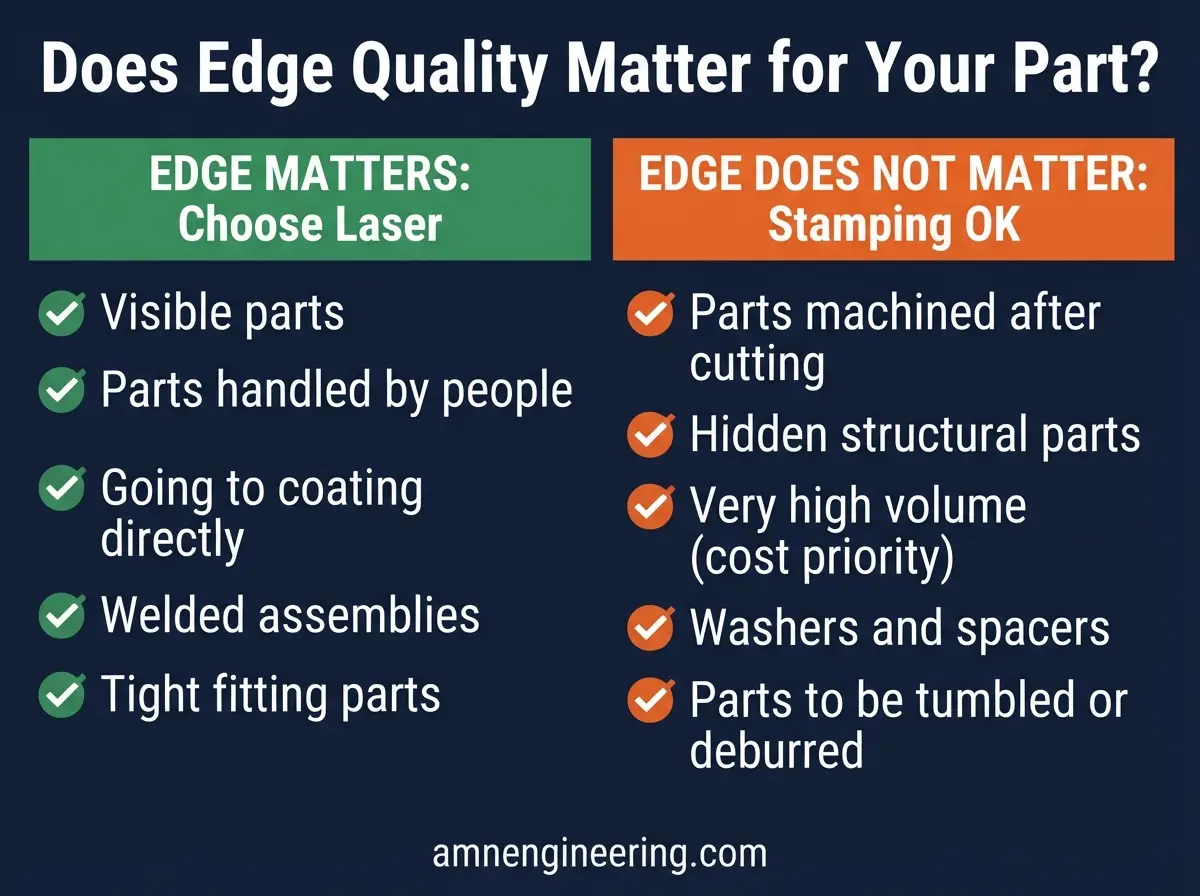
Visible parts. Brackets, panels, covers, guards, and decorative screens that are seen by end users. Stamped burrs and rollover look unprofessional. Laser edges look finished.
Parts that are handled. If workers or end users touch the parts, stamped burrs are a safety hazard. Laser cut edges are smooth and safe to handle without gloves.
Parts going directly to coating. Powder coating, painting, and plating adhere better to smooth laser cut edges. Burrs on stamped parts can cause coating defects (thin spots over sharp edges, drips at burr locations).
Welded assemblies. Clean laser cut edges produce better weld joints. The welder starts with a clean, square edge rather than having to grind off burrs first.
Tight fitting parts. When parts nest or fit together closely, the rollover and burr on stamped parts can interfere with fit. Laser cut parts fit as drawn.
When Edge Quality Does Not Matter
Parts that will be ground or machined after cutting. If the edge gets CNC machined or ground to final dimension anyway, the as cut edge quality is irrelevant.
Structural parts hidden from view. Internal brackets, gussets, and structural reinforcements that nobody sees or touches. The burr does not affect structural performance.
Parts at very high volume where cost is critical. At 50,000+ parts, stamping is dramatically cheaper than laser. If the application tolerates a burr (or the burr is removed by tumbling), the cost savings justify the rougher edge.
Washers, spacers, and simple blanks. Parts with no aesthetic or safety requirement on the edge. A washer with a small burr works just as well as one without.
In these cases, choose stamping for its speed and cost advantage and accept the edge quality. Or add a tumbling or deburring step after stamping to remove the burr (this adds cost but is still cheaper than laser at high volumes).
Frequently Asked Questions
Laser melts and vaporizes material without mechanical force. There is no physical tool contact, so there is no rollover, no fracture zone, and no burr. The edge is consistently clean from first part to last.
Yes. As the stamping die wears, punch to die clearance increases, which makes burrs larger and edge quality rougher. Dies need periodic resharpening (every 10,000 to 50,000 strokes depending on material).
Yes. Common deburring methods include tumbling (barrel finishing), vibratory finishing, manual grinding, and belt sanding. Deburring adds 5 to 15 percent to part cost but is often cheaper than switching to laser at high volumes.
When parts are visible, handled by people, going directly to coating, welded into assemblies, or need to fit together precisely.