Understanding BS EN ISO 1461: Hot Dip Galvanizing Standards Explained
By Adil, Managing Director at AMN Engineering · · 6 min read
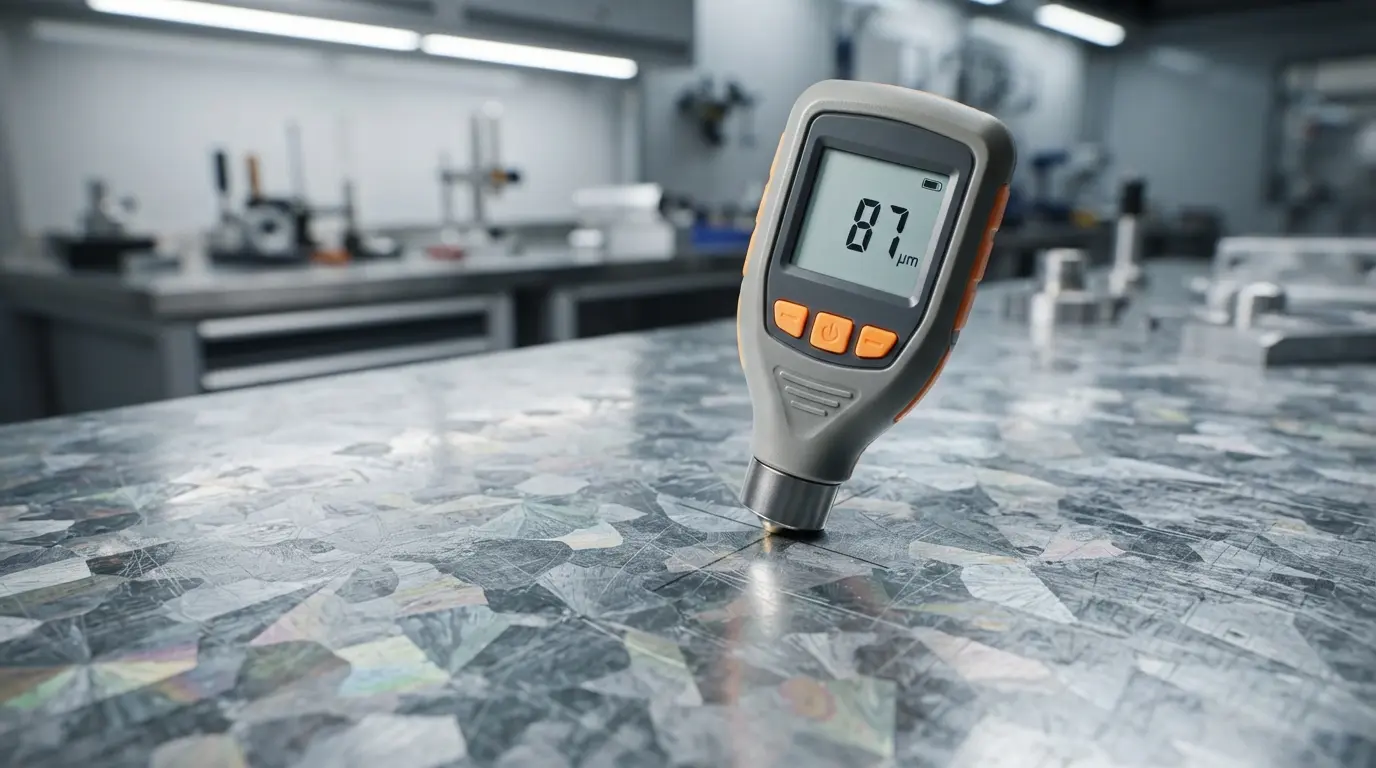
BS EN ISO 1461 is the international standard that governs hot dip galvanizing of iron and steel products. If you specify galvanized steel on a project, this is the standard your coating must meet.
But what does it actually require? What coating thickness is minimum? How is it measured? And what should you check when inspecting galvanized parts?
This guide translates ISO 1461 into plain language for engineers, specifiers, and procurement managers who need to understand what they are specifying without reading a 20 page standards document.
What Is ISO 1461?
ISO 1461 specifies the requirements for hot dip galvanized coatings on iron and steel articles. It covers:
- Minimum coating thickness based on steel thickness
- Appearance and surface condition requirements
- How to measure coating thickness
- How to test adhesion
- Inspection and acceptance criteria
- Marking and certification requirements
The standard applies to general hot dip galvanizing of fabricated articles and structural steelwork. It does not cover continuous sheet galvanizing (that is covered by different standards like EN 10346).
The standard is published as BS EN ISO 1461 in the UK (BS prefix) and is identical to EN ISO 1461 used across Europe and internationally.
Minimum Coating Thickness Requirements
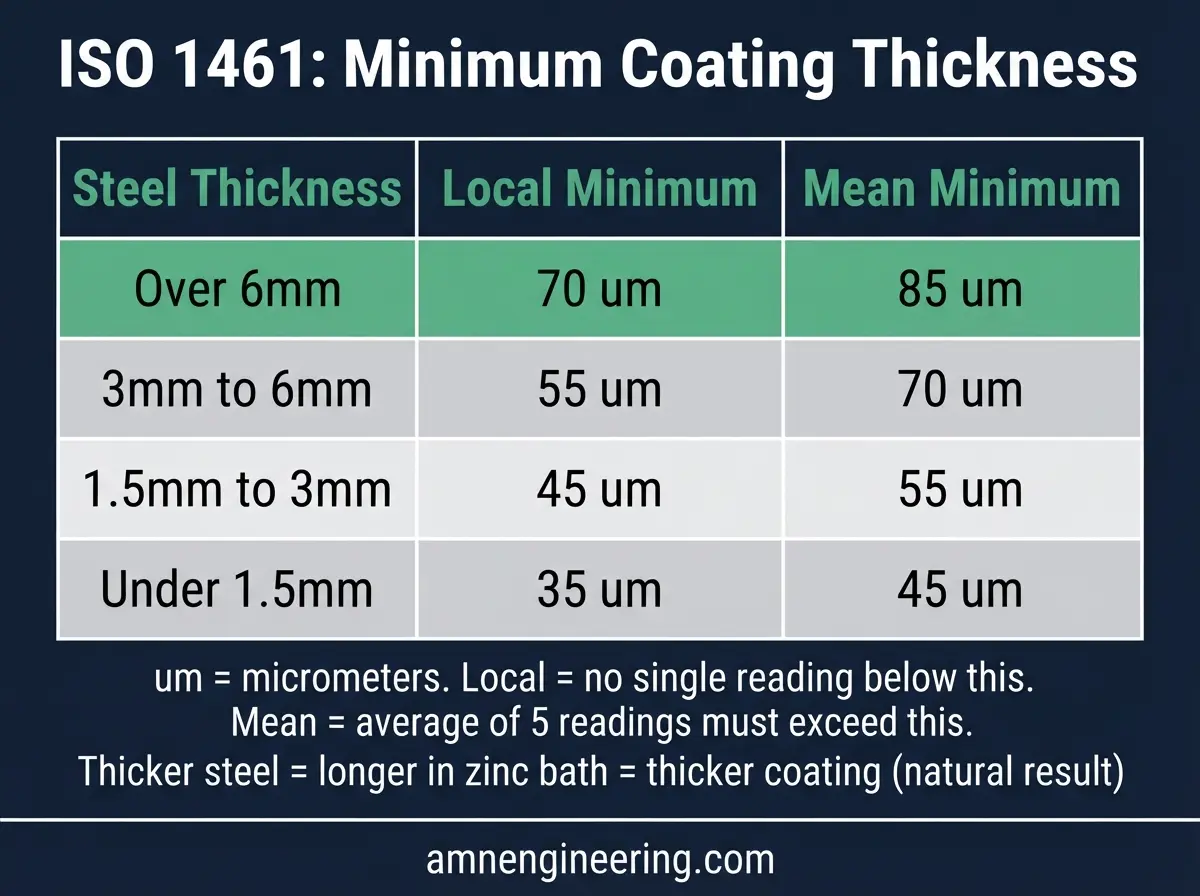
This is the most important table in the standard. Minimum thickness depends on the thickness of the steel being galvanized:
Steel Articles (Not Centrifuged)
| Steel Thickness | Minimum Local Thickness | Minimum Mean Thickness |
|---|---|---|
| Steel over 6mm | 70 micrometers | 85 micrometers |
| Steel 3mm to 6mm | 55 micrometers | 70 micrometers |
| Steel 1.5mm to 3mm | 45 micrometers | 55 micrometers |
| Steel under 1.5mm | 35 micrometers | 45 micrometers |
Centrifuged Articles (Small Parts Like Bolts, Nuts, Washers)
| Steel Thickness | Minimum Local Thickness | Minimum Mean Thickness |
|---|---|---|
| Steel over 6mm | 45 micrometers | 55 micrometers |
| Steel 3mm to 6mm | 35 micrometers | 45 micrometers |
| Steel under 3mm | 25 micrometers | 35 micrometers |
Centrifuged articles (small parts that are spun after galvanizing to remove excess zinc) have lower minimum thicknesses because the spinning removes some coating.
Why Thicker Steel Gets Thicker Coating
Thicker steel stays in the zinc bath longer (it takes longer to heat through). The longer immersion time allows more zinc iron alloy to form, resulting in a naturally thicker coating. The standard reflects this physical reality.
How Coating Thickness Is Measured
ISO 1461 specifies two methods:
Magnetic Method (Most Common)
A magnetic thickness gauge measures the distance between the steel substrate and the outer surface of the zinc coating. This is non destructive, fast, and the standard method used in production.
The gauge is placed on the galvanized surface and gives an instant reading in micrometers. Multiple readings are taken at specified locations across the article.
Gravimetric Method (Destructive)
A sample of the coated article is weighed, the coating is dissolved in acid, and the sample is weighed again. The weight difference gives the coating mass per unit area, which is converted to thickness.
This method is used for referee testing (resolving disputes) and is destructive (the sample is unusable afterward).
Inspection and Acceptance Criteria
Visual Inspection
The galvanized coating must be:
- Continuous (no uncoated areas)
- Reasonably smooth (minor roughness, runs, and drips are acceptable if they do not interfere with the intended use)
- Free from blisters, flux inclusions, and bare spots that would reduce protection
Coating Thickness Inspection
The standard requires measuring coating thickness at specified reference areas:
Reference area: A 10 cm x 10 cm (100 sq cm) area for articles large enough. For smaller articles, the entire surface may be the reference area.
Number of readings: At least 5 readings per reference area. The average of the 5 readings must meet the "mean" minimum. No single reading may fall below the "local" minimum.
Adhesion Test
The coating must not flake or peel when handled normally. If adhesion is questioned, a standard knife test can be used: a sharp knife is used to attempt to lift the coating. A properly galvanized coating that is metallurgically bonded will not lift or peel.
What "Local" vs "Mean" Thickness Means
This is where many people get confused:
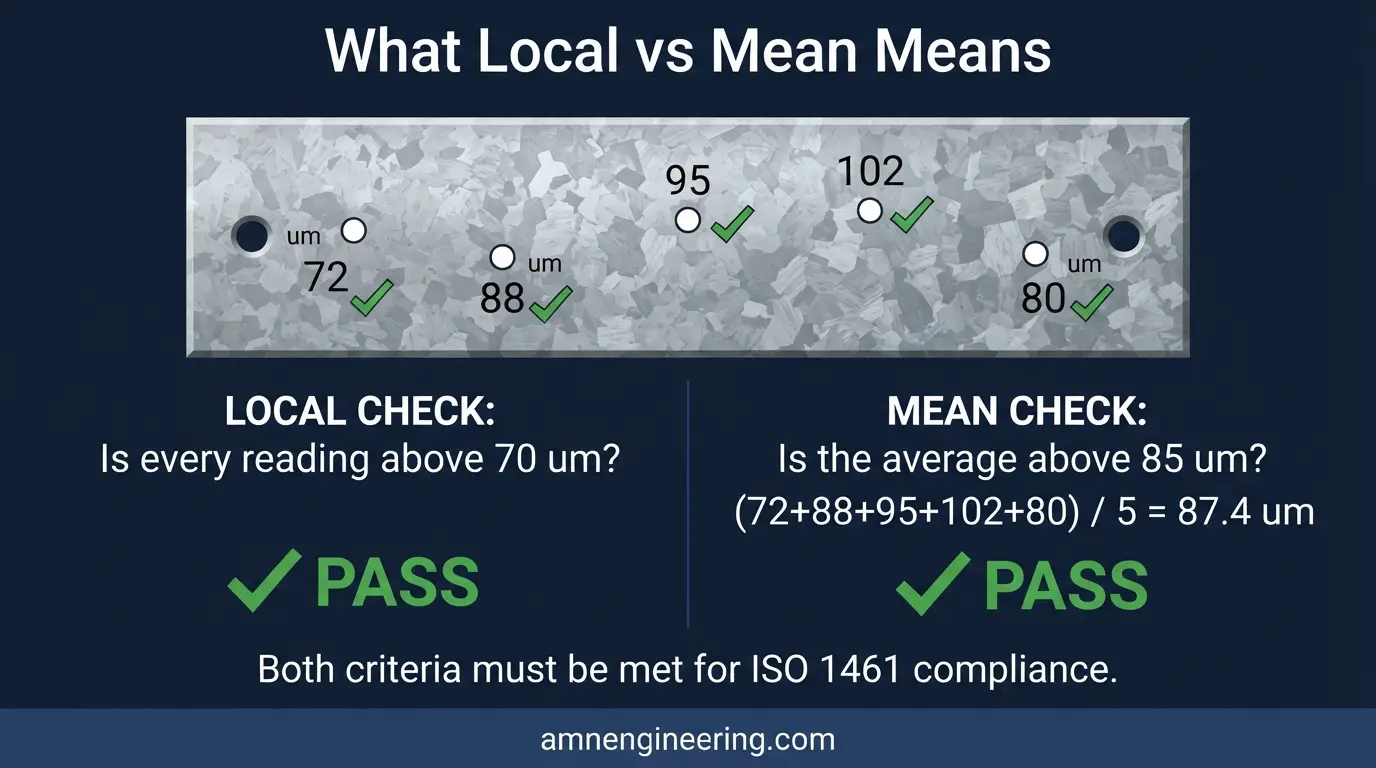
Local minimum is the absolute minimum at any single measurement point. No single reading may fall below this value.
Mean minimum is the average of all readings in a reference area. The average must meet or exceed this value.
Example
For steel over 6mm thick: Local minimum = 70 micrometers, Mean minimum = 85 micrometers.
If you take 5 readings on a reference area and get: 72, 88, 95, 102, 80 micrometers.
Local check: All readings are above 70? Yes (lowest is 72). Pass.
Mean check: Average = (72+88+95+102+80)/5 = 87.4 micrometers. Is it above 85? Yes. Pass.
Both criteria must be met for the area to comply.
Common Questions from Specifiers
"Can I specify a thicker coating than ISO 1461 minimum?"
Yes. ISO 1461 specifies minimums. You can request a thicker coating (e.g., 100 micrometers minimum mean instead of 85). However, coating thickness is primarily controlled by the steel chemistry and immersion time, not by adding more zinc. Very thick coatings may also be more brittle.
"Does ISO 1461 cover conduits?"
Yes. Steel conduits galvanized to Class 4 (per BS 31) should meet ISO 1461 coating thickness requirements on both interior and exterior surfaces.
"How do I request ISO 1461 compliance?"
State on your drawing or purchase order: "Hot dip galvanized to BS EN ISO 1461." If you want a specific minimum thickness, add it: "Minimum mean coating thickness 85 micrometers per ISO 1461."
"What documentation should the galvanizer provide?"
A certificate of conformity stating the parts were galvanized to ISO 1461, with coating thickness measurements recorded. At AMN Engineering, we provide coating thickness reports with every galvanized shipment.
Frequently Asked Questions
The international standard for hot dip galvanizing of iron and steel. It specifies minimum coating thicknesses, measurement methods, inspection criteria, and acceptance requirements.
70 micrometers local minimum, 85 micrometers mean minimum per ISO 1461.
Using a magnetic thickness gauge (non destructive). Multiple readings are taken and compared against local and mean minimum values.
Yes. Thicker steel requires longer immersion in the zinc bath, which naturally produces a thicker coating.
Yes. State your required minimum thickness on the purchase order. However, very thick coatings may be more brittle.