Class 3 vs Class 4 Conduits: Which One Does Your Installation Need?
By Adil, Managing Director at AMN Engineering · · 9 min read
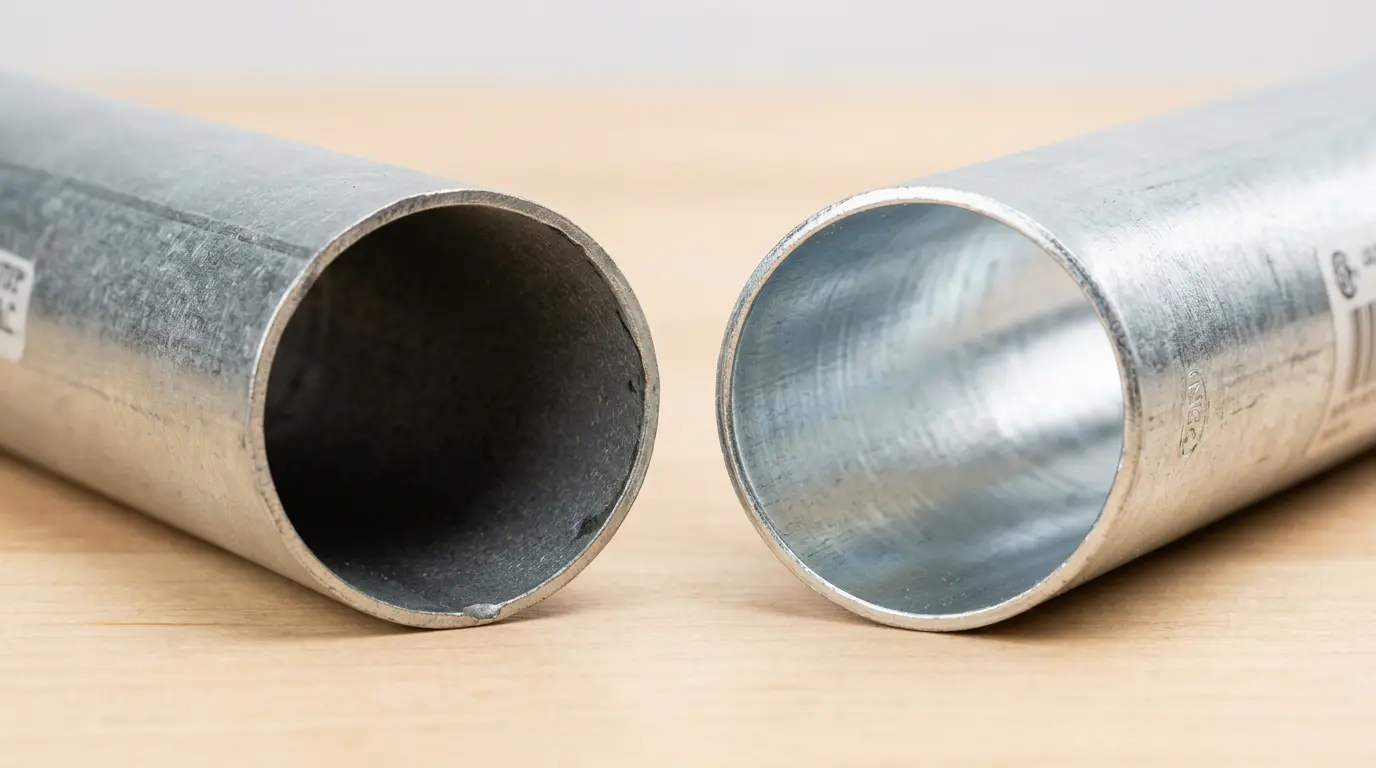
Class 3 vs Class 4 conduits. If you are specifying steel conduits to BS 31, this is one of the first decisions you need to make. Getting it wrong can mean conduit that corrodes within a few years, or overspending on a class you do not need.
We manufacture both Class 3 and Class 4 conduits at AMN Engineering in Lahore, along with conduit fittings. We export to GCC, Africa, and Asia. This guide explains the difference in plain language so you can specify the right class for your project.
The Simple Difference
Here is the simplest way to understand the two classes:
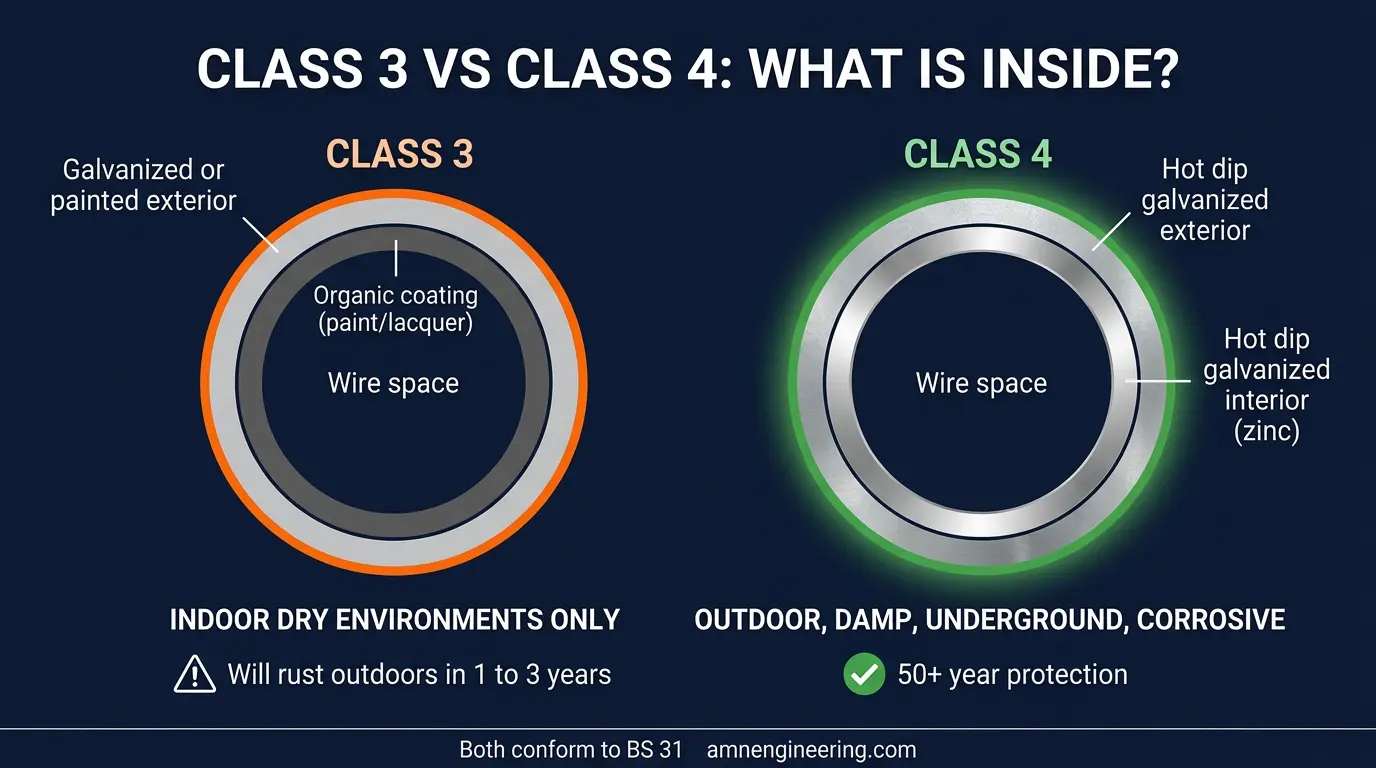
Class 3 = Indoor conduit. Organic (paint/lacquer) interior coating. Lighter gauge steel. Designed for dry environments only.
Class 4 = Outdoor conduit. Full hot dip galvanized interior and exterior. Heavier gauge steel. Designed for outdoor, damp, underground, and corrosive environments.
That is the core difference. Class 3 is protected by paint on the inside. Class 4 is protected by zinc on the inside. Everything else follows from this.
Class 3 Conduit Explained
Class 3 conduit has a lighter wall thickness. The interior is coated with an organic material (paint or lacquer). The exterior is galvanized or painted.
Characteristics
- Lighter gauge steel
- Organic (paint/lacquer) interior coating
- Suitable for indoor dry environments only
- Easier to bend due to thinner wall
- Lower cost
- Standard lengths of 3.75 meters
Where Class 3 Is Used
- Indoor commercial buildings
- Residential installations
- Dry factory interiors
- Above ceiling installations
Class 4 Conduit Explained
Class 4 conduit has a heavier wall thickness. It is fully hot dip galvanized on both the interior and exterior per ISO 1461.
Characteristics
- Heavier gauge steel
- Hot dip galvanized interior and exterior
- Suitable for outdoor, damp, underground, and corrosive environments
- More rigid due to thicker wall
- Higher cost (20 to 40 percent more than Class 3)
- Standard lengths of 3.75 meters
Where Class 4 Is Used
- Outdoor installations
- Industrial plants
- Damp environments (basements, tunnels, coastal areas)
- Underground or embedded in concrete
- Chemical plants
- Food processing facilities
- GCC extreme outdoor conditions
The Full Comparison
| Feature | Class 3 | Class 4 |
|---|---|---|
| Wall Thickness | Lighter gauge | Heavier gauge |
| Interior Coating | Organic (paint/lacquer) | Hot dip galvanized (zinc) |
| Exterior Coating | Galvanized or painted | Hot dip galvanized |
| Corrosion Protection | Basic (indoor only) | Excellent (50+ years outdoor) |
| Mechanical Strength | Good | Higher |
| Suitable Indoor (Dry) | Yes | Yes (but over specified) |
| Suitable Outdoor | No | Yes |
| Suitable Damp/Humid | No | Yes |
| Suitable Underground | No | Yes |
| Cost | Lower (baseline) | 20 to 40% higher |
| Weight | Lighter | Heavier |
| Ease of Bending | Easier (thinner wall) | Harder (thicker wall) |
| Standard | BS 31 | BS 31 |
When to Specify Class 3
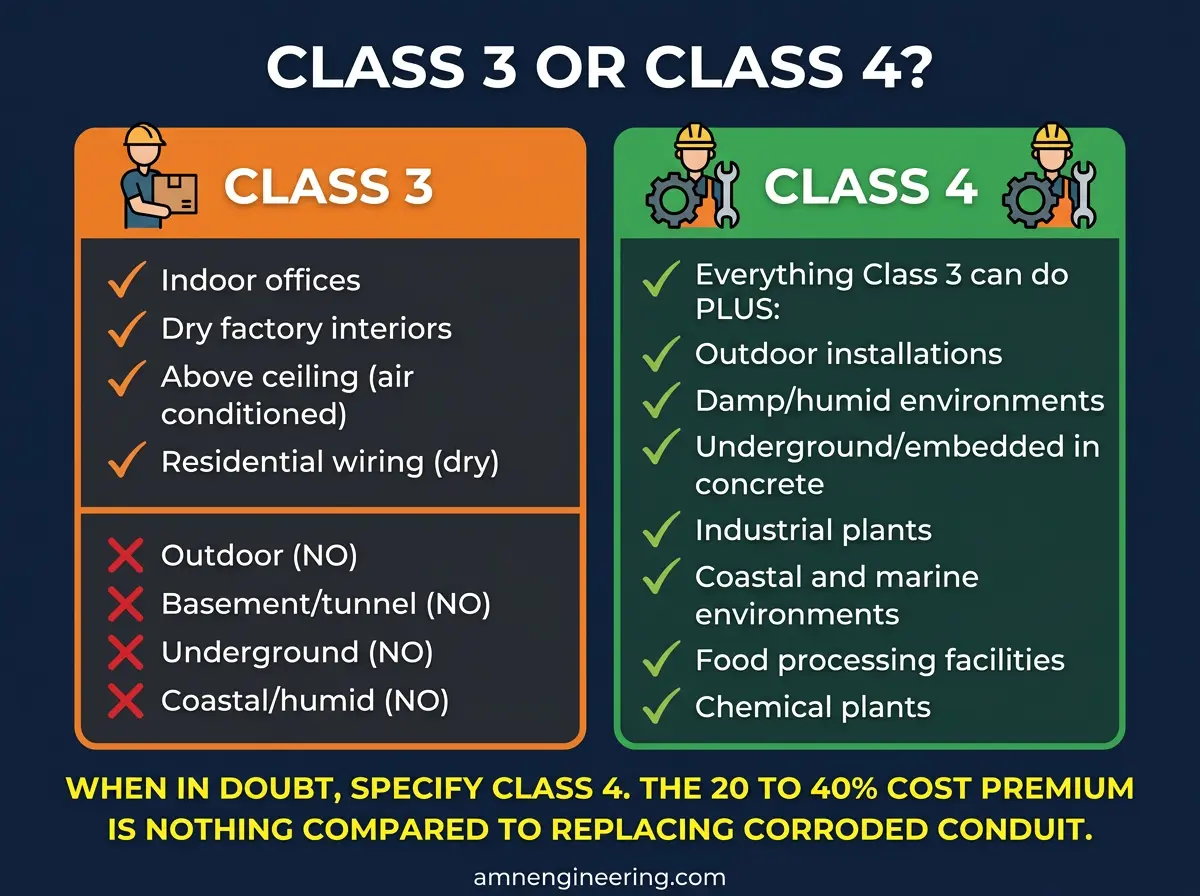
Specify Class 3 when ALL of the following are true:
- The installation is indoor
- The environment is dry
- There is no moisture, humidity, or condensation
- There are no chemical fumes
- Standard mechanical protection is sufficient
- Budget optimization is a priority
Common Class 3 Applications
Office fit outs, retail spaces, residential installations, dry factory interiors, and above ceiling runs in air conditioned buildings.
When to Specify Class 4
Specify Class 4 when ANY of the following are true:
- Outdoor installation (exposed to weather)
- Damp or humid environment (basements, tunnels, coastal areas)
- Underground or embedded in concrete
- Exposure to chemical fumes or salt spray
- Food processing or pharmaceutical facility
- Maximum mechanical protection is needed
- The project specification requires Class 4
- GCC region (extreme outdoor conditions)
When in doubt, specify Class 4. The 20 to 40 percent cost premium is small compared to the cost of replacing corroded Class 3 conduit in a few years.
Common Mistakes
1. Using Class 3 Outdoors
This is the most common and most costly mistake. Class 3 conduit will rust within 1 to 3 years in outdoor conditions. The organic interior coating cannot resist moisture. The conduit rusts from the inside out, which means the damage is often invisible until the conduit fails completely.
2. Using Class 3 in "Sheltered" Outdoor Locations
A covered walkway is not indoor. Any location with humidity, rain splash, dew, or temperature cycling needs Class 4 conduit. If the environment is not fully enclosed and climate controlled, it is not dry enough for Class 3.
3. Specifying Class 4 for Dry Indoor Work
This is the opposite mistake. Using Class 4 where Class 3 is perfectly adequate wastes money. For dry indoor installations, Class 3 provides all the protection you need at a lower cost.
4. Mixing Class 3 and Class 4 Fittings
Using Class 3 fittings with Class 4 conduit (or vice versa) creates a weak point at every joint. The fitting becomes the point of failure. Fittings must match the conduit class throughout the installation.
Frequently Asked Questions
Class 3 has an organic (paint/lacquer) interior and is for indoor dry environments only. Class 4 has a full hot dip galvanized interior and exterior and is suitable for outdoor, damp, underground, and corrosive environments. Class 4 has thicker walls and costs 20 to 40 percent more.
No. Class 3 conduit will corrode within 1 to 3 years in outdoor conditions because the organic interior coating cannot resist moisture. Always specify Class 4 for any outdoor or damp installation.
Yes, by approximately 20 to 40 percent. The extra cost comes from heavier gauge steel and the hot dip galvanizing process. For outdoor installations, this premium is small compared to the cost of replacing failed Class 3 conduit.
BS 31 (British Standard for steel conduit and fittings for electrical installations). This standard is used in the UK, GCC, Asia, Africa, and Australia.