Rigid Steel Conduit vs EMT vs IMC: A Complete Guide for Specifiers
By Adil, Managing Director at AMN Engineering · · 11 min read
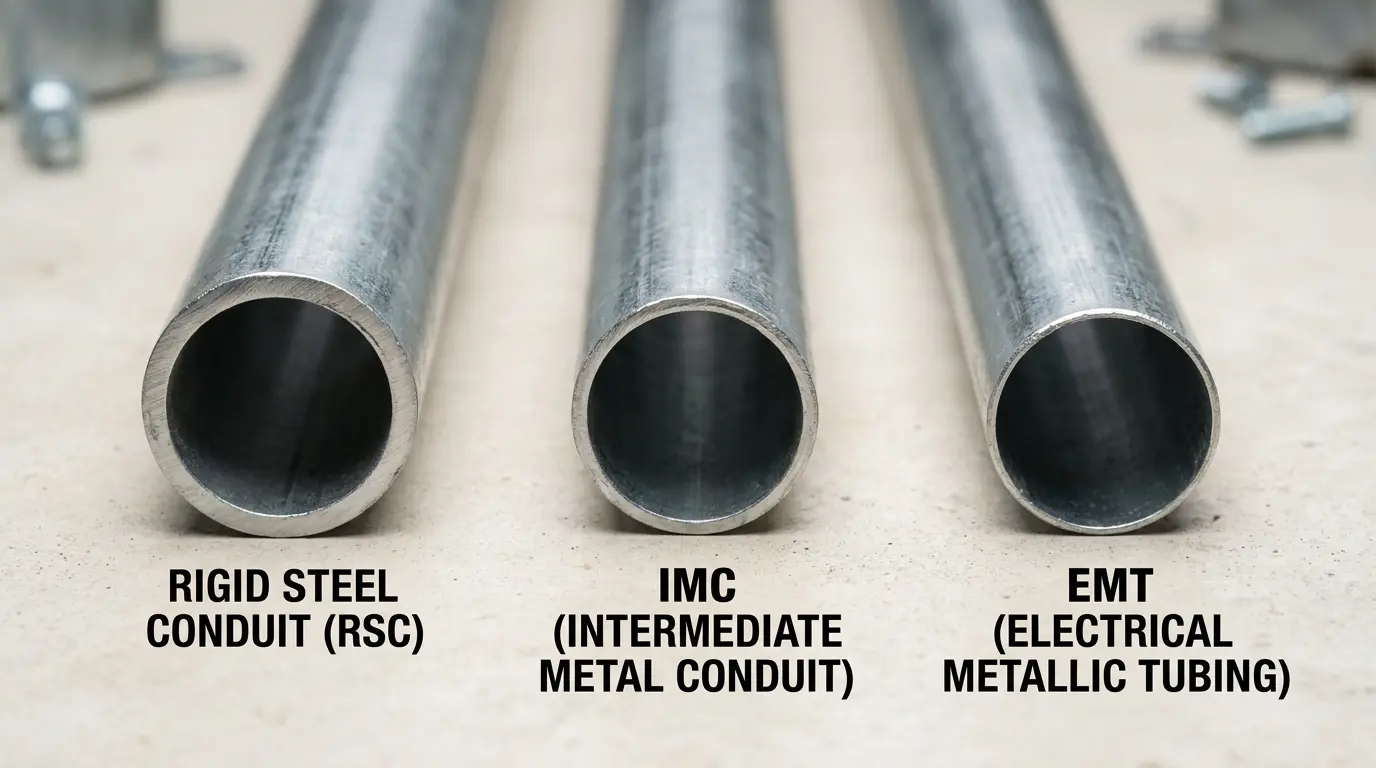
Rigid steel conduit vs EMT vs IMC. Three types of steel conduit, each designed for different installation environments. Specifying the wrong type means either overspending on conduit that is heavier than you need, or underspecifying and failing inspection.
This guide compares all three conduit types in plain language. Wall thickness, weight, cost, fittings, standards, and when to specify each one. Based on 25 years of manufacturing steel conduits at our factory in Lahore.
Rigid Steel Conduit (RSC, called RMC in the NEC) has the thickest walls and the highest mechanical protection. EMT (Electrical Metallic Tubing) is the thinnest, lightest, and cheapest. IMC (Intermediate Metal Conduit) is the middle ground, roughly 25 to 33 percent lighter than RSC but still threaded. Under the US National Electrical Code, RSC and IMC are approved for hazardous, outdoor, and exposed runs, while EMT suits protected indoor areas.
AMN Engineering manufactures steel conduit and fittings and supplies custom and OEM orders to buyers across North America and worldwide.
The Quick Summary
RSC / RMC (Rigid Steel Conduit): Thickest walls, threaded ends, heaviest and strongest. Use in industrial plants, hazardous areas, exposed outdoor installations.
EMT (Electrical Metallic Tubing): Thinnest walls, no threads, lightest and cheapest. Use in commercial buildings, offices, residential installations.
IMC (Intermediate Metal Conduit): Medium wall thickness, threaded ends, 25 to 33 percent lighter than RSC. Use when you need threaded conduit but want to save weight.
What Is Rigid Steel Conduit (RSC)?
Rigid Steel Conduit, also called RMC (Rigid Metal Conduit), is the heaviest and strongest type of steel conduit. It has the thickest walls of the three types and is threaded on both ends. RSC is manufactured from hot dip galvanized steel to BS 31 (Class 3 or Class 4) and ANSI C80.1.
Key Features of RSC
- Thickest wall of all three conduit types
- Threaded on both ends
- Can be bent with a conduit bender
- Excellent mechanical protection
- Fully grounding capable
- Available in sizes 20mm to 150mm
What Is EMT?
EMT (Electrical Metallic Tubing) is the thinner, lighter alternative to rigid conduit. It is not threaded and uses compression or set screw fittings instead. EMT is easy to cut, bend, and install, making it the most common conduit in commercial and residential construction.
Key Features of EMT
- Thin wall (40 to 50 percent thinner than RSC)
- Not threaded
- Very lightweight
- Easy to bend
- Lower mechanical protection than RSC or IMC
- Available in sizes 15mm to 100mm
What Is IMC?
IMC (Intermediate Metal Conduit) is the middle ground between RSC and EMT. It has thinner walls than RSC but thicker walls than EMT, and it is threaded on both ends like RSC. IMC is 25 to 33 percent lighter than RSC, making it easier to handle and faster to install while still providing good mechanical protection.
Key Features of IMC
- Medium wall thickness
- Threaded on both ends
- Easier to handle than RSC
- Good mechanical protection
- Available in sizes 15mm to 100mm
The Full Comparison
| Feature | RSC (Rigid) | IMC (Intermediate) | EMT (Thin Wall) |
|---|---|---|---|
| Wall Thickness | Thickest | Medium | Thinnest |
| Threading | Threaded both ends | Threaded both ends | Not threaded |
| Fittings | Threaded couplings | Threaded couplings | Compression / set screw |
| Weight (25mm size) | Heaviest (baseline) | 25 to 33% lighter | 40 to 50% lighter |
| Mechanical Protection | Highest | Good | Moderate |
| Bendability | Harder (thick wall) | Moderate | Easiest |
| Corrosion Protection | Hot dip galvanized | Hot dip galvanized | Galvanized (thinner) |
| Cost (material) | Highest | Moderate | Lowest |
| Installation Speed | Slowest | Moderate | Fastest |
| Indoor Use | Yes (overkill for most) | Yes | Yes (standard choice) |
| Outdoor Use | Excellent | Good | Limited |
| Hazardous Areas | Yes (NEC, IEC approved) | Yes (NEC approved) | No |
| Underground | Yes (with protection) | Yes (with protection) | Not recommended |
| Standard (N. America) | ANSI C80.1 / UL 6 | ANSI C80.6 / UL 1242 | ANSI C80.3 / UL 797 |
| Standard (UK/Commonwealth) | BS 31 Class 4 | Not standard in BS 31 | BS 31 Class 3 |
Wall Thickness and Weight
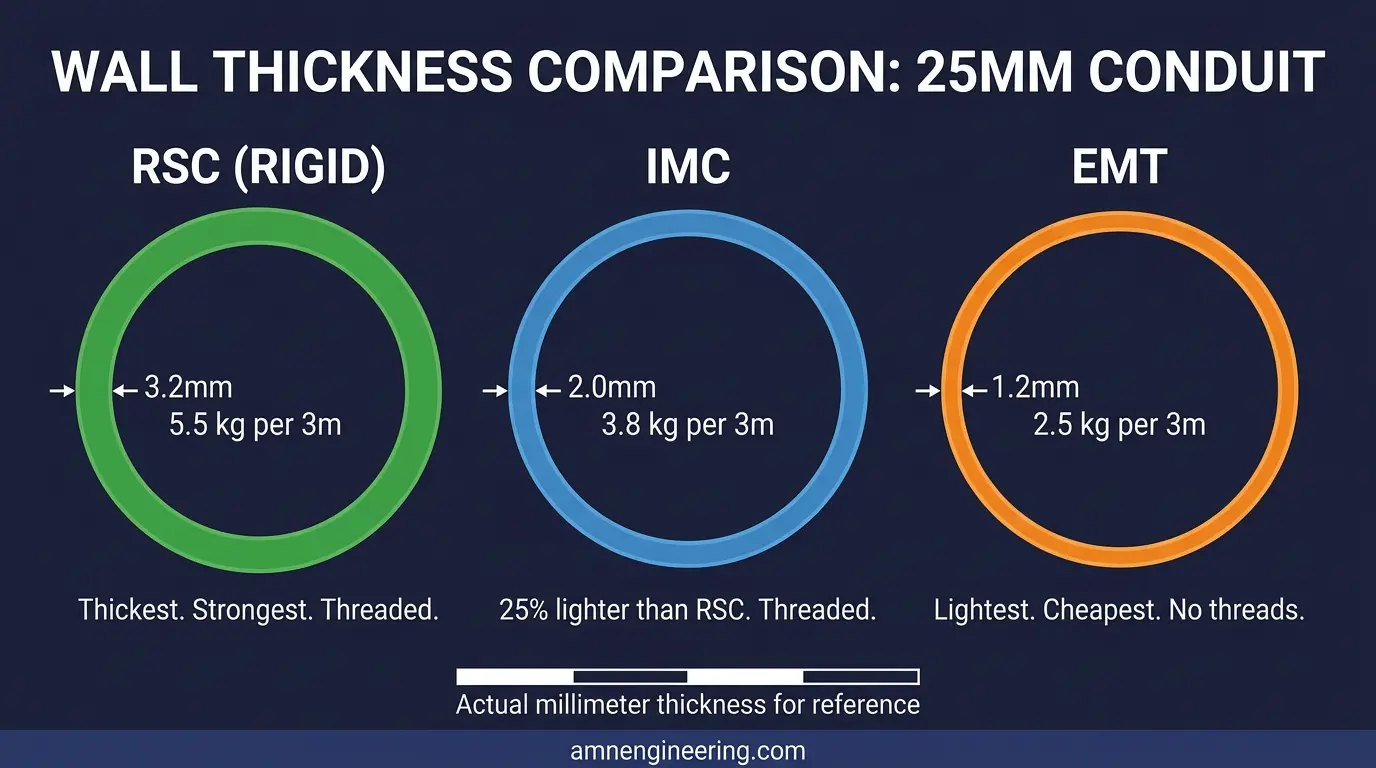
The table below shows typical wall thickness and weight for 25mm (1 inch) trade size conduit:
| Type | Wall Thickness | Weight per 3m | Relative Weight |
|---|---|---|---|
| RSC (Rigid) | 3.2mm | ~5.5 kg | 100% |
| IMC (Intermediate) | 2.0mm | ~3.8 kg | 69% |
| EMT (Thin Wall) | 1.2mm | ~2.5 kg | 45% |
The weight difference matters significantly on large installations. A project using thousands of meters of conduit will see major differences in shipping cost, support structure requirements, and installation labor when choosing between RSC and EMT.
In North America, conduit is sold by trade size (1/2 inch through 6 inch) and listed to UL standards: UL 6 for RSC (referred to as RMC in the NEC), UL 1242 for IMC, and UL 797 for EMT. The NEC covers each type in a separate article: Article 344 (RMC/RSC), Article 342 (IMC), and Article 358 (EMT).
Cost Comparison
Material Cost
EMT is the cheapest conduit type by material cost. It uses less steel due to thinner walls and does not require threading. RSC is the most expensive because of heavy wall thickness and threading. IMC sits between the two.
Installed Cost
EMT is the cheapest to install. It is light, easy to cut and bend, and uses fast compression or set screw fittings. RSC is the most expensive to install because it is heavy, requires threading, and bending thick wall conduit takes more time and effort.
Fitting Cost
EMT fittings are generally cheaper than threaded fittings used with RSC and IMC. Compression and set screw connectors are simpler and require no threading equipment on site.
When to Specify Each Type
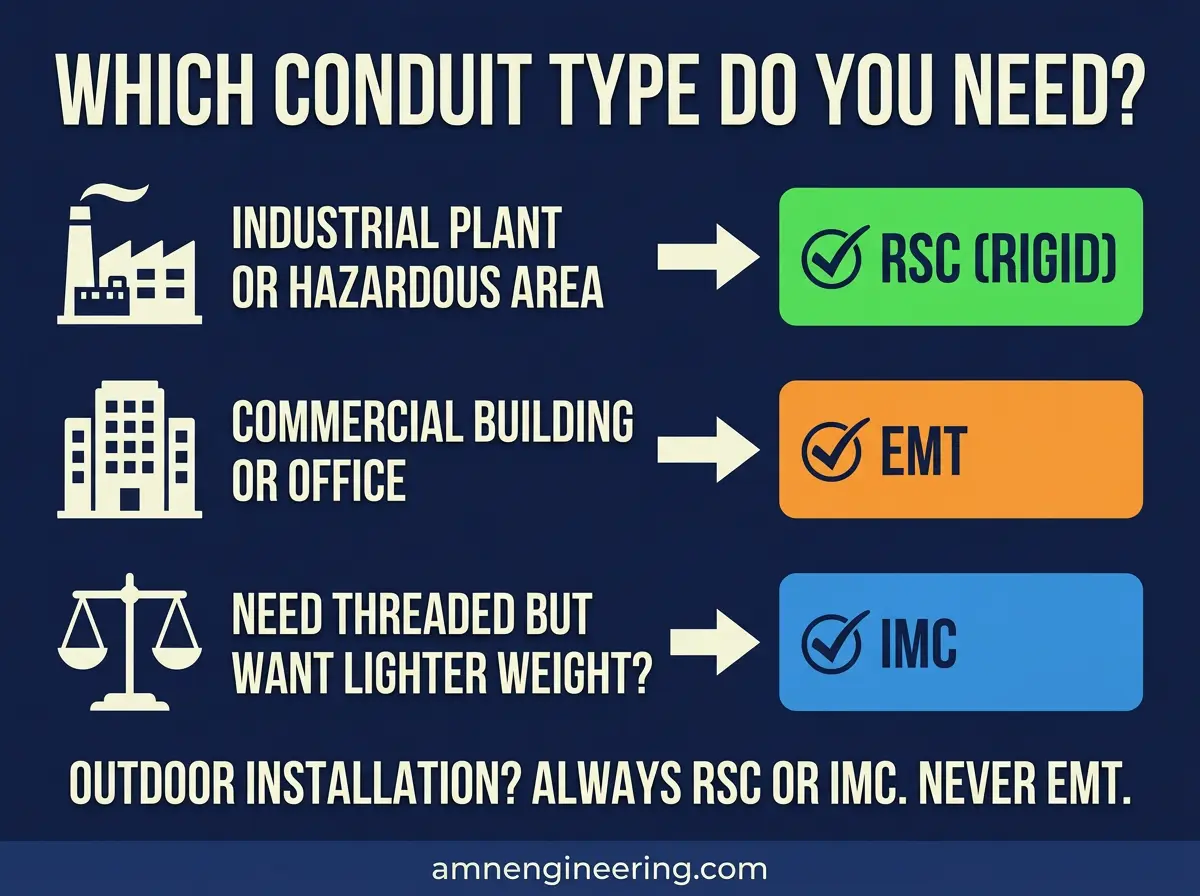
When to Specify RSC (Rigid Steel Conduit)
- Industrial environments with heavy machinery
- Hazardous locations (NEC Class I, II, III)
- Exposed installations where impact or crush risk exists
- Underground installations
- Outdoor installations in harsh environments
- When code specifically requires RSC
When to Specify IMC
- When you need threaded conduit but want to reduce weight and installation time
- Applications similar to RSC without extreme hazard requirements
- When code allows IMC as an alternative to RSC
When to Specify EMT
- Inside commercial buildings, offices, schools, hospitals
- Low physical damage risk environments
- When budget is a primary concern
- When installation speed matters (30 to 50 percent faster than RSC)
Conduit Standards: BS 31 vs ANSI
BS 31 (UK and Commonwealth)
BS 31 defines two classes of steel conduit:
- Class 3 (Light Gauge): Thinner wall with organic interior coating. Suitable for indoor dry environments.
- Class 4 (Heavy Gauge): Thicker wall with full hot dip galvanized finish. Suitable for outdoor, damp, and corrosive environments.
For a detailed comparison, see our guide on Class 3 vs Class 4 conduits.
ANSI (North America)
- ANSI C80.1: Rigid Steel Conduit (RSC)
- ANSI C80.6: Intermediate Metal Conduit (IMC)
- ANSI C80.3: Electrical Metallic Tubing (EMT)
IEC 61386 (International)
IEC 61386 is the international standard covering conduit systems for cable management, referenced in many countries outside North America and the UK.
AMN Engineering manufactures steel conduits to BS 31 and can produce to customer-specified dimensions and standards. We supply steel conduits and conduit fittings, plus custom and OEM metal parts, for projects across North America, the Middle East, Africa, and South Asia.
Frequently Asked Questions
Rigid steel conduit (RSC or RMC) has thicker walls, is threaded on both ends, and provides the highest mechanical protection. EMT (Electrical Metallic Tubing) has thinner walls, is not threaded, and uses compression or set screw fittings. RSC is stronger and used in exposed industrial installations. EMT is lighter, cheaper, and used in commercial and residential applications where heavy mechanical protection is not required.
IMC (Intermediate Metal Conduit) offers similar protection to rigid steel conduit but with thinner walls and lighter weight. It is approximately 25 to 33 percent lighter than RSC while still being threaded and providing good mechanical protection. IMC is a good middle ground when you need threaded conduit but want to save weight and cost.
EMT is the cheapest conduit type. It uses less steel due to thinner walls and does not require threading. RSC is the most expensive due to heavy wall thickness and threading. IMC sits between the two in price. However, total installed cost should also consider fittings, labor time, and the specific requirements of the installation environment.
EMT can be used in sheltered outdoor locations if properly galvanized. However, RSC or IMC is preferred for exposed outdoor installations because they provide better mechanical and corrosion protection.
In North America: ANSI C80.1 / UL 6 (RSC, called RMC in the NEC), ANSI C80.6 / UL 1242 (IMC), ANSI C80.3 / UL 797 (EMT). In the UK and Commonwealth: BS 31 (Class 3 and Class 4). Internationally: IEC 61386.
RMC (Rigid Metal Conduit) is the term the US National Electrical Code uses in Article 344, and it covers rigid conduit made from steel, aluminum, or other metals. RSC (Rigid Steel Conduit) specifically refers to the steel version, which is the most common. In everyday use, RMC and RSC refer to the same steel product, listed to UL 6 and ANSI C80.1.
Yes. The US National Electrical Code covers IMC in Article 342 and permits it in all the same locations as RMC (rigid steel conduit), including hazardous, outdoor, wet, and exposed installations. IMC is lighter and thinner than RSC while providing equivalent code-recognized protection, which is why many US specifiers choose it as a lighter alternative to rigid conduit.