Complete Guide to Conduit Fittings: Locknuts, Saddles, Bushes, Bends, and Elbows
By Adil, Managing Director at AMN Engineering · · 6 min read
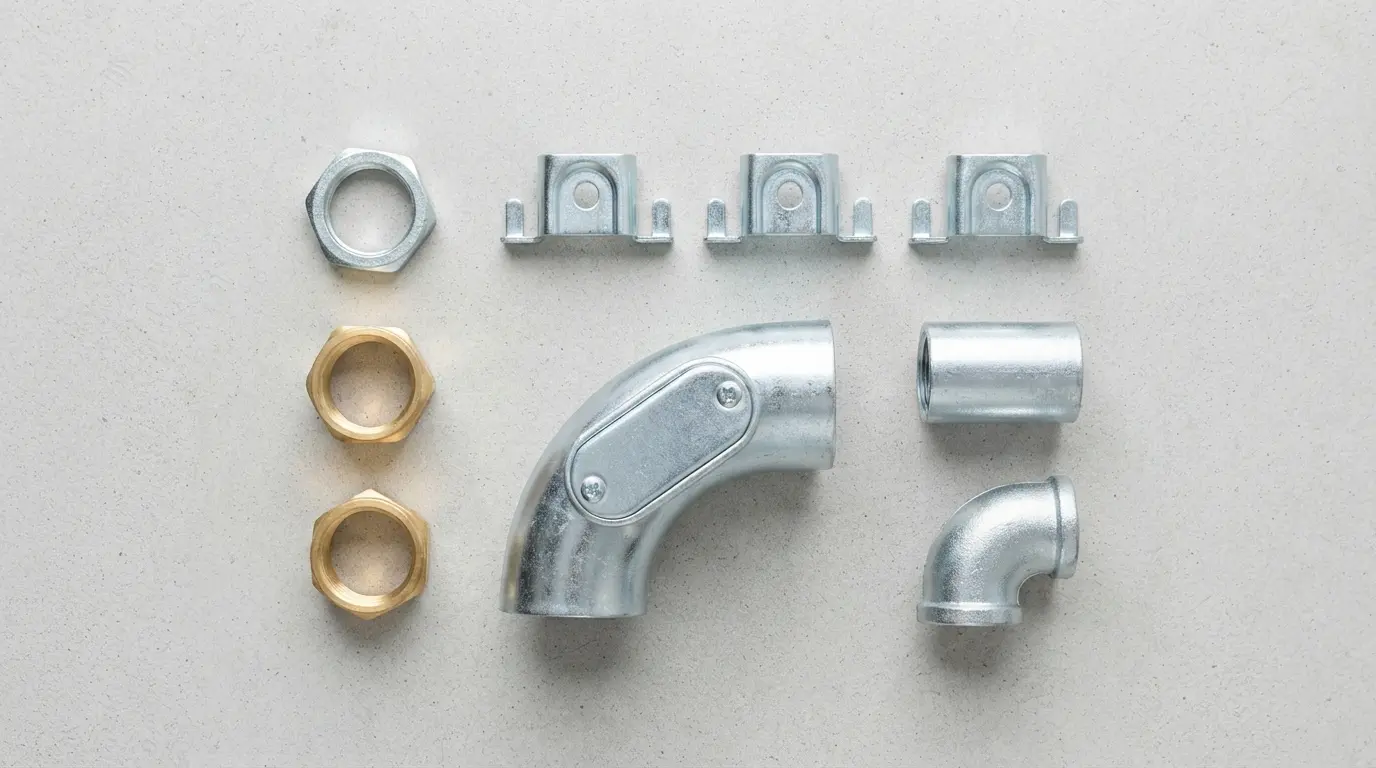
Steel conduit protects electrical wiring. But conduit alone is just a tube. It is the fittings that make the system work: connecting conduit to enclosures, changing direction, securing runs to walls, and protecting cable entry points from sharp edges.
This guide covers every common conduit fitting type: what it does, what sizes are available, and when to use it. We manufacture the complete range of BS 31 conduit fittings at AMN Engineering in Lahore, from 16mm to 50mm and beyond.
What Are Conduit Fittings?
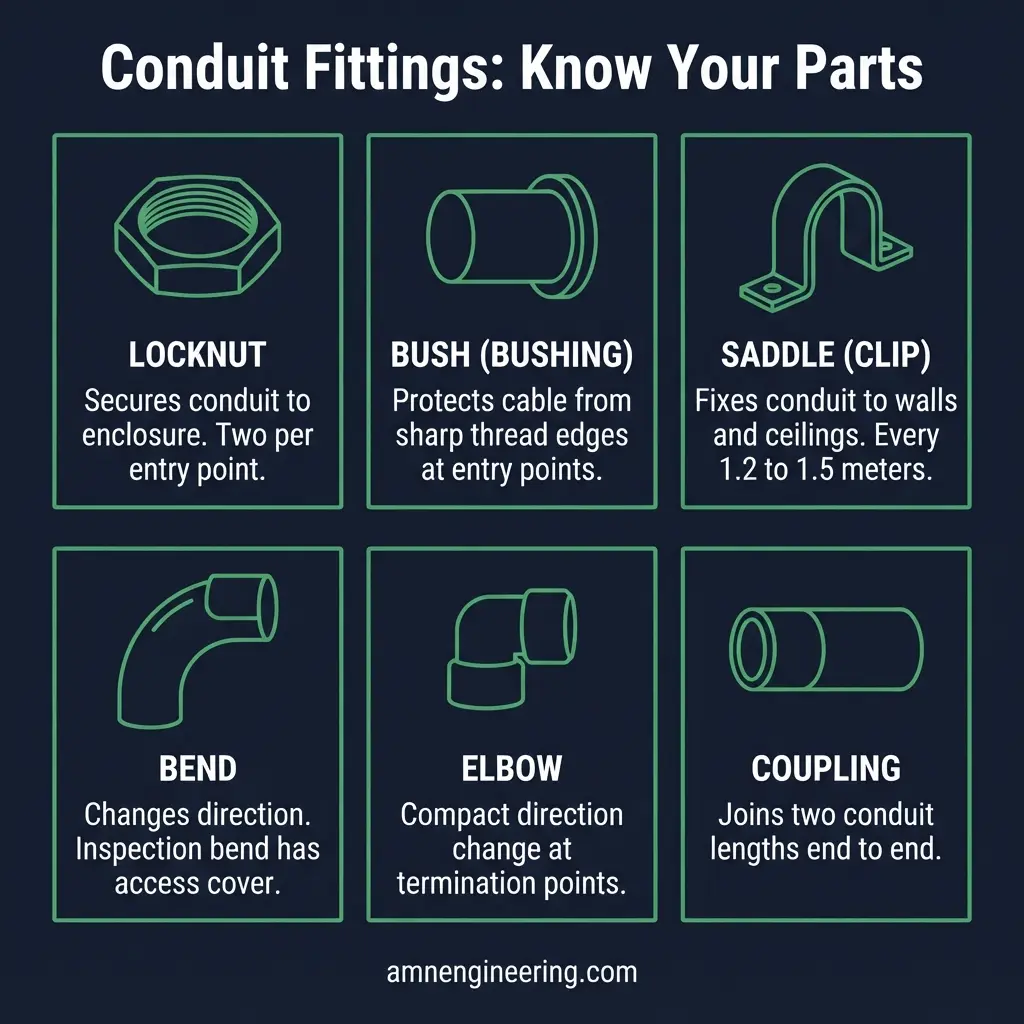
Conduit fittings are the accessories that connect, secure, and terminate steel conduit runs in electrical installations. They include:
- Locknuts: Secure conduit to enclosures and junction boxes
- Bushes: Protect cable insulation at conduit entry points
- Saddles: Fix conduit to walls, ceilings, and surfaces
- Bends and elbows: Change direction of conduit runs
- Couplings: Join two lengths of conduit together
- Junction boxes: Provide access points for cable pulling and connections
All fittings must match the conduit class (Class 3 or Class 4) and size.
Locknuts
Locknuts are threaded nuts that screw onto the conduit end to clamp it against an enclosure wall, junction box, or panel knockout.
How They Are Used
Two locknuts are used at each entry point: one on each side of the enclosure wall. The conduit is inserted through the knockout, and the locknuts tighten on both sides to create a secure mechanical and ground connection.
Available Sizes
16mm, 20mm, 25mm, 32mm, 40mm, 50mm (matching standard BS 31 conduit sizes).
Material
Steel, hot dip galvanized for Class 4 installations.
Bushes (Bushings)
Bushes (also called bushings) screw onto the end of a conduit where it enters an enclosure. They provide a smooth, rounded edge that protects cable insulation from being cut or damaged by the sharp thread end of the conduit.
Types
- Male bush: Screws into the conduit end from outside
- Female bush: Screws onto the conduit end from inside the enclosure
Why They Matter
Without a bush, cables passing over the sharp cut end of the conduit can have their insulation nicked or cut. Over time, vibration and cable movement can cause insulation failure, short circuits, and fire risk. Bushes are a code requirement in most installations.
Saddles (Clips)
Saddles (also called spacer bar saddles or conduit clips) fix the conduit to walls, ceilings, and structural surfaces.
Types
- Spacer bar saddle: Holds the conduit away from the surface by approximately 6mm, allowing the conduit to expand and contract with temperature changes
- Hospital saddle: Fully enclosed, holding the conduit flush and preventing dirt accumulation underneath (used in hygiene sensitive environments)
- Half saddle (clip): A simpler open clip used for lighter installations
Spacing
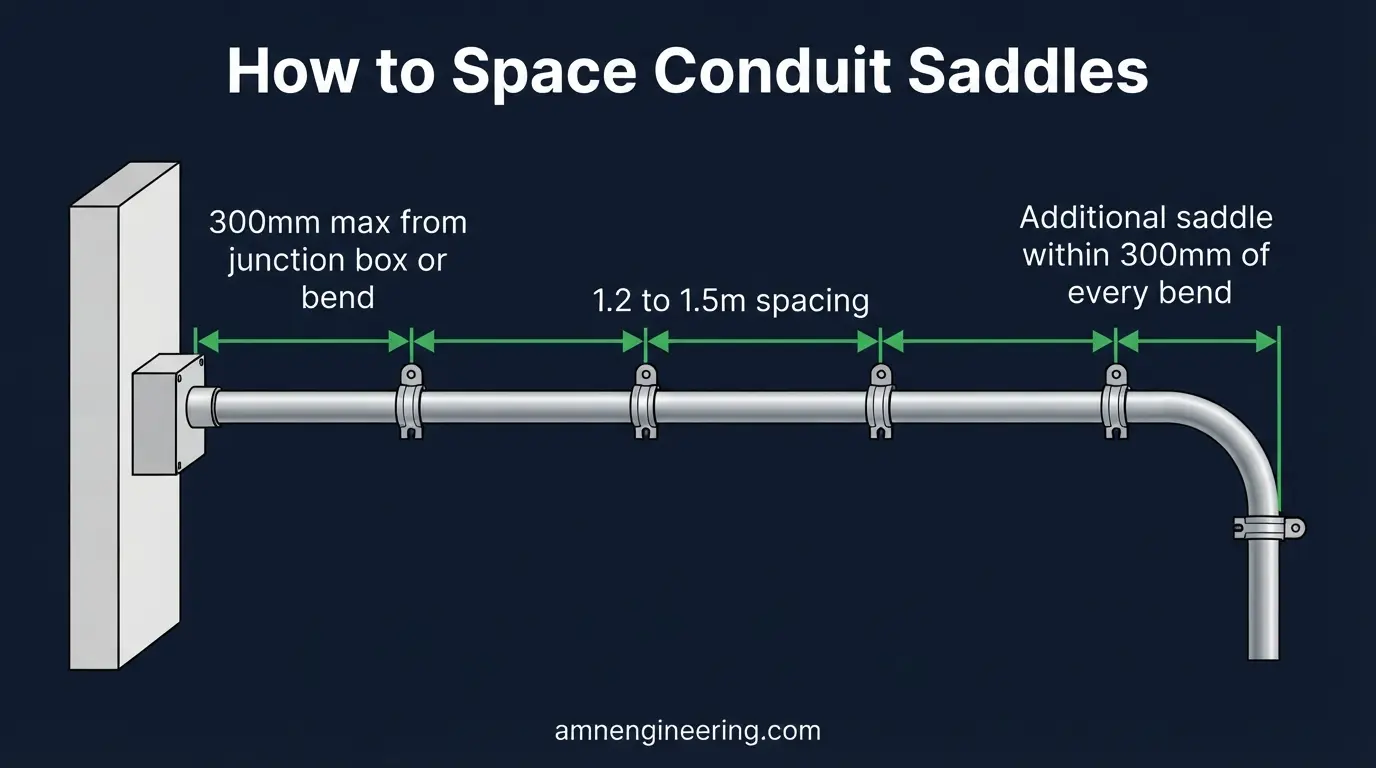
Saddles should be installed at intervals specified by the electrical code. Typical spacing is 1.2 to 1.5 meters for horizontal runs and 1.5 to 2.0 meters for vertical runs, with additional support within 300mm of any bend, junction box, or termination point.
Bends and Elbows
Bends change the direction of a conduit run. They are available as factory manufactured fittings or can be formed on site using a conduit bender.
Types
- Inspection bend: Has a removable cover for cable access and inspection. Required at most direction changes per electrical codes.
- Solid bend: No access cover. Used where inspection access is not needed and space is limited.
- Normal bend: 90 degree standard radius
- Sharp bend: 90 degree tight radius for confined spaces
Bend Radius
Factory bends maintain a specific internal radius that prevents cable damage. The minimum bend radius depends on the conduit size and the cable diameter being installed. A bend that is too tight can crush cable insulation.
Elbows
Elbows are short 90 degree fittings used at termination points (e.g., where conduit enters the top of an enclosure). They are more compact than standard bends.
Couplings
Couplings join two lengths of conduit end to end. One conduit end screws into one side of the coupling, and the next length screws in from the other side.
Types
- Standard coupling: Straight joining of two conduit lengths
- Running coupling: Has one longer thread side, allowing the coupling to slide along the conduit before tightening. Used when you cannot rotate one of the conduit lengths.
Junction Boxes and Through Boxes
Junction boxes provide access points in the conduit system for cable pulling, splicing, and maintenance.
Types
- Circular junction box: For conduit entries from multiple directions
- Through box: For straight through runs where access is needed
- Angle box: For right angle conduit connections
- Tee box: For T shaped junctions
All boxes must match the conduit class and have appropriately sized knockouts for the conduit diameter.
Sizing Guide
All fittings must match the conduit trade size:
| Conduit Size | Locknut | Bush | Saddle | Bend | Coupling |
|---|---|---|---|---|---|
| 16mm | 16mm | 16mm | 16mm | 16mm | 16mm |
| 20mm | 20mm | 20mm | 20mm | 20mm | 20mm |
| 25mm | 25mm | 25mm | 25mm | 25mm | 25mm |
| 32mm | 32mm | 32mm | 32mm | 32mm | 32mm |
| 40mm | 40mm | 40mm | 40mm | 40mm | 40mm |
| 50mm | 50mm | 50mm | 50mm | 50mm | 50mm |
Never mix sizes. A 20mm locknut will not fit a 25mm conduit.
How to Specify Fittings for Your Project
When ordering conduit fittings, specify:
- Type: Locknut, bush, saddle, bend, coupling, etc.
- Size: 16mm, 20mm, 25mm, 32mm, etc. (must match conduit size)
- Class: Class 3 or Class 4 (must match conduit class)
- Material: Steel, galvanized for Class 4
- Quantity: Number of each fitting type needed
- Standard: BS 31
Frequently Asked Questions
At minimum: locknuts (2 per entry point), bushes (1 per entry point), saddles (every 1.2 to 1.5 meters), couplings (for joining conduit lengths), and bends (at every direction change).
Yes. Class 4 conduit installations must use Class 4 (galvanized) fittings throughout. Mixing Class 3 fittings with Class 4 conduit creates weak points where corrosion will start.
A bend is a longer fitting that maintains a specific radius for cable protection. An elbow is a shorter, more compact 90 degree fitting typically used at termination points.
Yes, using a conduit bender. However, factory bends provide more consistent radius and are required where inspection access is needed (inspection bends with removable covers).