BS 31 vs ANSI C80.1: Understanding Global Conduit Standards
By Adil, Managing Director at AMN Engineering · · 7 min read
If you are specifying steel conduits for an electrical installation project, the conduit standard determines everything: the dimensions, wall thickness, threading, coating, and which fittings are compatible. Using the wrong standard means conduits that do not fit the fittings, or a specification that does not meet local code requirements.
The two dominant global standards for steel conduit are BS 31 (used in the UK, Middle East, Asia, Africa, and Australia) and ANSI C80.1 (used in North America). This guide explains both, compares the key differences, and tells you which one applies in your market.
We manufacture steel conduits and conduit fittings to BS 31 at AMN Engineering, exporting to the GCC, Africa, and South Asia where BS 31 is the dominant standard. For cable management alongside conduit runs, we also produce cable trays in GI and stainless steel.
Why Standards Matter
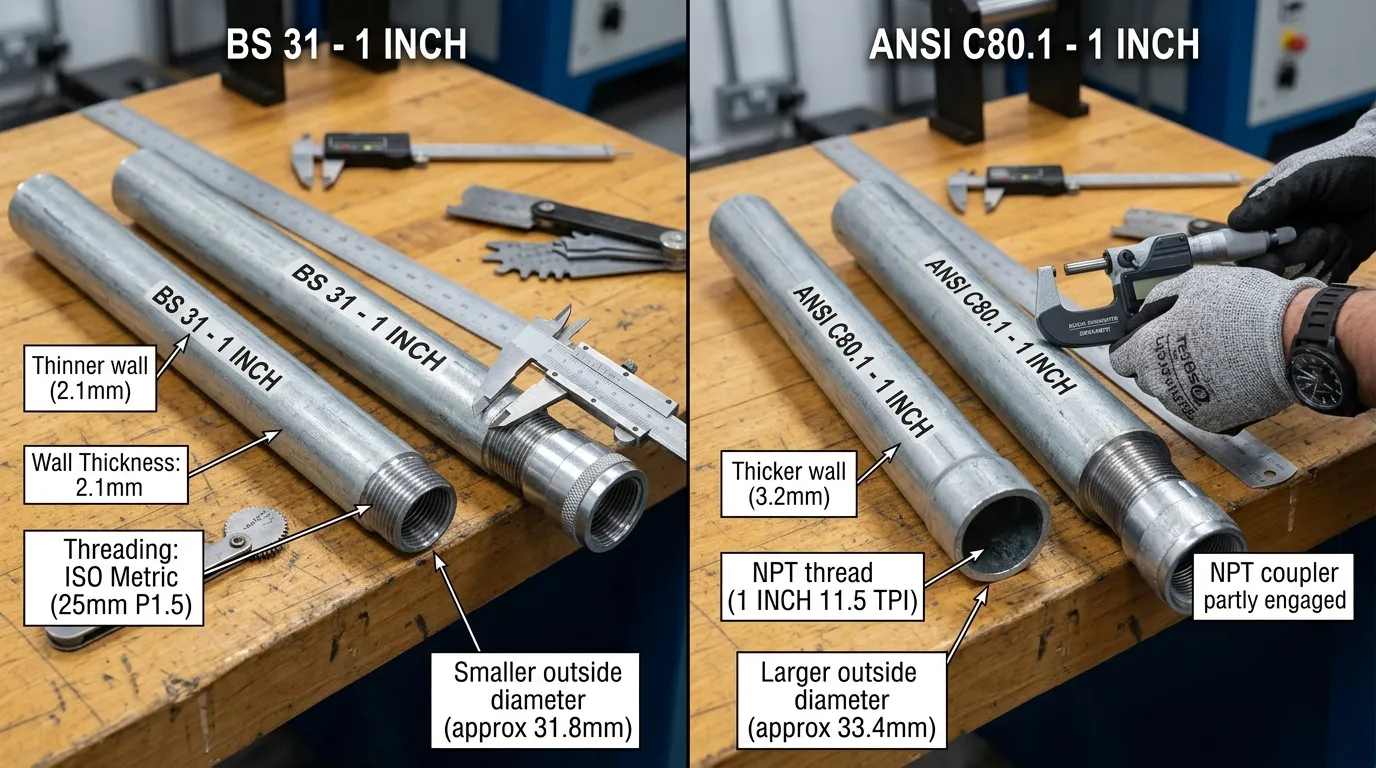
A 25mm conduit to BS 31 and a 1 inch conduit to ANSI C80.1 are not the same thing. The outside diameters are different. The wall thicknesses are different. The thread types are different. The fittings are not interchangeable.
Mixing standards on a project means fittings that do not thread onto conduits, inspection failures, and expensive rework. Always confirm which standard applies before ordering.
BS 31 Explained
BS 31 is the British Standard for steel conduit and fittings for electrical installations. It specifies steel conduit in two classes (Class 3 and Class 4) and defines dimensions, wall thickness, threading, coating, and testing requirements.
BS 31 Key Features
- Sizes: 16mm, 20mm, 25mm, 32mm nominal bore (and larger)
- Threading: Parallel threads per BS 31 / ISO 65
- Coating: Class 3 (organic interior) or Class 4 (full hot dip galvanized per ISO 1461)
- Standard length: 3.75 meters
- Fittings: BS 31 compatible conduit fittings: locknuts, bushes, saddles, bends, elbows, junction boxes
Where BS 31 Applies
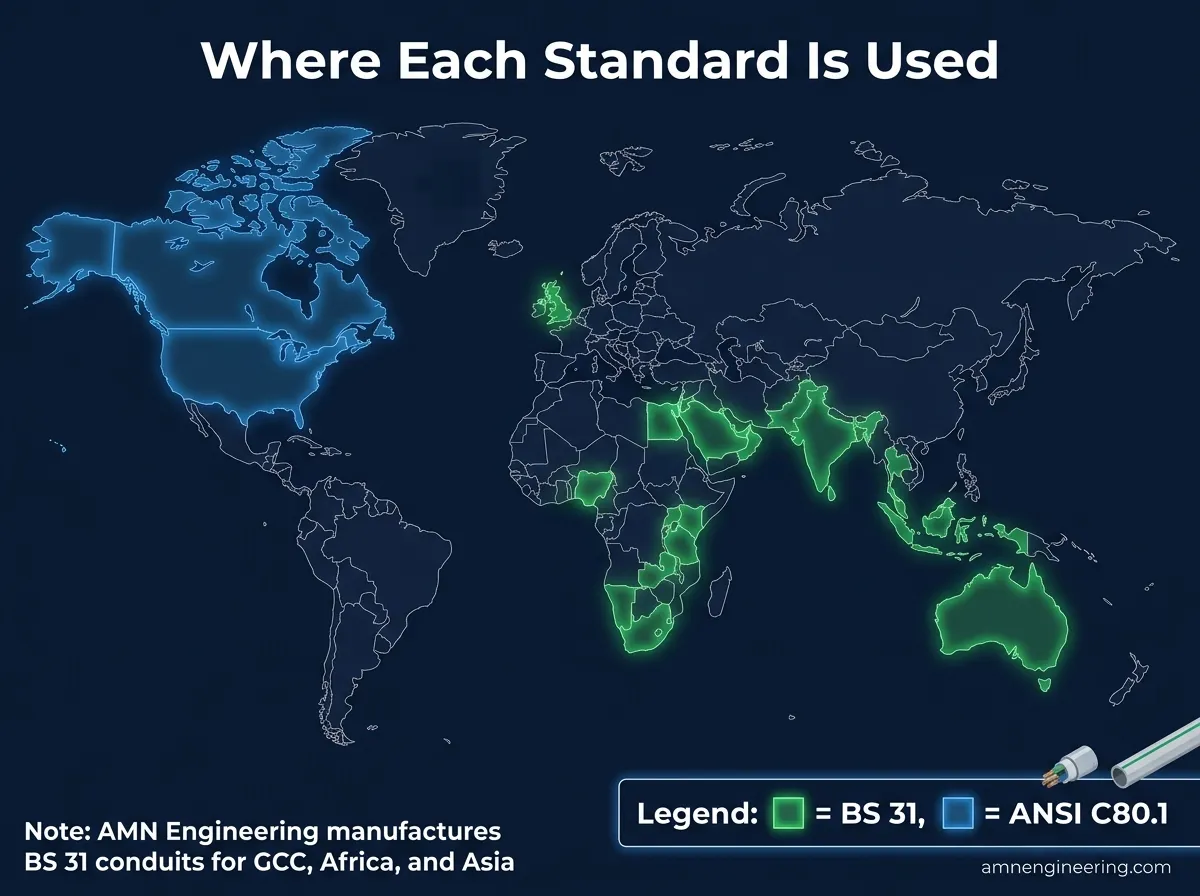
UK, Ireland, Middle East (UAE, Saudi Arabia, Qatar, Kuwait, Bahrain, Oman), India, Pakistan, Bangladesh, Sri Lanka, Malaysia, Singapore, Hong Kong, Australia, New Zealand, and most of Africa.
ANSI C80.1 Explained
ANSI C80.1 (also referenced as UL 6) is the American standard for rigid steel conduit. It defines the dimensions, wall thickness, threading, coating, and testing for RMC (Rigid Metal Conduit) used in North America.
ANSI C80.1 Key Features
- Sizes: 1/2 inch, 3/4 inch, 1 inch, 1 1/4 inch, 1 1/2 inch, 2 inch (and larger, measured in trade size inches)
- Threading: Tapered threads per NPT (National Pipe Thread) / ANSI B1.20.1
- Coating: Hot dip galvanized (interior and exterior) or PVC coated for corrosive environments
- Standard length: 10 feet (3.048 meters)
- Fittings: UL listed conduit fittings, couplings, connectors per ANSI/NEMA standards
Where ANSI C80.1 Applies
United States, Canada, and projects worldwide that follow NEC (National Electrical Code) or specify UL listed products.
The Key Differences
| Feature | BS 31 | ANSI C80.1 |
|---|---|---|
| Sizing System | Metric (mm nominal bore) | Imperial (inch trade size) |
| Thread Type | Parallel (straight) | Tapered (NPT) |
| Thread Standard | BS 31 / ISO 65 | ANSI B1.20.1 (NPT) |
| Standard Length | 3.75 meters | 10 feet (3.048 meters) |
| Classes | Class 3 (light) and Class 4 (heavy) | Single class (rigid) |
| Coating Options | Galvanized, painted, or lacquered | Galvanized, PVC coated |
| Fittings Compatibility | BS 31 fittings only | UL listed fittings only |
| Primary Markets | UK, GCC, Asia, Africa, Australia | USA, Canada |
| Electrical Code | BS 7671 (IET Wiring Regulations) | NEC (National Electrical Code) |
Where Each Standard Is Used
BS 31 Markets (Our Primary Export Markets)
The GCC region (UAE, Saudi Arabia, Qatar) predominantly uses BS 31 conduits. Most electrical installations in these countries follow BS 7671 or local codes derived from British standards. This makes BS 31 conduit the default specification for commercial, industrial, and residential electrical projects across the Middle East.
Africa (particularly East and West Africa), South Asia (India, Pakistan, Bangladesh), and Southeast Asia (Malaysia, Singapore) also use BS 31 as the primary conduit standard.
ANSI C80.1 Markets
The United States and Canada use ANSI C80.1 exclusively. Projects worldwide that follow NEC or require UL listing also specify ANSI conduit, regardless of the country.
IEC 61386 (International)
IEC 61386 provides an international framework for conduit systems but is less commonly specified than BS 31 or ANSI in practice. Many countries that have adopted IEC standards still use BS 31 or ANSI conduit as the local default.
Thread Compatibility
BS 31 threads are parallel. The thread diameter stays constant along the entire length. Sealing is achieved by the fitting (locknut, bush) clamping against the conduit end.
ANSI C80.1 threads are tapered (NPT). The thread diameter decreases toward the end. The conduit screws tighter as it is threaded into the fitting, creating a wedge seal.
These threads are not interchangeable. You cannot use an ANSI fitting on a BS 31 conduit or vice versa. The thread angle, pitch, and taper are all different.
Always specify the correct standard when ordering conduit fittings. Mixing standards will result in fittings that do not thread on, connections that leak, and failed inspections.

Frequently Asked Questions
BS 31 uses metric sizing with parallel threads and is used in the UK, Middle East, Asia, and Africa. ANSI C80.1 uses imperial sizing with tapered NPT threads and is used in North America.
No. The thread types are different (parallel vs tapered) and the dimensions do not match. Always use fittings that match your conduit standard.
BS 31 is the dominant standard in the UAE, Saudi Arabia, Qatar, Kuwait, Bahrain, and Oman. Most electrical codes in the GCC are based on British standards.
We currently manufacture BS 31 conduits (Class 3 and Class 4). For ANSI specification projects, please contact us to discuss your specific requirements.
The international standard for conduit systems that provides a framework for classification and testing. Many countries reference IEC 61386 but still use BS 31 or ANSI conduit in practice.