Thread Standards Decoded: BSP, BSW, UNC, UNF, and Metric
By Adil, Managing Director at AMN Engineering · · 7 min read
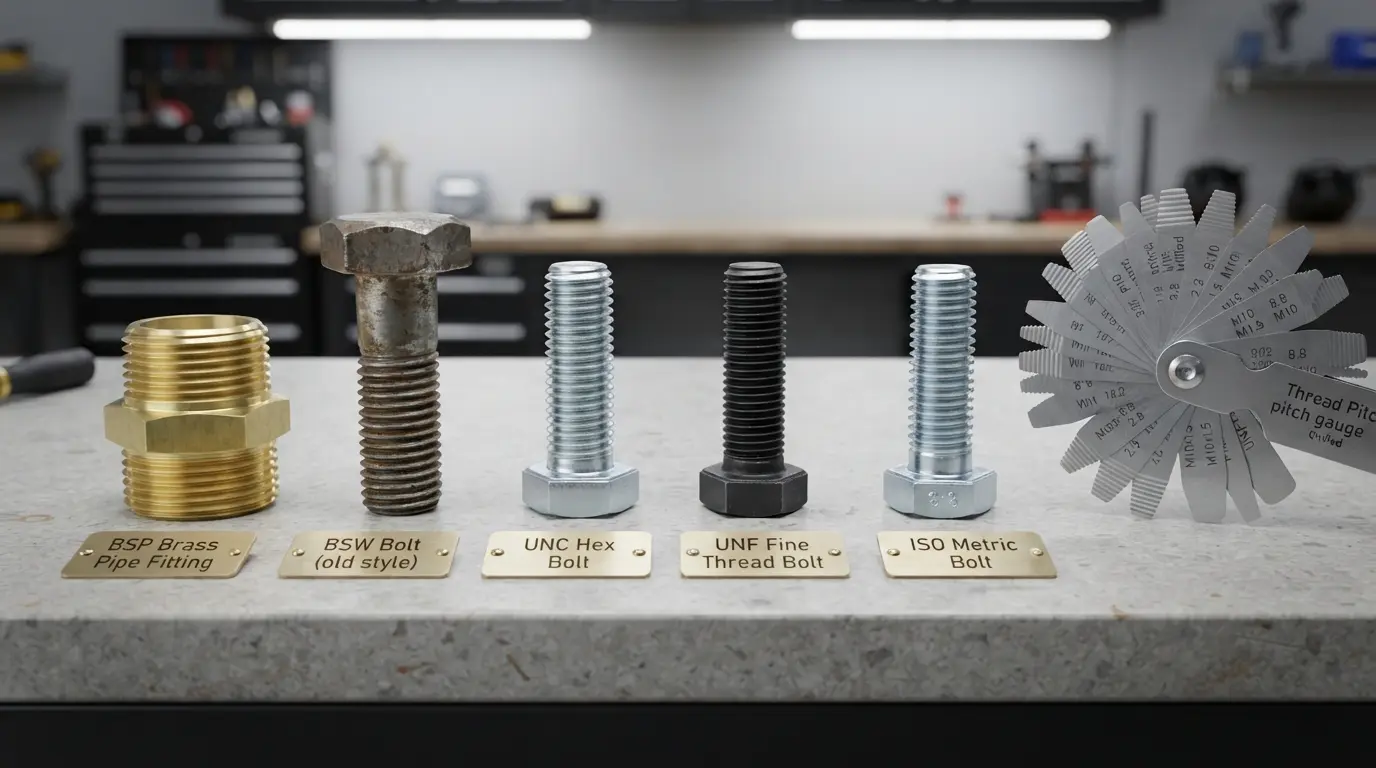
BSP, BSW, UNC, UNF, metric. Five different thread standards, each with its own dimensions, angles, and pitches. None of them are interchangeable with each other. Using the wrong one means bolts that do not fit, fittings that leak, and assemblies that fail.
This guide decodes all five standards in one place: what each one is, where it is used, and which one to specify for your application. We cut threads in all standards at AMN Engineering using CNC lathes and dedicated threading equipment.
For a detailed comparison of BSP vs metric vs UNC specifically, see our in depth guide: BSP vs Metric vs UNC Threading.
Why So Many Thread Standards?
Thread standards evolved independently in different countries before global standardization. Britain developed BSW and BSP in the 1800s. The USA developed UNC and UNF. ISO metric was created as a global standard but has not replaced the others because billions of existing parts use the older standards.
Today, the practical result is that engineers must know which standard applies to their application and specify it correctly on drawings.
ISO Metric (M Threads)
The global standard for fasteners and machine components.
| Feature | Detail |
|---|---|
| Designation | M followed by diameter and pitch (e.g., M12 x 1.75) |
| Measurement | Millimeters |
| Thread angle | 60 degrees |
| Coarse and fine | Yes (coarse is default if pitch not stated) |
| Standard | ISO 261, ISO 965 |
| Used in | Worldwide for machine components and fasteners |
Metric is the most commonly used thread standard in the world. If you are designing a new product for international markets, metric is the default choice. Read more: BSP vs Metric vs UNC.
BSP: British Standard Pipe
The standard for pipe connections and fluid fittings.
| Feature | Detail |
|---|---|
| Designation | Size in inches by nominal pipe bore (e.g., 1/2 inch BSP) |
| Measurement | Inches (but note: the inch size refers to nominal bore, NOT outside diameter) |
| Thread angle | 55 degrees |
| Types | BSPP (parallel) and BSPT (tapered) |
| Standard | BS 21 (tapered), BS 2779 (parallel) |
| Used in | UK, GCC, Asia, Africa, Australia for pipe and fluid connections |
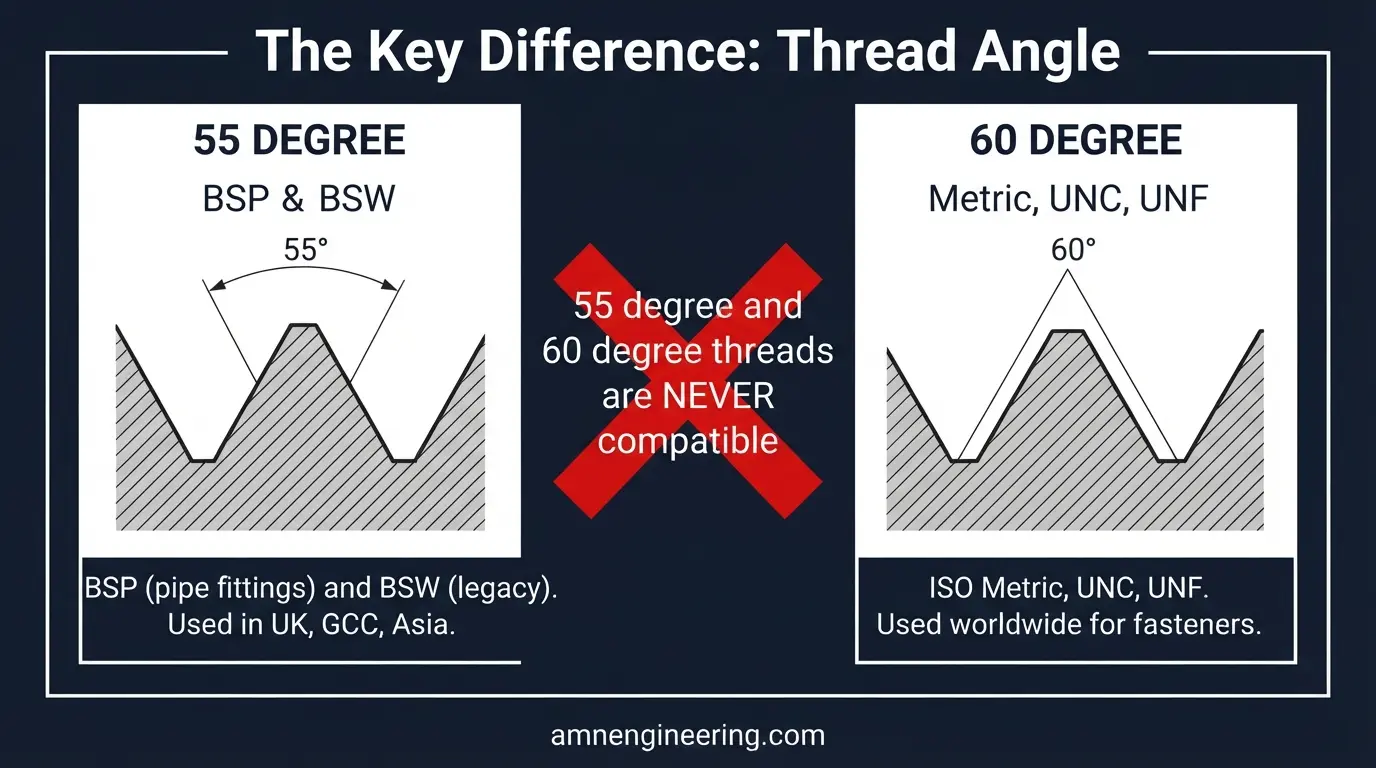
BSP is the dominant thread standard for plumbing, hydraulics, pneumatics, and conduit fittings outside North America. The 55 degree thread angle distinguishes BSP from all other standards (metric and UNC use 60 degrees).
Critical: A "1/2 inch BSP" has an actual outside diameter of 20.95mm. A "1/2 inch UNC" has an outside diameter of 12.70mm. They share the name but are completely different threads.
BSW: British Standard Whitworth
The original standardized thread (1841). Now largely obsolete but still found on old equipment.
| Feature | Detail |
|---|---|
| Designation | Size in inches (e.g., 1/2 inch BSW) |
| Measurement | Inches |
| Thread angle | 55 degrees (same as BSP) |
| Standard | BS 84 |
| Used in | Legacy equipment, vintage machinery, some agricultural equipment |
BSW was the first standardized screw thread in the world, created by Joseph Whitworth in 1841. It has been superseded by metric and UNC for new designs but still appears on old machinery, agricultural equipment, and some British and Commonwealth legacy systems.
When you encounter BSW: If you are reverse engineering an old part or replacing a fastener on vintage machinery, check for BSW. It looks similar to BSP (same 55 degree angle) but the thread pitches and diameters are different.
UNC: Unified National Coarse
The standard coarse thread in North America.
| Feature | Detail |
|---|---|
| Designation | Diameter and TPI (e.g., 1/2 13 UNC) |
| Measurement | Inches |
| Thread angle | 60 degrees |
| Standard | ASME B1.1 |
| Used in | USA, Canada |
UNC is the default thread for fasteners and general purpose bolting in North America. It is equivalent in role to metric coarse threads but uses inch dimensions.
UNC has coarser pitch (fewer threads per inch) than UNF, making it faster to assemble, more tolerant of minor damage, and better for softer materials (like aluminum and cast iron) that need more thread engagement area.
UNF: Unified National Fine
The fine thread version of UNC.
| Feature | Detail |
|---|---|
| Designation | Diameter and TPI (e.g., 1/2 20 UNF) |
| Measurement | Inches |
| Thread angle | 60 degrees |
| Standard | ASME B1.1 |
| Used in | USA, Canada for precision, vibration resistance, thin wall |
UNF has finer pitch (more threads per inch) than UNC at the same diameter. This provides: higher tensile strength (larger minor diameter), better resistance to loosening from vibration, finer adjustment capability, and better performance in thin wall applications.
UNF is common in automotive, aerospace, and precision equipment in North America.
The Master Comparison Table
| Standard | Measurement | Thread Angle | Coarse/Fine | Primary Use | Region |
|---|---|---|---|---|---|
| ISO Metric | mm | 60 degrees | Both | Fasteners, machine parts | Worldwide |
| BSP | inches (nominal bore) | 55 degrees | N/A (defined by size) | Pipe, fluid, conduit fittings | UK, GCC, Asia, Africa, Australia |
| BSW | inches | 55 degrees | Coarse only | Legacy equipment | Obsolete (maintenance only) |
| UNC | inches | 60 degrees | Coarse | Fasteners, general bolting | USA, Canada |
| UNF | inches | 60 degrees | Fine | Precision, vibration, aerospace | USA, Canada |
The key distinguishing feature: BSP and BSW use a 55 degree thread angle. Metric, UNC, and UNF use 60 degrees. This 5 degree difference means BSP/BSW threads are NEVER compatible with metric or UNC/UNF threads, even if diameters appear similar.
Coarse vs Fine: When to Use Each
Both metric and unified threads come in coarse and fine pitch variants.
Choose Coarse (Metric Coarse, UNC) When:
- General purpose fastening
- Threading into softer materials (aluminum, cast iron, plastic)
- Quick assembly and disassembly needed
- Threads may be slightly damaged during handling (coarse is more tolerant)
- This is your default unless you have a specific reason for fine
Choose Fine (Metric Fine, UNF) When:
- Higher tensile strength needed (larger root diameter)
- Vibration resistance is critical (fine threads resist loosening better)
- Fine adjustment is needed (e.g., adjusting screws, precision mechanisms)
- Thin wall material (finer pitch allows more threads in a short engagement length)
- Aerospace, automotive, and precision instrument applications
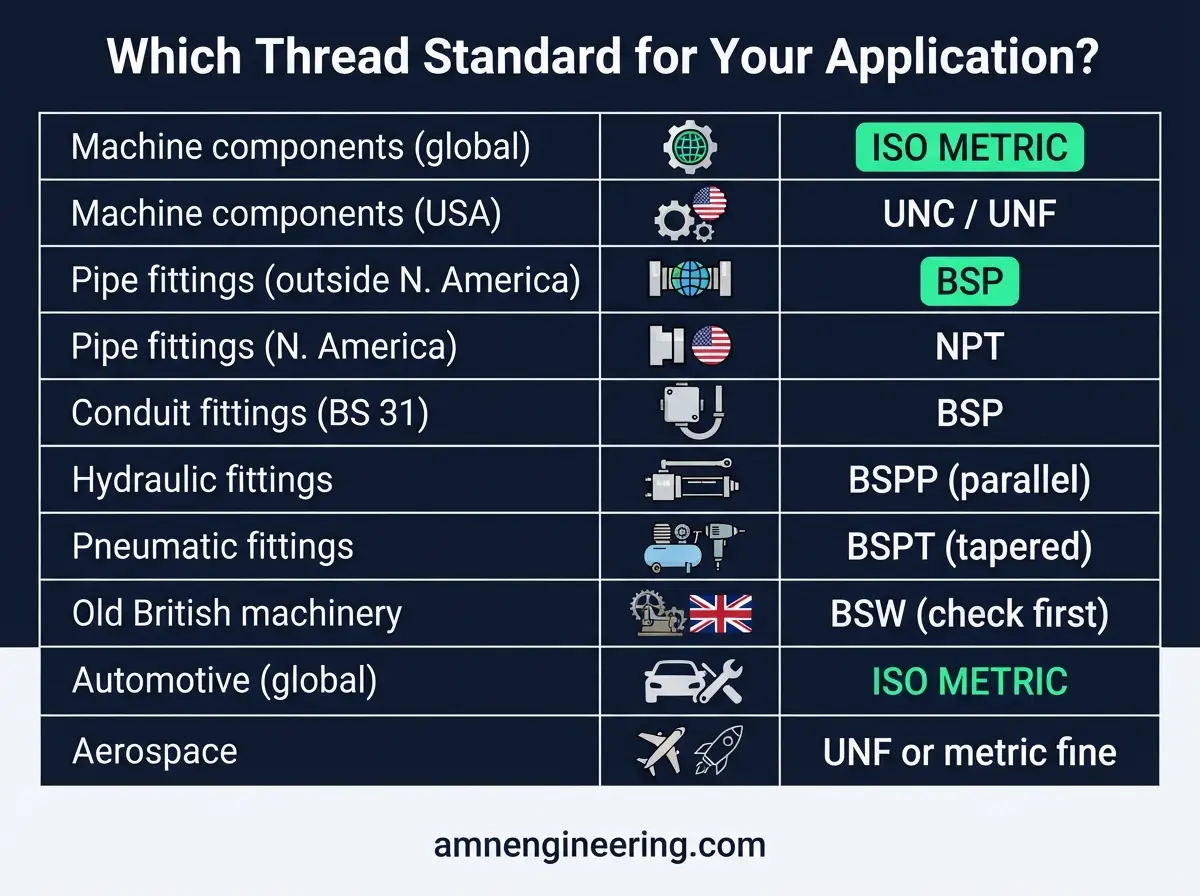
Which Standard to Specify by Application
| Application | Recommended Standard |
|---|---|
| Machine components (global market) | ISO Metric |
| Machine components (USA market only) | UNC / UNF |
| Pipe and fluid connections (outside N. America) | BSP (BSPP or BSPT) |
| Pipe and fluid connections (N. America) | NPT |
| Steel conduit fittings (BS 31) | BSP |
| Hydraulic fittings | BSPP (parallel with O ring seal) |
| Pneumatic fittings | BSPT (tapered with tape seal) |
| Old British or Commonwealth machinery | BSW (check first) |
| Automotive (N. America) | UNC / UNF |
| Automotive (global) | ISO Metric |
| Aerospace | UNF or metric fine |
Specify the standard clearly on your drawing and we will cut it to spec. See our threading services for BSP, metric, UNC, UNF, and BSW.
Frequently Asked Questions
Five major ones: ISO metric, BSP, BSW, UNC, and UNF. Plus NPT for North American pipe threads. Each has specific applications and none are interchangeable across families.
ISO metric for machine components and fasteners (global compatibility). BSP for pipe and fluid connections outside North America. UNC/UNF only if your market is exclusively North American.
No. Different pitches make them incompatible even when diameters appear similar. Forcing mismatched threads destroys both parts.
Only on legacy equipment. BSW has been obsolete for new designs since the mid 20th century, but many old machines, agricultural implements, and vintage vehicles still have BSW threads. Replacement fasteners are available from specialty suppliers.
BSP uses a 55 degree thread angle and is used outside North America. NPT uses a 60 degree thread angle and is the North American pipe thread standard. They are not interchangeable.