BSP vs Metric vs UNC Threading: A Quick Identification and Selection Guide
By Adil, Managing Director at AMN Engineering · · 10 min read
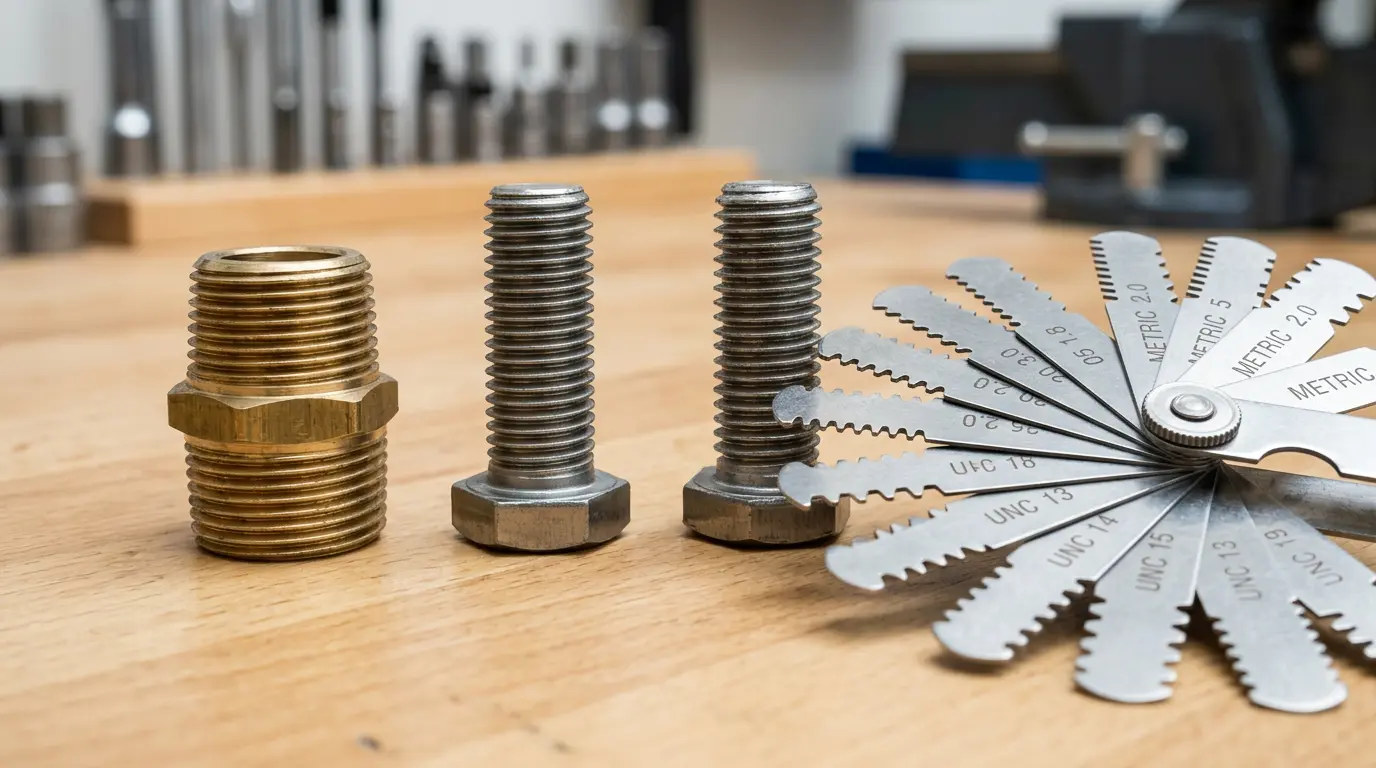
BSP, metric, UNC. Three different thread standards that look similar but are not interchangeable. Using the wrong thread standard means bolts that do not fit, fittings that leak, and assemblies that fail. We cut threads in all three standards daily at AMN Engineering using CNC lathes and dedicated threading equipment.
This guide explains how to identify, measure, and choose between BSP, metric, and UNC threads. No guesswork. Just a practical comparison based on 25 years of threading experience at our factory in Lahore.
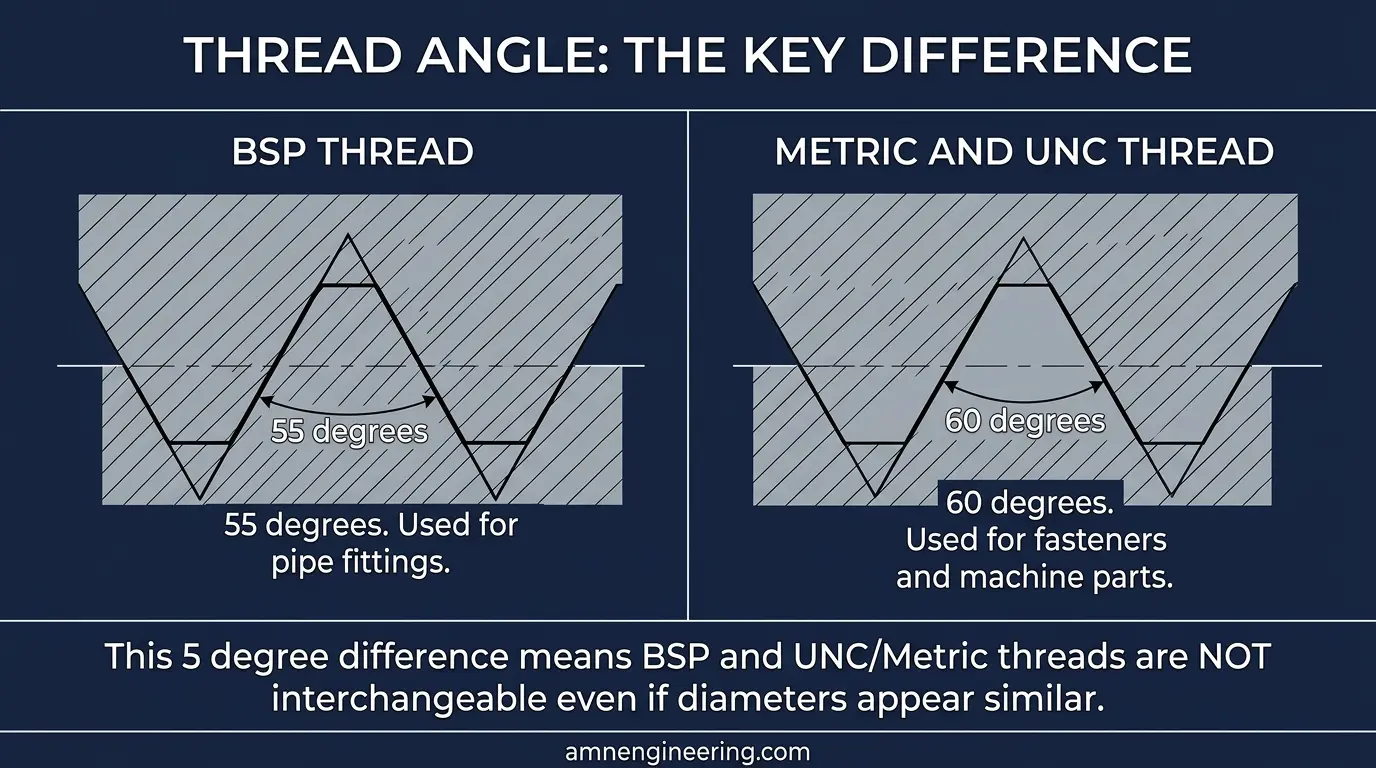
BSP (British Standard Pipe) is the British and Commonwealth pipe thread, with a 55 degree thread form measured in inches. Metric (ISO) threads use a 60 degree form and millimeter sizing for general fasteners. UNC (Unified National Coarse) is the inch-based US and North American thread standard, defined by ASME B1.1, with a 60 degree form and UNF as its fine-pitch version.
AMN Engineering provides pipe threading and machining in BSP, metric, and UNC/UNF, and serves buyers in Pakistan, the Gulf, the US, and worldwide.
Why Thread Standards Matter
Threads are not universal. A 1/2 inch BSP fitting will not screw into a 1/2 inch UNC hole. An M12 metric bolt will not fit into a 12mm BSP port. Thread angles are different. Pitches are different. Getting the thread standard right on your drawing is critical.
Specifying the wrong thread standard leads to parts that cannot be assembled, fittings that leak under pressure, and costly rework. Every thread standard defines a specific combination of diameter, pitch, and angle. Even when two threads appear to be the same size, they are not interchangeable.
BSP Threads Explained
BSP stands for British Standard Pipe. It is the dominant thread standard for pipe connections in the UK, Europe (piping), Middle East, Asia, Australia, and Africa.
Two Types of BSP
BSPP (British Standard Pipe Parallel). Parallel threads with a constant diameter. Seals with a washer or O ring. Common in hydraulic systems.
BSPT (British Standard Pipe Tapered). Tapered threads with a 1:16 taper. Seals through thread interference, typically with PTFE tape. Common in plumbing and pneumatics.
Key Facts
- Measured in inches (nominal pipe bore, NOT outside diameter)
- 55 degree thread angle
- Standards: BS 21 (tapered) and BS 2779 (parallel)
- Common sizes: 1/8 to 2 inch
Important: BSP sizes refer to the nominal pipe bore, not the actual outside diameter. A 1/2 inch BSP thread has an outside diameter of 20.95mm, not 12.7mm. This catches many engineers off guard.
Metric (ISO) Threads Explained
ISO metric threads are the global standard for fasteners. They are used for general fastening, machine components, and most modern engineering applications worldwide.
Designation
Metric threads are designated with M followed by diameter and pitch. For example, M12 x 1.75 means 12mm diameter with 1.75mm pitch. If no pitch is stated, it means coarse pitch.
Key Facts
- Measured in millimeters
- 60 degree thread angle
- Standards: ISO 261 and ISO 965
- Coarse and fine pitch available
- Common sizes: M3 to M30
Metric coarse pitch is the default. Fine pitch threads are used when you need a tighter fit, better resistance to vibration loosening, or when threading into thin walled parts.
UNC Threads Explained
UNC stands for Unified National Coarse. It is the standard thread system in North America. The fine version is UNF (Unified National Fine).
Designation
UNC threads are designated by diameter and threads per inch. For example, 1/2 13 UNC means 1/2 inch diameter with 13 threads per inch.
Key Facts
- Measured in inches
- 60 degree thread angle (same as metric, different from BSP)
- Standard: ASME B1.1
- Common sizes: #6 to 1 inch
UNC and metric threads share the same 60 degree thread angle, which makes them easy to confuse. However, the pitches are completely different. A 1/2 UNC bolt will not fit in an M12 hole even though the diameters are close.
The Full Comparison
| Feature | BSP | ISO Metric | UNC |
|---|---|---|---|
| Measurement System | Inches (nominal pipe bore) | Millimeters | Inches |
| Thread Angle | 55 degrees | 60 degrees | 60 degrees |
| Primary Use | Pipe connections, fittings | Fasteners, machine parts | Fasteners (N. America) |
| Parallel and Tapered | Both (BSPP and BSPT) | Parallel only (standard) | Parallel only (standard) |
| Sealing Method | Washer/O ring (BSPP) or tape (BSPT) | Not a sealing thread | Not a sealing thread |
| Geographic Use | UK, GCC, Asia, Australia, Africa | Worldwide | USA, Canada |
| Common in Pakistan | Yes (dominant for pipe fittings) | Yes (machine components) | Rare (US export work only) |
| Coarse/Fine Options | Defined by pipe size | Yes (coarse and fine) | Yes (UNC and UNF) |
How to Identify a Thread
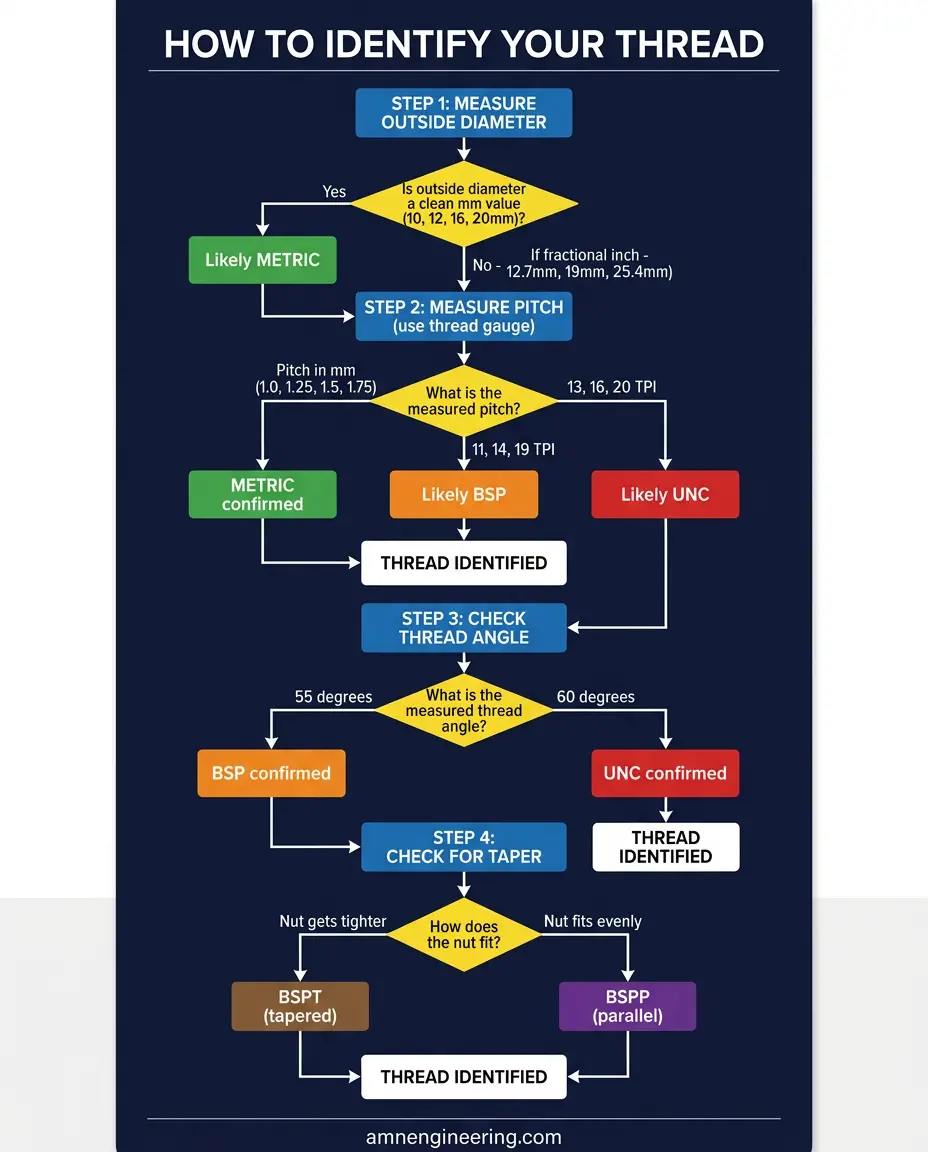
Follow these four steps to identify an unknown thread:
Step 1: Measure Outside Diameter
Use calipers to measure the outside diameter of the thread. A clean millimeter value (such as 12.00mm, 16.00mm, 20.00mm) strongly indicates a metric thread. A fractional inch value points to BSP or UNC.
Step 2: Measure Thread Pitch
Use a thread pitch gauge to determine the pitch. If the pitch reads in millimeters (such as 1.75mm, 2.00mm, 2.50mm), the thread is metric. If the pitch is expressed in threads per inch (TPI), check the following: TPI values of 11, 14, 18, or 19 indicate BSP. TPI values of 13, 16, or 20 indicate UNC or UNF.
Step 3: Check Thread Angle
A 55 degree thread angle confirms BSP. A 60 degree thread angle means metric or UNC. You can check the angle visually with a thread gauge or under magnification.
Step 4: Check for Taper
If the thread gets progressively tighter as you screw it in, you have a BSPT (tapered) thread. Parallel threads that maintain the same fit throughout the length are either BSPP, metric, or UNC.
Common Sizes Side by Side
| Designation | Outside Diameter | TPI | Pitch |
|---|---|---|---|
| 1/2 BSP | 20.95mm | 14 | 1.814mm |
| 1/2 UNC | 12.70mm | 13 | 1.954mm |
| 3/4 BSP | 26.44mm | 14 | 1.814mm |
| 3/4 UNC | 19.05mm | 10 | 2.540mm |
| 1 inch BSP | 33.25mm | 11 | 2.309mm |
| 1 inch UNC | 25.40mm | 8 | 3.175mm |
| M12 | 12.00mm | N/A | 1.750mm (coarse) |
| M16 | 16.00mm | N/A | 2.000mm (coarse) |
| M20 | 20.00mm | N/A | 2.500mm (coarse) |
Note: 1/2 inch BSP (20.95mm OD) vs 1/2 inch UNC (12.70mm OD) are completely different threads despite sharing the same nominal size. Always specify the standard, not just the size.
Which Standard to Specify
Specify BSP When
- You are connecting pipes, hoses, or fittings
- Your project is in the UK, GCC, Asia, Africa, or Australia
- You need a sealing thread
- You are manufacturing conduit fittings
Specify Metric When
- You are designing machine components, fasteners, or assemblies
- Your product targets international markets
- You want the widest availability of off the shelf hardware
- You are using modern CNC (metric is the default)
Specify UNC When
- Your product is for the North American market
- You are matching existing UNC components in an assembly
- Your customer requires ASME B1.1 compliance
When in doubt, specify metric for fasteners and BSP for pipe connections. This combination covers the vast majority of engineering applications outside North America.
Frequently Asked Questions
BSP (British Standard Pipe) threads are measured in inches and have a 55 degree thread angle. They are primarily used for pipe connections and fittings. Metric threads (ISO metric) are measured in millimeters and have a 60 degree thread angle. They are used for general fastening, machine components, and most modern engineering applications outside of piping.
Measure the outside diameter (BSP sizes do not match actual inch measurements, for example 1/2 BSP is 20.95mm outside diameter). Use a thread pitch gauge to check the TPI. BSP has a 55 degree thread angle versus 60 degrees for metric and UNC.
No. UNC and metric threads have different pitches even when diameters appear similar. Forcing a mismatched thread will damage both parts. Always verify the thread standard before assembly.
BSPP has parallel threads (constant diameter) and seals with a washer or O ring. BSPT has tapered threads (1:16 taper) and seals through thread interference with PTFE tape. BSPP is common in hydraulics. BSPT is common in plumbing and pneumatics.
ISO metric is the most common worldwide for general fastening. BSP dominates pipe and fitting connections outside North America. UNC is primarily used in the USA and Canada.
Yes. UNC (Unified National Coarse) is the inch-based thread standard used in the United States and North America, defined by ASME B1.1, with UNF as its fine-pitch version.