Progressive Die Stamping Explained: How High Volume Metal Parts Are Made
By Adil, Managing Director at AMN Engineering · · 6 min read
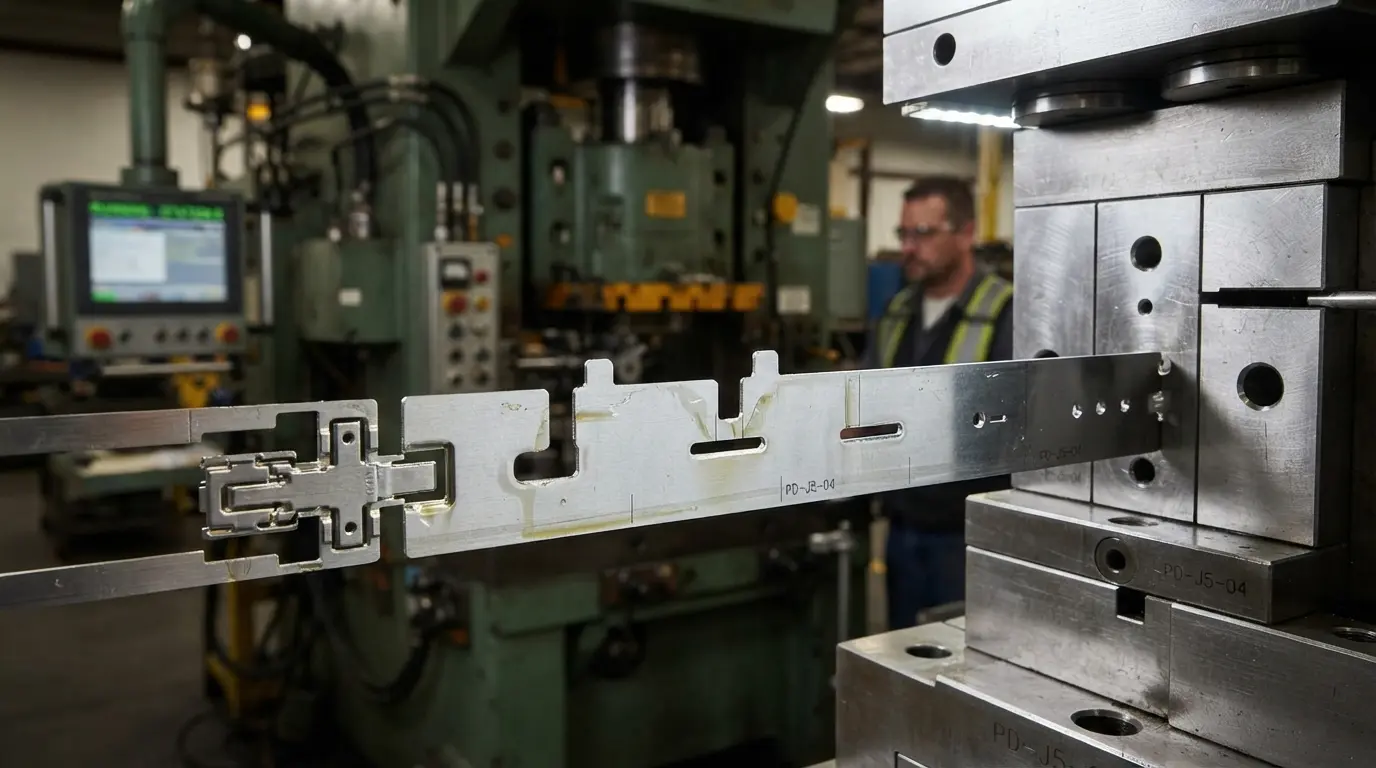
Progressive die stamping is the fastest and most cost effective way to produce complex sheet metal parts in high volumes. A single press stroke performs multiple operations (cutting, bending, forming, piercing) simultaneously, producing a finished part every 1 to 3 seconds.
This guide explains how progressive stamping works, when it makes sense vs single station stamping or laser cutting, and what the tooling costs look like.
What Is Progressive Die Stamping?
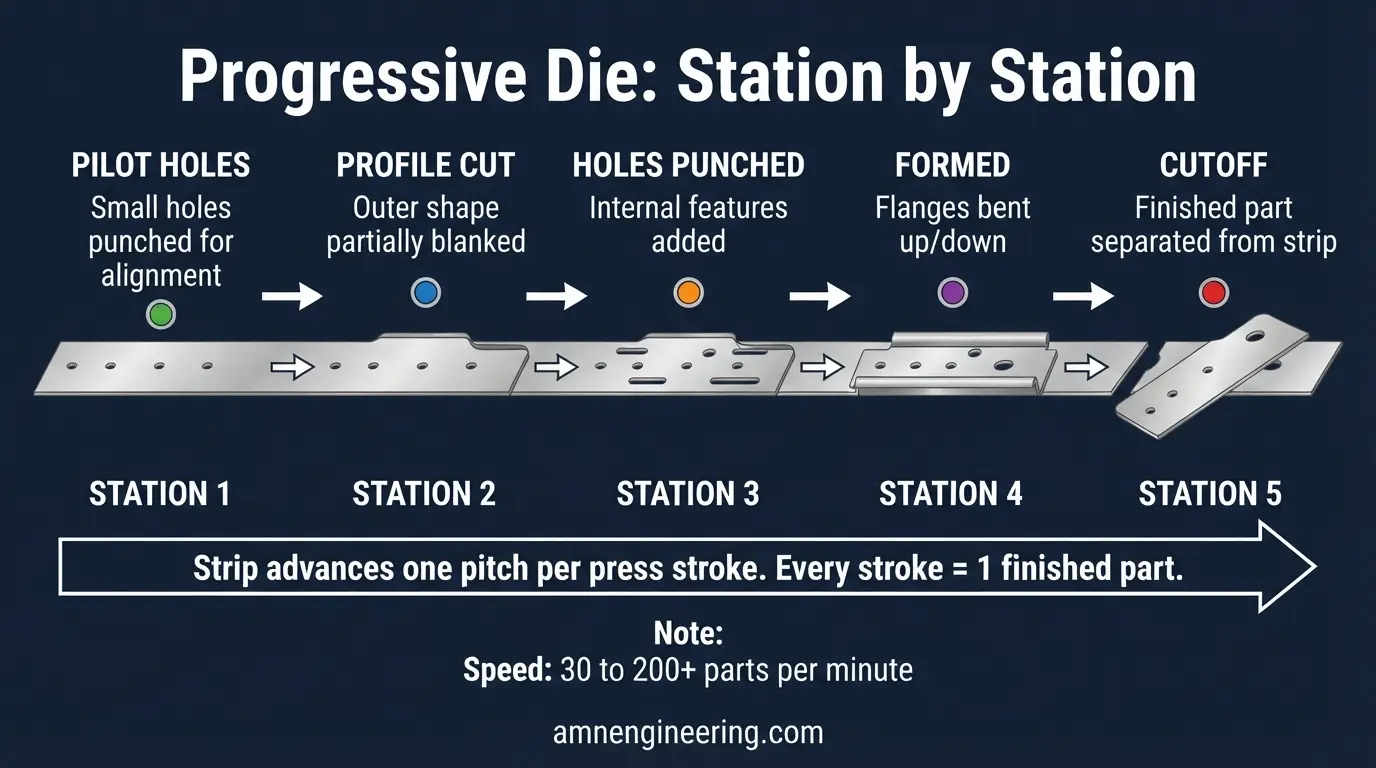
Progressive die stamping uses a single die with multiple stations (stages) that perform different operations as the metal strip advances through the press. Each press stroke advances the strip one station forward, performing a new operation at each station simultaneously.
By the time the strip exits the final station, the part is completely finished: cut to shape, holes punched, flanges bent, and features formed. All in a single continuous process.
How It Works: Step by Step
A coil of sheet metal is fed into the press. The strip advances automatically by a fixed distance (the "pitch") with each press stroke.
Station by Station Example (Simple Bracket)
Station 1: Pilot holes. Two small holes are punched at precise locations. These pilot holes register the strip at every subsequent station to ensure alignment.
Station 2: Profile blanking. The outer profile of the part is partially cut (most of the outline, leaving small tabs to keep the part attached to the strip).
Station 3: Holes and features. Internal holes, slots, or other cut features are punched.
Station 4: Forming. Flanges are bent upward or downward. Embossments or dimples are formed.
Station 5: Final cutoff. The remaining tabs are cut, separating the finished part from the strip. The part drops into a collection bin or onto a conveyor.
Speed
A typical progressive die runs at 30 to 200 strokes per minute. At 100 strokes per minute, you get 100 finished parts per minute or 6,000 parts per hour. This is why progressive stamping dominates high volume production.
Progressive Die vs Single Station Stamping
| Factor | Progressive Die | Single Station |
|---|---|---|
| Operations per stroke | Multiple (all stations simultaneously) | One |
| Handling between operations | None (automatic strip feed) | Manual (part moved between presses) |
| Speed | 30 to 200+ parts per minute | 5 to 30 parts per minute |
| Tooling Cost | Higher ($5K to $50K+) | Lower ($1K to $10K) |
| Part Complexity | High (cut, bend, form in one die) | Low (one operation per die) |
| Labor | Minimal (automatic) | Higher (manual handling) |
| Ideal Volume | 10,000+ parts | 500 to 10,000 parts |
| Quality Consistency | Very high (no re registration between steps) | Lower (alignment varies between operations) |
When Single Station Is Better
Single station stamping is cheaper for: lower volumes (500 to 5,000 parts), simple parts that need only one operation (a plain washer), and parts where the tooling cost of a progressive die is not justified.
When to Use Laser Cutting Instead
For quantities under 2,000, laser cutting eliminates tooling cost entirely. Complex profiles that would require an expensive progressive die can be laser cut from a DXF file with zero setup cost.
When Progressive Stamping Makes Sense
Volume above 10,000 parts. The tooling investment pays for itself through extremely low per part cost and high production speed.
Repeat orders. If you order the same part quarterly or annually, the die is a one time cost. Every reorder uses the existing die at pure production cost.
Multiple features. Parts that need cutting + bending + forming + piercing in a single part are ideal for progressive dies. The alternative (separate operations on separate machines) is slower and less consistent.
Tight tolerances across features. Because all operations happen in one die with precise registration, progressive stamping holds feature to feature tolerances (hole to edge, hole to bend) much better than multi station approaches.
Tooling Cost and Payback
Typical Progressive Die Costs
| Part Complexity | Die Cost Estimate |
|---|---|
| Simple (2 to 3 stations) | $5,000 to $10,000 |
| Medium (4 to 6 stations) | $10,000 to $25,000 |
| Complex (7+ stations) | $25,000 to $50,000+ |
Payback Example
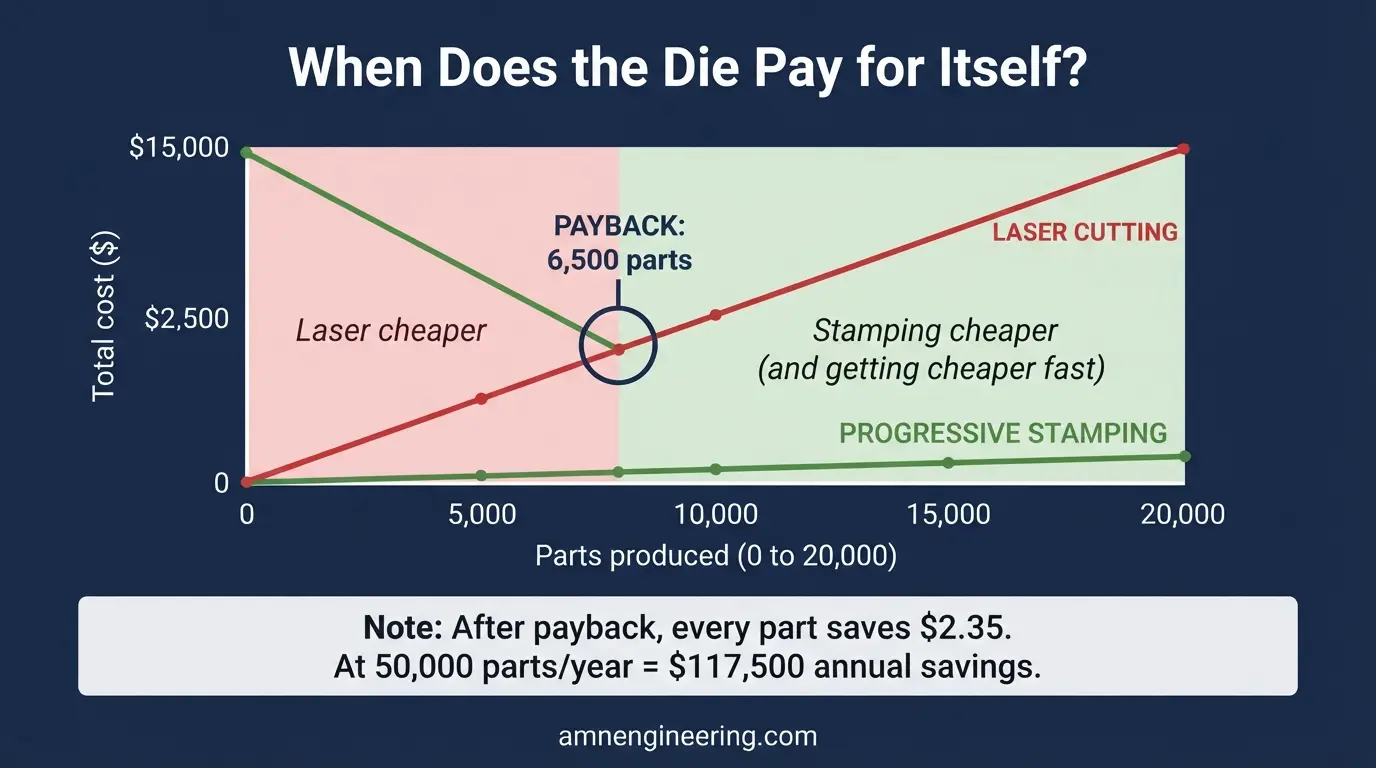
Die cost: $15,000. Part cost with progressive die: $0.15 per part. Part cost with laser cutting: $2.50 per part.
Savings per part: $2.35. Payback point: $15,000 / $2.35 = 6,383 parts.
After 6,383 parts, the die has paid for itself. Every part after that saves $2.35. At 50,000 parts per year, the die pays for itself in less than 2 months and saves $117,500 annually.
Design Guidelines
- Material thickness: 0.3mm to 6mm sheet metal (most progressive dies handle 0.5 to 3mm)
- Strip width: Design the part to nest efficiently on the strip. Material waste should be under 30%.
- Grain direction: Bends perpendicular to the rolling direction have less risk of cracking.
- Minimum hole diameter: Equal to material thickness (e.g., 2mm hole in 2mm sheet is the minimum).
- Minimum distance between features: 2x material thickness between holes, and between holes and edges.
- Draft on formed features: Sides of drawn features need 2 to 5 degrees draft for easy ejection.
Frequently Asked Questions
A manufacturing process where a sheet metal strip advances through multiple die stations, each performing a different operation (cutting, punching, bending, forming). A finished part is produced with every press stroke.
30 to 200+ parts per minute depending on part size and complexity. A typical run produces 3,000 to 12,000 parts per hour.
$5,000 to $50,000+ depending on complexity and number of stations. The die is a one time investment that pays for itself through low per part cost at high volumes.
When you need more than 10,000 parts, the design is finalized, and parts need forming (bends) in addition to cutting. Below 2,000 parts, laser cutting is cheaper.