How to Calculate Total Landed Cost When Sourcing Parts from Pakistan
By Adil, Managing Director at AMN Engineering · · 9 min read

When procurement teams compare quotes from different countries, they often look only at the unit price. But the unit price is just one piece of the puzzle. The total landed cost of manufacturing parts from Pakistan includes freight, customs duties, packaging, insurance, and several other charges that can change the final number by 15 to 30 percent.
Understanding total landed cost is essential for making smart sourcing decisions. A quote that looks cheap on paper may end up costing more once you add shipping, duties, and handling. And a supplier like AMN Engineering in Pakistan, with a slightly different unit price, may actually deliver a lower total cost when everything is included.
This guide breaks down every component of landed cost, shows you how to calculate it, and compares Pakistan against China with real numbers.
What Is Total Landed Cost and Why It Matters
Total landed cost (TLC) is the complete cost of getting a manufactured part from the factory floor to your warehouse door. It includes every expense along the way: the part itself, the tooling, the packaging, the truck to the port, the ocean or air freight, the customs duty, the insurance, the local delivery, and any inspection or handling fees.
Why does this matter? Because two suppliers quoting different unit prices may end up at the same landed cost, or the cheaper quote may actually cost more once logistics are added.
Under Incoterms 2020, published by the International Chamber of Commerce (ICC), the responsibility for each cost component shifts between buyer and seller depending on the agreed trade term. Understanding these terms is essential for accurate cost comparison, and we cover them in detail further down.
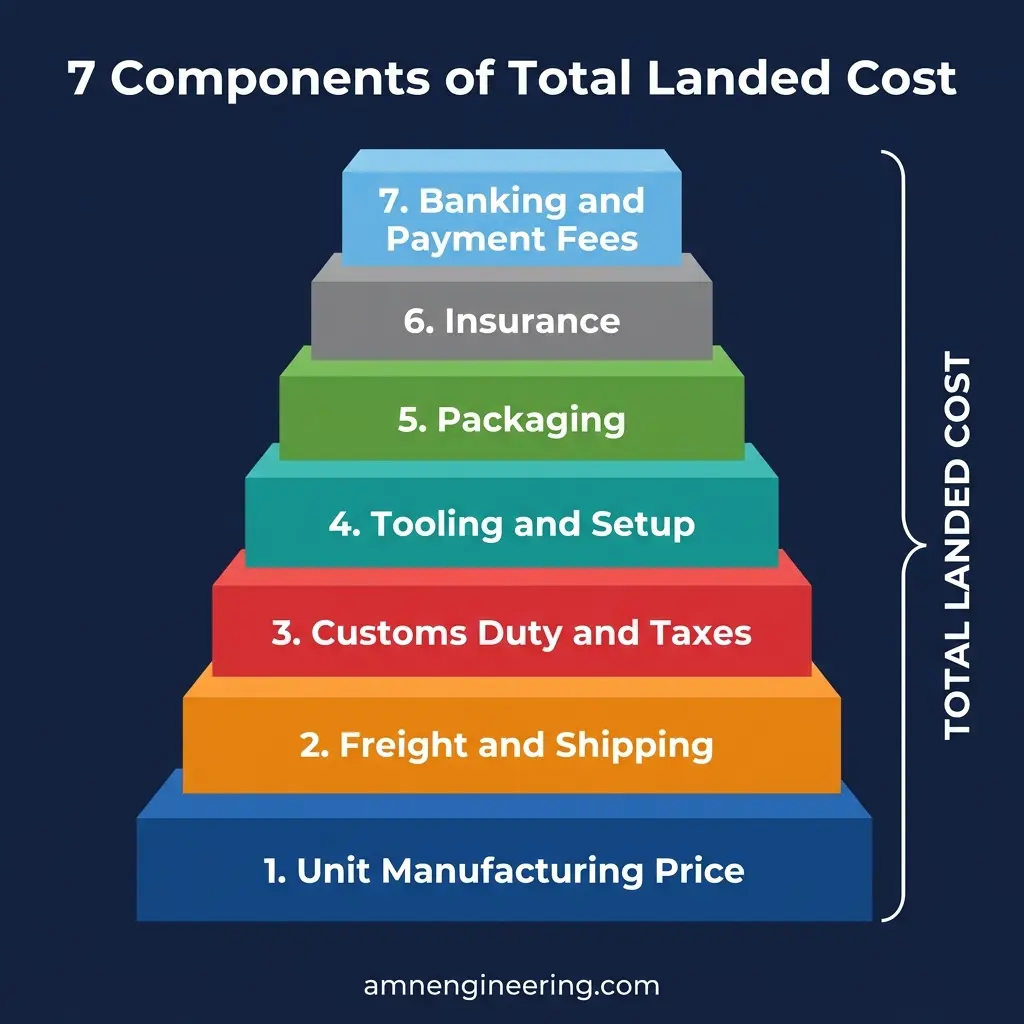
The Seven Components of Total Landed Cost
Here is every cost element that makes up your total landed cost when sourcing from Pakistan:
1. Unit Manufacturing Price
This is the per piece cost quoted by the manufacturer. It includes material, machining time, labor, and factory overhead. When you get a quote from our CNC machining services, this is the number you see first.
2. Tooling and Setup Costs
If your part requires custom tooling, jigs, fixtures, or dies, these are usually one time costs charged separately. For forged components, die costs can range from 500 to 5,000 dollars depending on complexity. For CNC machined parts, setup costs are typically minimal.
3. Packaging and Crating
Heavy metal parts need proper packaging to survive international shipping. This includes individual wrapping, foam or wooden separators, wooden crates or pallets, and moisture protection for sea freight. Packaging typically adds 2 to 5 percent of the order value.
4. Inland Transportation
This is the cost of moving the goods from the factory to the port of export. In Pakistan, this means transport from Lahore to Karachi port (approximately 1,200 km by road). Typical costs range from 200 to 500 dollars per shipment depending on weight and volume.
5. Ocean or Air Freight
The cost of shipping from Pakistan to your destination. This varies significantly based on weight, volume, destination, and shipping method.
| Route | Sea Freight (per CBM) | Air Freight (per kg) | Transit Time (Sea) |
|---|---|---|---|
| Pakistan to Dubai/UAE | $300 to $600 | $3 to $5 | 5 to 7 days |
| Pakistan to Saudi Arabia | $400 to $700 | $3 to $5 | 7 to 10 days |
| Pakistan to UK | $800 to $1,200 | $4 to $6 | 18 to 22 days |
| Pakistan to Germany | $900 to $1,300 | $4 to $6 | 20 to 25 days |
| Pakistan to USA (East Coast) | $1,000 to $1,500 | $5 to $7 | 25 to 30 days |
CBM = cubic meter. Rates are approximate and vary by season and carrier.
6. Customs Duty and Import Taxes
Every country applies customs duties based on the HS (Harmonized System) code of the product. For machined metal parts, typical duty rates are:
| Destination | Typical Duty Rate |
|---|---|
| UAE/GCC Free Zones | 0% to 5% |
| Saudi Arabia | 5% to 12% |
| European Union | 2% to 8% |
| United Kingdom | 2% to 6.5% |
| United States | 2.5% to 6.5% |
You can look up exact rates on your country’s customs tariff database or consult your freight forwarder.
7. Insurance
Marine cargo insurance typically costs 0.3 to 0.5 percent of the shipment value. It is optional but strongly recommended for international shipments. Most buyers include it as standard practice.
Step by Step: How to Calculate Your Total Landed Cost
Use this formula to calculate the total landed cost for any order:
Total Landed Cost = Unit Price × Quantity + Tooling + Packaging + Inland Transport + Freight + Customs Duty + Insurance + Handling Fees
Per piece landed cost = Total Landed Cost ÷ Quantity
Example Calculation
Let us calculate the landed cost for 500 CNC machined steel bushings delivered to Dubai:
| Cost Component | Amount (USD) |
|---|---|
| Unit price ($4.50 × 500 pieces) | $2,250 |
| Tooling (none required for CNC) | $0 |
| Packaging (wooden crate, foam separators) | $120 |
| Inland transport (Lahore to Karachi) | $250 |
| Sea freight (Pakistan to Dubai, 0.3 CBM) | $180 |
| Customs duty (5% of goods value in UAE) | $113 |
| Marine insurance (0.4% of shipment value) | $12 |
| Port handling and clearance (Dubai) | $200 |
| Bank transfer fee | $35 |
| Total Landed Cost | $3,160 |
| Per Piece Landed Cost | $6.32 |
The unit price was $4.50 per piece, but the landed cost is $6.32 per piece. That is a 40 percent increase over the quoted unit price. This is exactly why comparing unit prices alone is misleading.
Pakistan vs China: A Real Landed Cost Comparison
Let us compare the same order (500 CNC machined steel bushings to Dubai) from Pakistan and China:
| Cost Component | Pakistan (AMN) | China (Typical) |
|---|---|---|
| Unit price (× 500) | $2,250 | $2,750 |
| MOQ issue | None (500 OK) | May require 1,000+ |
| Tooling | $0 | $0 |
| Packaging | $120 | $150 |
| Inland transport | $250 | $200 |
| Sea freight to Dubai | $180 | $450 |
| Transit time | 5 to 7 days | 15 to 20 days |
| Customs duty (5%) | $113 | $138 |
| Insurance | $12 | $15 |
| Port handling | $200 | $200 |
| Bank fees | $35 | $45 |
| Third party inspection | $0 (client visited factory) | $500 |
| Total Landed Cost | $3,160 | $4,448 |
| Per Piece Landed Cost | $6.32 | $8.90 |
| Savings with Pakistan | Baseline | 29% cheaper |
Pakistan wins on unit price, freight cost, transit time, and the ability to order exactly the quantity needed. For GCC buyers especially, the geographic advantage makes Pakistan the clear choice. For a wider head to head, see our breakdown of manufacturing in Pakistan vs China vs India.
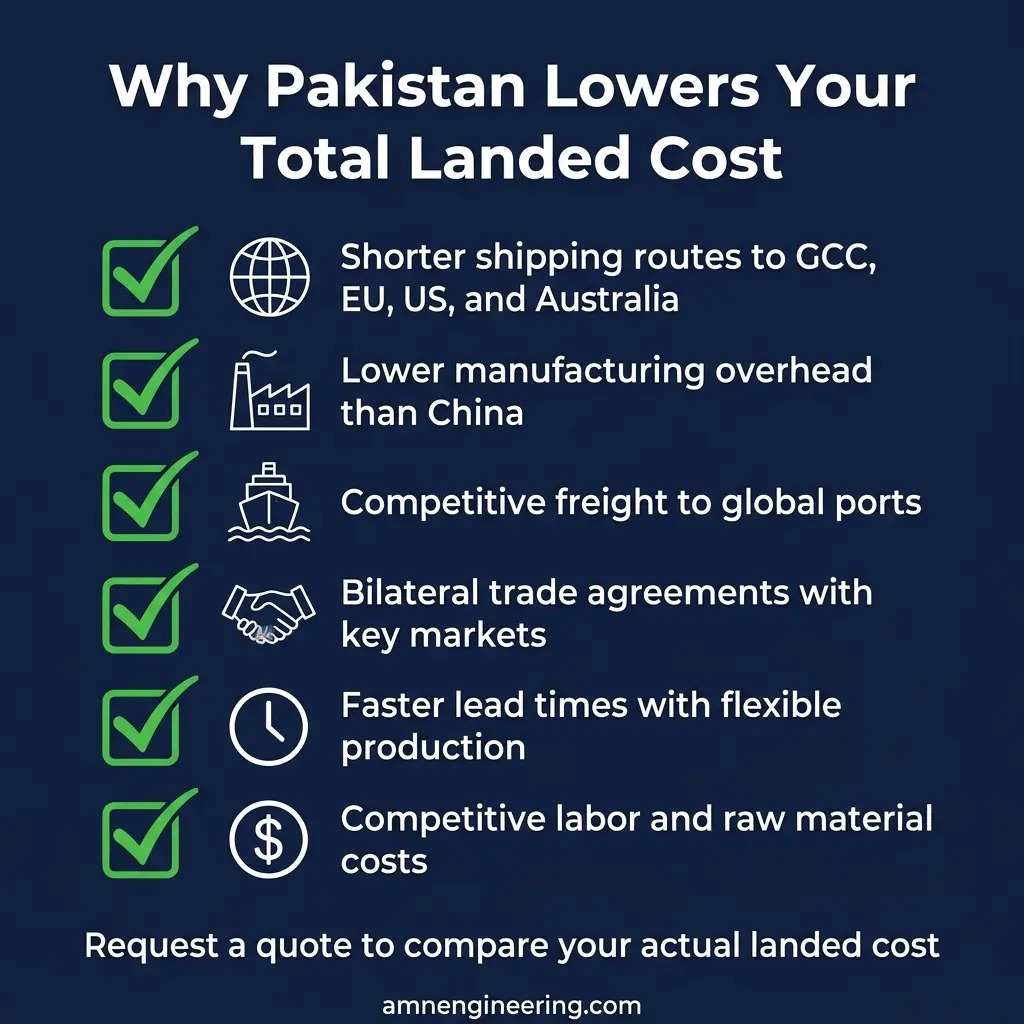
Why Pakistan Wins on Landed Cost for GCC Buyers
For buyers in the UAE, Saudi Arabia, Qatar, Bahrain, Kuwait, and Oman, Pakistan offers several landed cost advantages that no other manufacturing country can match:
Geographic proximity. Karachi port to Jebel Ali (Dubai) is 5 to 7 days by sea. Shanghai to Jebel Ali is 15 to 20 days. This cuts transit time by 60 percent or more.
Lower freight rates. Shorter distances mean lower shipping costs. Sea freight from Pakistan to the GCC is typically 50 to 60 percent less than from China.
No MOQ barrier. Chinese suppliers often require 1,000 or more pieces. AMN Engineering has no minimum order. You can order exactly what you need, which reduces inventory holding costs.
Direct communication. English speaking engineers, direct WhatsApp communication, and the same time zone (Pakistan is only 1 hour ahead of GCC countries) eliminate the communication delays and trading company markups common with Chinese suppliers.
Easy factory visits. A flight from Dubai to Lahore takes 3 hours. A flight from Dubai to Shenzhen takes 8 to 10 hours with a connection. Factory visits are faster, cheaper, and more practical. For the full case, read why Pakistan is the best manufacturing partner for GCC buyers.
Incoterms Explained: FOB, CIF, and DDP
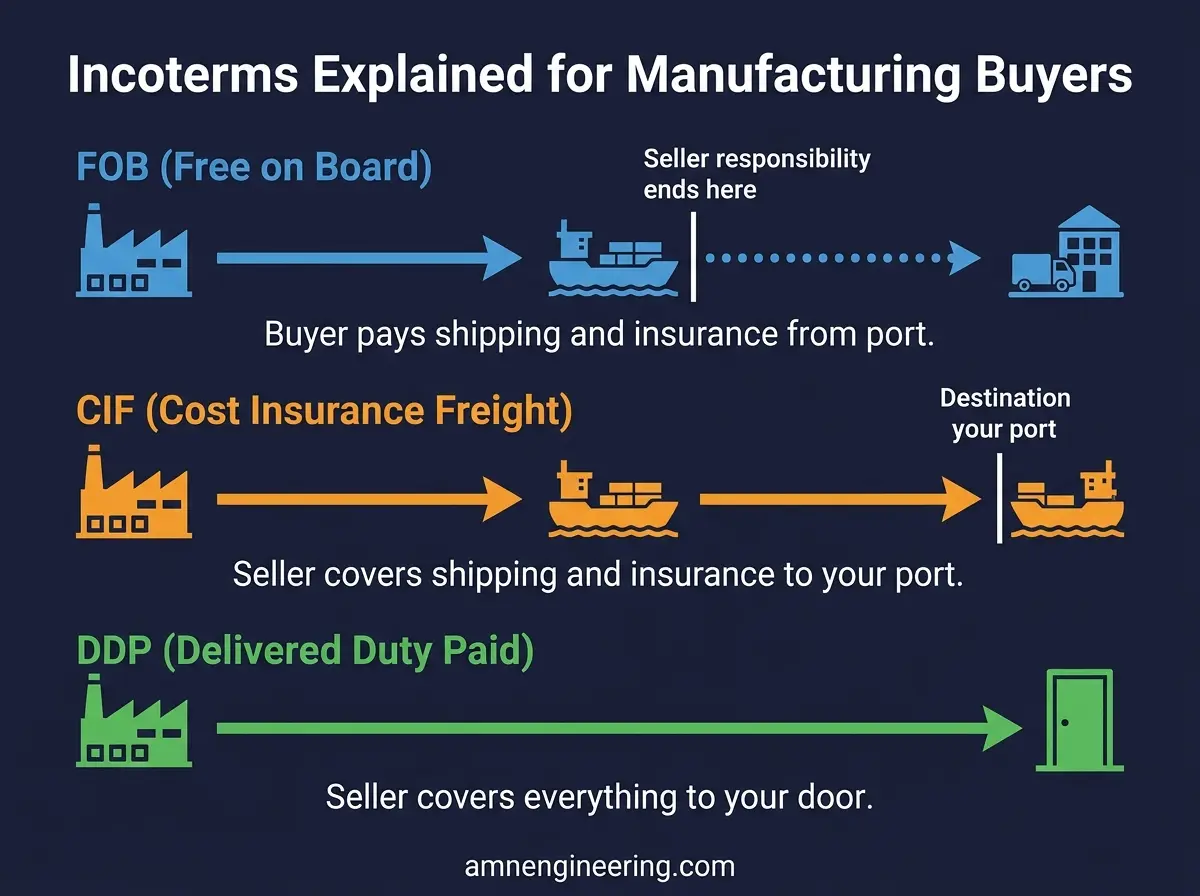
When your supplier quotes a price, the Incoterm tells you exactly what is included:
| Incoterm | What the Supplier Covers | What You Cover |
|---|---|---|
| Ex Works (EXW) | Part manufacturing only | Everything from factory door onward |
| FOB (Free on Board) | Manufacturing + inland transport + export clearance | Freight, insurance, import duties, local delivery |
| CIF (Cost, Insurance, Freight) | Manufacturing + transport + freight + insurance | Import duties, port handling, local delivery |
| DDP (Delivered Duty Paid) | Everything. Part arrives at your door, all costs included | Nothing. This is your true landed cost |
Tip: When comparing quotes from different suppliers, always convert them to the same Incoterm. A $5.00 FOB quote from Pakistan and a $4.80 EXW quote from China are not directly comparable until you add the missing cost components to both.
How AMN Engineering Helps You Control Landed Cost
At AMN Engineering, we work with international buyers to keep their total landed cost as low as possible:
Transparent pricing. Our quotes clearly break down unit price, tooling, packaging, and inland transport. No hidden charges appear after the order is placed.
Flexible shipping. We offer Ex Works, FOB Karachi, and CIF pricing. We can also arrange door to door delivery through trusted freight partners.
No minimum order. Order 10 pieces or 10,000 pieces. We do not force you to buy more than you need, which keeps your inventory cost low.
Multi process manufacturing. Because we offer CNC machining, metal fabrication, forging, and surface treatment under one roof as a single contract manufacturing partner, there are no inter vendor shipping costs or coordination delays.
Quality at source. We provide material test certificates, dimensional inspection reports, and photos with every shipment. This reduces the need for expensive third party inspections. Learn how to package a request for the tightest quote in our guide to contract manufacturing in Pakistan.
Frequently Asked Questions
Total landed cost is the complete cost of a manufactured part delivered to your door. It includes the unit price, tooling, packaging, freight, customs duties, insurance, inspection fees, and any other charges between the factory and your warehouse.
For small to medium batches (under 5,000 pieces), Pakistan is typically 20 to 40 percent cheaper than China on total landed cost. Pakistan has lower labor rates, no minimum order requirements, shorter shipping times to the GCC and Middle East, and lower freight costs for nearby regions.
Customs duty varies by country and product type. For CNC machined steel parts, typical duty rates range from 0 percent in GCC free zones to 5 to 8 percent in EU countries and 2.5 to 6.5 percent in the USA. You can check exact rates using the HS code for your specific part on your country’s customs website.
The most commonly missed costs include packaging and crating for heavy parts, inland transport from factory to port, bank charges for wire transfers or letters of credit, quality inspection fees if using a third party inspector, storage charges if a shipment clears customs slowly, and currency exchange fees.
Freight cost depends on weight, volume, destination, and shipping method. Sea freight from Karachi port to Dubai typically costs 300 to 600 dollars per cubic meter. Air freight costs 3 to 6 dollars per kilogram. Your manufacturer or freight forwarder can provide an exact quote based on the shipment details.
